Built backwards: what Normandy taught me about partner enablement
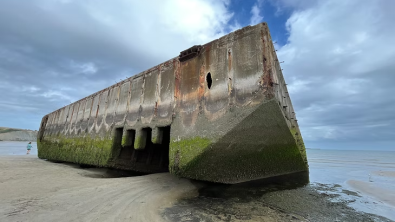
I stood on the beach at Arromanches last week and stared at the remains of something that should not have been possible.
Rusting steel. Broken concrete. Sections of a structure that once stretched across the English Channel and helped turn the tide of the Second World War. The Mulberry Harbour. Most of it is gone now, swallowed by the sea or dismantled after the war. But enough remains to stop you in your tracks.
I went to Normandy to understand how large-scale coordinated effort actually works. What I found was more useful than I expected.
Nobody sat in a room in 1942 and said, “We need 146 Phoenix caissons, 10 kilometers of Whale floating roadway, and a series of Spud pierheads.” They sat in a room and said, “We need a functioning harbor off the coast of Normandy, or we cannot sustain the invasion.” The outcome came first. The engineering followed. Over 300 firms built the components in secret across the UK, most workers unaware of what they were actually building. The largest caissons weighed 6,000 tons each. The whole structure was operational within 12 days of D-Day. It moved nearly 3 million men, 4 million tons of supplies, and 500,000 vehicles onto the continent.
That is what happens when you start with the problem and work backwards. Not when you start with the components and work forwards.
What outcome-first thinking means for partner enablement
This is the thing I talk about most with our partners. The customers they serve are not buying software. They are trying to achieve something. They are trying to get a product to market faster, reduce engineering rework, connect their supply chain, or close the gap between design and manufacturing. The technology is how they get there, not the destination. The partners who understand this ask different questions. Not “what does this solution do?” but “what does your customer need to achieve, and by when, and what is stopping them right now?” That shift in thinking is the difference between a transaction and a partnership.
The terrain around Normandy is not flat. The bocage, the dense hedgerows and sunken lanes, broke up formations, separated units, and turned every field into a potential ambush. Walking the roads around the area on a warm day, I stopped at the top of one and thought about what it took to move across that ground in June 1944. Heavy equipment. Coordinated units. People who had never met each other before, from different countries, speaking different languages, trained on different doctrines, all moving toward the same objective.
No single person did that alone. No single unit did that alone. The Canadians on Juno Beach, the British on Gold and Sword, the Americans on Utah and Omaha, the Polish armored divisions arriving through Arromanches, the naval gunners offshore, the airmen overhead. Every one of them was a specialist. Every one of them had a role. The outcome required all of them, working together, each doing the thing they were trained to do.
That is a partner network.
Specialization is what makes the partner network work
The 1st Polish Armoured Division did not land on D-Day. They arrived through Arromanches in August 1944 and went straight into the Battle of the Falaise Pocket. Their job was to close the gap, to act as the force that prevented the German 7th Army from escaping encirclement. They lost 66 tanks in two weeks doing it. They held. They were not trying to do everything. They were doing the specific thing they were trained and equipped to do, at the moment it was needed, as part of a larger coordinated effort.
My grandfather served as a signaler in the Polish 1st Independent Parachute Brigade. He fought at Arnhem. Before any of that, he survived a Soviet gulag in Karabash, Siberia. He walked out of that camp in 1941, made his way west through Iran, and eventually jumped over Arnhem. A name on a plaque at Juno Beach, Stanley Markut, connects to another branch of my family. He was a gunner in a Sherman tank with the 1st Polish Armored Division. His tank was hit. He survived, but spent the rest of the war in hospital.
Neither of them trained to do everything. They trained to do one thing with precision, as part of a crew and a brigade that each did their own thing with equal precision.
Strong partners work the same way. The ones who try to be everything to everyone end up being nothing in particular to anyone. The ones who specialize, who build deep knowledge in specific areas, who hold certifications that prove they know the solutions inside out, those are the partners who deliver real outcomes for customers. They know what they are doing. Their customers know they know. That trust is not built through a sales pitch. It is built through demonstrated competence.
Prepared partners win
In three years running global partner enablement programs, the pattern I see most clearly is this: prepared partners win. Not because they have more resources, but because they show up knowing what the customer needs before the customer has finished explaining it.
Good partner enablement makes that possible. Not long programs that cover everything and leave partners remembering nothing. Short, targeted, relevant training that addresses a specific gap, tied to a real customer situation, delivered at the moment it is needed.
The standard worth working for
What I left Normandy thinking about was the sheer scale of coordinated effort it took. The engineers who built the caissons without knowing what they were for. The signalers keeping communications alive under fire. The tank crews closing the pocket at Falaise. The planners who worked backwards from the outcome and built everything around it. Thousands of specialists, each doing their specific thing, at the right moment, as part of something far larger than any one of them.
That is the standard worth working toward.
About the author
Kryz Orlinski leads global partner enablement programs through Siemens Digital Industries Software Partner Academy, where his work sits at the intersection of certification strategy, partner evaluations and the operating model that connects the two. He works with sales, product, services and partner teams to translate capability goals into role-based learning paths, clear standards and practical validation.