How to turn assets into a useful AI sales enablement bot
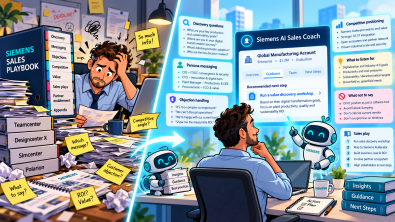
An AI sales enablement bot solves a problem every seller knows. You’re prepping for a call, you need a specific datasheet or battle card, and twenty minutes later you’re still buried in a SharePoint folder. You go in under-prepared. Not because the content doesn’t exist, but because you couldn’t find it in time.
That’s not a time management problem. It’s a systems problem.
I’ve watched this play out across enterprise sales teams for years. The assets are there. The campaigns are built. The content is created. And then it sits there, invisible, at the exact moment it would have made a difference.
Most organizations treat this as a content organization problem. More folders, better naming conventions, a new portal. It doesn’t work because it’s not a content problem. It’s a behavior problem. Sellers won’t hunt. If it takes more than a few seconds, they default to what they already know and move on.
That’s the gap I’ve been thinking about, and what got me interested in using AI bots to close it.
What an AI sales enablement bot actually is
The idea is simpler than it sounds. You build a conversational AI bot and embed direct links to your sales assets inside it. The bot becomes your always-on enablement layer, available whenever a seller needs it.
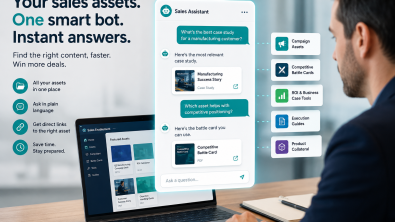
A rep asks a question in plain language: what’s the best case study for a manufacturing customer, which asset handles competitive positioning, what’s the deck for this campaign. The bot responds with the answer and a direct link to the asset. Not a search result. The asset itself.
You configure it around the context you define. You decide the scope. You embed the links. You write the logic that connects questions to content. The whole thing is purpose-built around how your sellers actually work.
The kinds of inputs that go in:
- Campaign assets and launch materials
- Competitive battle cards
- ROI and business case tools
- Execution guides and playbooks
- Technical product collateral
Why this matters for sellers
Sales reps are carrying a lot. Multiple accounts, multiple campaigns, multiple stakeholders all moving at the same time. When assets are hard to find, they don’t get used. When they don’t get used, the message doesn’t land and the deal loses momentum before it even gets going.
An AI sales enablement bot like this closes that distance. It gets the seller to the right content faster, improves preparation quality before calls and makes execution more consistent without requiring anyone to remember where everything lives.
It also reduces dependency on managers and enablement teams. Instead of a rep chasing someone the night before a big meeting, they ask the bot and get the answer in seconds.
Practical ways sales teams can use it
Pre-call preparation. A seller going into discovery with a manufacturing prospect asks the bot for the most relevant materials. It returns the right deck, the right case study and the right pricing tool, immediately.
Campaign execution. Build a bot containing every asset tied to a specific campaign. Sellers ask questions, the bot handles navigation and no human needs to be in the loop.
Competitive handling. A rep facing live objections asks for competitive positioning support. The bot surfaces the battle card and objection-handling guide on the spot.
Onboarding new sellers. Someone new to the team uses the AI sales enablement bot to get up to speed. Instead of reading through a 40-page guide, they ask questions and follow the links.
A simple way to get started
Start with one campaign. Collect every asset associated with it and be clear about what each one is for and when a seller would reach for it.
Build an AI sales enablement bot using a tool that supports custom configuration and embedded links. Write clear descriptions for each asset category. Then test it the way a seller would, ask the questions they’d actually ask, and refine before you release.
Put it in front of five reps first. Get feedback. Fix what doesn’t work. Then scale.
A bot that does one campaign well is more valuable than one that tries to cover everything and surfaces nothing useful. Start narrow. Prove the value. Build from there.
Where this is heading
The sellers who consistently outperform aren’t always the ones with the deepest product knowledge. They’re the ones who prepare faster, access resources better and execute with fewer gaps. What I’m describing doesn’t replace that skill. It gives it better infrastructure.
As AI embeds further into the day-to-day of sales execution, the ability to build lightweight, purpose-specific tools like this will separate teams that move early from those that spend the next two years catching up.
The technology is accessible. The barrier is just taking the first step.
I’ve put together a podcast that goes deeper on this, including how to set up an AI sales enablement bot, what to put in it and how to roll it out across a sales team. Listen here: https://www.linkedin.com/smart-links/AQEpvBtNZFx0Ow
About the author
Benedict Russell is a Global Partner Development Executive responsible for scaling global GTM programs across all motions. He helps shape Siemens’ digital selling and AI strategy, embedding best practices that accelerate SaaS adoption and recurring revenue. Previously, he drove partner coverage and expansion, adding 300+ partners to the Siemens ecosystem. Read Benedict’s most recent blog here.