AI bot vs AI agent: What’s the difference and which should sales teams use?
The term “AI agent” is everywhere.
A tool answers questions about your products and someone calls it an agent. Another tool researches accounts, analyses information and completes tasks across multiple systems, but gets called a bot.
It might sound like a minor terminology problem. It is not.
The label creates expectations about what the tool can do, how much access it needs and how closely its actions must be governed. If organisations cannot distinguish between bots and agents, they will either expect too much from simple tools or underestimate the controls required for more autonomous ones.
The confusion is understandable because bots and agents can look similar. Both may use the same AI models. Both may have a conversational interface. Both may even appear in the same chat window.
The difference is what happens after you give them an instruction.
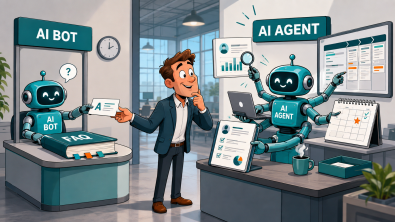
A bot primarily helps you interact with information. An agent can take that information and progress work towards an outcome.
That is the simple version. The more precise version matters too.
What an AI bot and AI agent actually are
IBM defines a chatbot as software that communicates with people through text or voice to answer questions, provide information and help with tasks.
In practice, an AI sales bot will usually:
- Wait for the seller to ask a question
- Interpret the request
- Search or use the knowledge available to it
- Generate an answer
- Stop and wait for the next instruction
An AI agent operates differently. OpenAI describes agents as systems that independently accomplish tasks on a user’s behalf. They combine a model for reasoning, tools for accessing information or taking action and instructions that define their behaviour.
Rather than only responding, an agent can:
- Work towards a defined goal
- Decide which steps are required
- Use tools and business systems
- Adapt when it encounters new information
- Continue until the task is complete or human input is needed
Anthropic offers another useful distinction: a predefined AI workflow follows a path designed in advance, while an agent can dynamically decide how to use its tools and complete the task.
A useful rule of thumb is therefore:
A bot helps you get an answer. An agent helps you progress an outcome.
This is not an absolute dividing line. A bot can be the conversational front end for an agent and an agent does not necessarily need a chat interface. The question is not what the tool looks like. It is how it operates.
Why this matters for sellers
Imagine a partner seller preparing for a meeting with an industrial manufacturer.
A sales bot could answer questions such as:
- What challenges are common in this industry?
- How should I position a SaaS migration?
- What discovery questions should I ask?
- How could I respond to a security objection?
That is valuable. The bot helps the seller think, prepare and improve the quality of the conversation.
An agent could take the broader instruction: “Prepare me for Thursday’s customer meeting.”
Depending on its access and guardrails, it could review the opportunity in the CRM, research the company, identify likely business priorities, analyse previous meeting notes and produce a tailored briefing. It might then recommend next steps, prepare follow-up content and ask the seller to approve any external action.
The bot supports the seller’s thinking. The agent coordinates several parts of the work.
That difference affects more than convenience. It determines the systems the AI needs to access, the decisions it is permitted to make and where human approval must remain mandatory.
Practical ways sales teams can use them
AI bots are well suited to repeatable, knowledge-led support.
They can give partner sellers access to product positioning, industry value messages, discovery questions, objection handling and enablement content without requiring them to search across multiple repositories.
They can also act as thought partners for meeting preparation, value hypothesis development and sales role-play.
AI agents become relevant when the desired outcome requires several connected steps.
An agent might prepare account plans, coordinate meeting preparation or turn meeting outputs into recommended actions. It could gather information from approved sources, assess what is missing and assemble a deliverable for the seller to review.
However, greater autonomy does not automatically mean greater value.
If the requirement is simply to answer a question from a trusted knowledge base, a bot may be faster, safer and easier to scale. An agent makes more sense when the workflow is variable, requires judgement and produces enough business value to justify additional integration and governance.
A simple way to get started
Start with the business outcome rather than the label.
First, define what the seller needs to achieve. Is the requirement better access to knowledge or completion of a multi-step task?
Next, map what the AI must do. If it only needs to interpret a question and provide an answer, start with a bot. If it must choose actions, access systems and adapt its approach, you may need an agent.
Then define the boundaries. Identify which data it can access, which actions it can take and where human approval is required. OpenAI’s guidance on agent design specifically highlights guardrails and human intervention as critical safeguards.
Finally, measure the result. For a bot, that could include usage, answer quality and preparation time saved. For an agent, it should also include task completion, action accuracy, human intervention rates and the business outcome produced.
The future of enterprise sales will include both bots and agents. One is not automatically a more advanced replacement for the other. They solve different problems and may increasingly work together.
The important thing is to stop calling every AI tool an agent simply because it sounds more impressive.
Before labelling your next AI solution, ask one question: does it provide an answer or can it decide and act towards an outcome within clear guardrails?
About the author
Benedict Russell is a Global Partner Development Executive responsible for scaling global GTM programs across all motions. He helps shape Siemens’ digital selling and AI strategy, embedding best practices that accelerate SaaS adoption and recurring revenue. Previously, he drove partner coverage and expansion, adding 300+ partners to the Siemens ecosystem. Read Benedict’s most recent blog here.