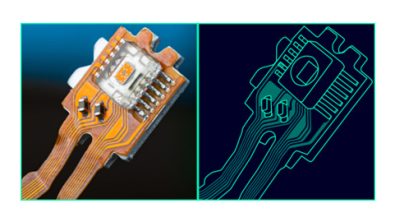
Rigid-flex PCB design with Xpedition Standard

When innovation demands flexibility, and space is limited, rigid-flex PCBs make it possible to reimagine product design across industries, from miniaturized medical devices to next-gen automotive and aerospace systems. But success in rigid-flex design depends not just on engineering prowess, but also on the right design tools. Xpedition Standard brings powerful, scalable, and intuitive capabilities that help you confidently navigate the unique challenges of rigid-flex PCB design, no matter your team’s size or experience.
Why should you use rigid-flex PCBs, and why now?
Compact, lightweight, and robust, the core promises of rigid-flex circuits, are driving demand in today’s electronics landscape. These boards combine the reliability and density of rigid PCBs with the mechanical versatility of flexible substrates, enabling electronics to bend, twist, and fit into the tightest spaces without connectors or reliability concerns.
Yet, designing these advanced interconnects introduces new challenges: adherence to bend radii, careful layer stack-up, specialized material selection, and rigorous data synchronization between mechanical and electrical domains. This is where Xpedition Standard stands apart, simplifying the complex, automating the routine, and helping you achieve first-time-right designs.
See Xpedition Standard in action: Rigid-flex PCB design overview video
Curious to see rigid-flex in Xpedition Standard? Watch this overview to experience:
- Intuitive stack-up editor: Define rigid and flexible zones with confidence.
- Real-time validation: Automated checks for bend radius, design constraints, and manufacturability.
- Productivity at scale: Collaborate and manage data continuity, whether you’re a small team or scaling up.
- Seamless integration: Synchronize mechanical and electrical domains via MCAD-ECAD co-design.
Core rigid-flex capabilities in Xpedition Standard
- Scalable, proven workflow
Activate rigid-flex functionality via tokens when you need it – fully integrated in Xpedition’s end-to-end flow with native data continuity, so there’s no tool switching, data translation, or retraining.
- Visual stackup zone definition
Quickly define and visualize rigid and flex zones. Easily configure copper weights, insulation layers, adhesives, and coverlays in an intuitive stack-up editor.
- Automated design rule checks
Dynamic rule validation tracks bend radii, layer transitions, trace width, spacing, and component placement, ensuring conformance to manufacturing specs and industry best practices.
- MCAD co-design
Bidirectional data exchange with leading mechanical CAD tools aligns team efforts and speeds up design validation, minimizing costly late-stage surprises. Siemens NX even allows you to sync up the layer properties, variants, and more.
- Real-time collaboration
Share stack-ups, designs, and mechanical outlines with stakeholders and manufacturing partners in the cloud, supporting iterative design and faster time to market.
Accelerate your rigid-flex journey
Xpedition Standard empowers every designer, from individual contributors to growing teams, with premium capabilities previously reserved for enterprise electronic systems design. By automating key aspects of the rigid-flex process, Xpedition Standard helps you realize designs faster, with fewer spin cycles, and at lower cost.
Ready to take the next step?
Transition from tools to techniques! Dive into Stephen Chavez’s recent blog for actionable best practices on everything from bend radius management to cross-hatched planes and material selection. Learn how industry pros ensure their rigid-flex designs are both manufacturable and reliable.