Self-verifying, long-running EDA AI agents that engineers can trust

In semiconductor and PCB design, there is no room for error and no tolerance for delay. Tapeout schedules are fixed, silicon costs are high, and the window between a design that ships on time and one that misses its market can be measured in weeks. That environment demands one thing above all when it comes to agentic workflows: every decision continuously validated against the physics of the design itself, not just checked at the end, but verified at every step. That is the architecture we have been building toward.
That architecture sits within a broader AI-native EDA strategy built on three pillars: faster engines through GPU acceleration and in-tool machine and reinforcement learning; smarter execution through purpose-built EDA AI agents that autonomously orchestrate multi-tool workflows; and trusted outcomes through continuous validation against physics-based EDA engines at every step.
This article focuses on the second and third pillars. It covers how we built our agentic architecture, why we built it in the sequence we did, and what we announced at DAC 2026: self-verifying, long-running EDA AI agents for semiconductor and PCB design, in collaboration with NVIDIA.
Building an agent-native architecture: DAC, June 2025
Before an EDA AI agent can act autonomously, it needs a foundation it can operate from, and that foundation was the Fuse EDA AI system. The industry conversation at the time was focused on whether large language models could be applied to EDA tasks at all. The more important question, the one that determined whether agentic AI for EDA would work in production, was architectural.
Generic AI frameworks are not suitable for EDA. LLMs lack domain-specific knowledge, cannot read, modify or write native EDA data formats, are incompatible with EDA design environments and are poorly suited to the security requirements of organizations whose design IP represents years of competitive advantage. The Fuse EDA AI system addressed each of these directly: a multimodal EDA data lake, a retrieval-augmented generation framework optimized for our tool portfolio, flexible deployment with bring-your-own-model support, and enterprise-grade security with granular access controls. These were the prerequisites for making an EDA AI agent’s knowledge reliable and its operating environment trustworthy before asking it to act autonomously.
Orchestrating across the full EDA workflow: NVIDIA GTC, March 2026
A production autonomous EDA workflow spans dozens of specialized systems, operating on different data formats, often across multiple vendors. Coordinating across that ecosystem is the central orchestration challenge, and it is one that no single-tool solution can address.
Fuse EDA AI Agent, launched at NVIDIA GTC in March 2026, introduced a unified orchestration layer built on a scalable MCP architecture. A single coordination layer orchestrates across the full design stack, spanning RTL generation, digital verification, custom and analog design, place-and-route, physical sign-off, high-level synthesis, design for test, hardware-assisted emulation and PCB design, composing sub-flows into comprehensive autonomous EDA workflows that scale as design complexity grows.
Delivering trusted engineering outcomes: DAC, July 2026
Engineering organizations operating at advanced nodes, with tapeout schedules and silicon costs that make errors expensive, need more than orchestration. They need confidence that EDA AI agents are continuously validated against deterministic, physics-based EDA engines they already trust, not just at the end of a workflow, but throughout every step of it.
At DAC 2026, we announced self-verifying, long-running EDA AI agents for semiconductor and PCB design that combine our EDA expertise and software with NVIDIA AI infrastructure and software to improve result quality, time-to-results, tool-calling reliability and token efficiency for long-running engineering workloads.
Five capabilities work together to deliver trusted, verifiable outcomes across the full EDA lifecycle, each layer enabling the next and the entire stack grounded in physics-based validation at the top.
- Physics-based truth: Siemens EDA engines
Our proprietary physics-based, deterministic engines deliver trusted, signoff-quality results and define the ground truth against which every EDA AI agent decision is validated. This is the layer that transforms orchestration into something engineers can build on with confidence, because every decision the agent makes is checked against the physics of the design before the next step begins. - Self-verification and optimization: NVIDIA NeMo Gym
Our purpose-built EDA AI agents use NeMo Gym for improved quality, speed and token efficiency, with self-verifying workflows that continuously learn and improve as they encounter real design conditions. - Governance and security: NVIDIA OpenShell
Delivers enterprise-grade governance, security and auditability, ensuring that autonomous workflows meet the security requirements of organizations whose design IP represents years of competitive advantage. - Reasoning and efficiency: NVIDIA Nemotron models and NeMo Switchyard
Delivers scalable agentic workflows at lower cost through powerful reasoning, tool-use capabilities and higher token efficiency, so agents operating across complex multi-tool workflows are doing so with models purpose-built for long-running engineering tasks. - Compute foundation: NVIDIA accelerated computing and CUDA-X GPU libraries
Powers both AI reasoning and EDA engines simultaneously, enabling signoff-quality results in hours instead of days through GPU-accelerated computing and making long-running autonomous workflows practical rather than theoretical.
Tiffany Jansen from Tiff in Tech sat down with the Siemens and NVIDIA team on the Design Automation Conference show floor for two sessions: a strategic overview from Amit Gupta and Timothy Costa, and a technical deep dive with Niranjan Sitapure and Joshua Mabry, together exploring how Siemens and NVIDIA are redefining what’s possible for electronic design.
The engineer goes to bed and the agent delivers: an autonomous characterization workflow
Library characterization has historically been one of the most labor-intensive steps in advanced node design, with generating and verifying Liberty files across process corners for standard cell and custom IP libraries typically demanding multiple full-time engineers, weeks of runtime and constant manual intervention.
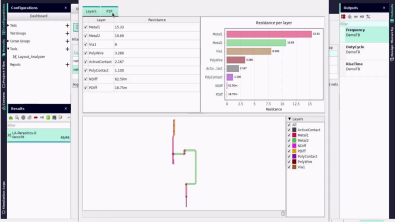
The engineer sets the intent and steps away. The prompt is: “Characterize my libraries across all PVTs. Verify, debug, and fix any problems. I am going to bed and will not be available to answer any questions. Resolve any issues on your own.” The agent runs, debugs, validates and delivers. Skill files guide automated debug throughout the flow, so when the agent encounters an issue it identifies and resolves it independently, with no interruption and no handoff back to the engineer.
Config setup that once took hours now takes minutes, pipecleaning that stretched across days now wraps up in hours, and the full flow, previously a weeks-long effort, now completes in days. Token costs are reduced by approximately 5X to 10X through NeMo Switchyard and Nemotron models, with an additional 25% reduction from NeMo Gym-based optimization of Agent Skills and MCP tools, delivering an overall 10X+ faster autonomous characterization workflow that has continuously validated its decisions against our physics-based EDA engines at every step.
See the agent in action:
Twelve months, three milestones: Self-verifying, long-running EDA workflows are here
Each step in this agentic journey was a prerequisite for the next.
Domain grounding without orchestration produces an EDA AI agent that acts and reasons correctly within a single tool but cannot coordinate across a workflow. Orchestration without domain grounding produces coordination without reliable execution and results. Both, without continuous validation against physics-based engines, produce autonomous EDA workflows that move quickly but cannot be trusted.
The sequencing from DAC 2025 through GTC 2026 to DAC 2026 was deliberate, and the distance traveled in twelve months represents an entirely different category of AI capability for EDA.
Twelve months ago, the question was whether large language models could be applied meaningfully to EDA. Today the answer is running in production: self-verifying, long-running EDA AI agents that engineers can trust with their most demanding workflows.