Is Agentic IC Design the Next Big Thing? Industry Experts Answer
Agentic IC design, where AI-powered autonomous agents handle complex chip design tasks, is rapidly gaining momentum. Is agentic IC design the next big thing? That was the central question at the Solido Custom IC Forum in India this fall, where this topic dominated keynotes, presentations, and even water cooler conversations.
I spoke with Jeff Dyck, VP of R&D, Siemens EDA, who moderated a panel dedicated to answering this question. It featured leaders from Axiro, Google, Nvidia, NXP, and onsemi, uncovering how these companies are implementing agentic AI in chip design. Here’s what emerged from the discussion.
What industry leaders say about agentic IC design’s future
1. Current industry adoption
All panelists are actively using agentic technology in chip design, reporting significant value despite being in early implementation stages.
2. Automation benefits
The focus is on automating repetitive, time-consuming tasks to free designers for more complex work. AI serves as a powerful multiplier for junior designers, accelerating their expertise and reducing learning curves.
3. Knowledge capture and utilization
AI systems gather expert knowledge on the fly through use and get smarter over time. This continuous learning capability is essential for long-term value delivery.
Systems are gathering and leveraging two types of expert knowledge:
- Hard knowledge: Information documented in PDFs, Jira/Confluence, Word documents
- Soft knowledge: Critical expertise residing in experts’ minds but not formally documented: intuitive problem-solving approaches and lessons learned through years of on-the-job experience.
4. Integration and context awareness
Direct integration into existing tools and workflows, combined with context-awareness of specific tasks and job requirements, provides substantial value.
5. Workforce adoption and trust
Successful workforce adoption of agentic AI comes from delivering positive initial user experiences that resonate with the design community. Trust emerges through demonstrating reliability, correctness, accuracy, and verifiability.
6. Robust security and data governance
Leading organizations are prioritizing robust data security and access control:
- AI solutions must be securely hosted within customer data centers.
- Systems must respect complex access control mechanisms to ensure user, group, and project-specific information boundaries.
- Compliance with export control requirements must be maintained.
After hearing from industry leaders actively deploying agentic AI technology in production environments, a clear picture emerges.
The verdict: is agentic IC design here to stay?
Industry leaders report significant value
The answer, based on what the panelists shared, is yes, but with some important considerations.
All panelists are actively using agentic technology in chip design and reporting significant value, even in these early implementation stages. The benefits are clear: automating repetitive tasks frees designers for complex work, AI accelerates junior designer expertise, and systems that capture both documented and undocumented expert knowledge deliver measurable impact. When integrated directly into existing tools, with context-awareness of specific tasks, the value is substantial. This is particularly true in the semiconductor industry, where constant pressure for time-to-market deadlines and innovation demands every advantage.
Three critical success factors
Whether it becomes the industry standard depends on mastering three critical dimensions: adoption, trust, and security. These are the exact requirements forward-thinking organizations are tackling right now—and the ones Siemens is focused on addressing through industrial-grade AI capabilities purpose-built for EDA workflows.
Looking ahead
This is clearly an ongoing discussion in the industry. With agentic AI evolving so rapidly, it will be fascinating to see how much progress has been made, and what other new developments have emerged, by the time next year’s forum rolls around.
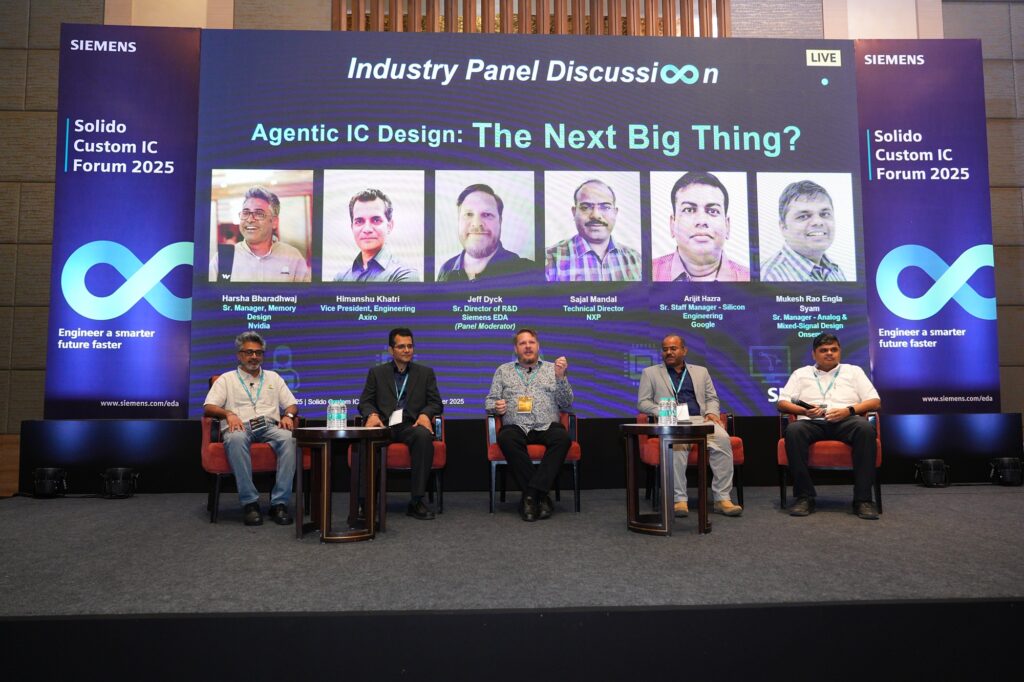
From left to right: Harsha Bharadhwaj, Senior Manager, Nvidia; Himanshu Khatri, Vice President, Engineering, Axiro; Jeff Dyck, Vice President of R&D, Siemens EDA; Sajal Mandal, Technical Director, NXP; Arijit Hazra, Physical Design Manager, Silicon Engineering, Google; Mukesh Rao Engla Syam, Senior Manager, Analog and Mixed-Signal Design Team, onsemi
Essential resources for agentic IC design
Ready to explore how agentic AI can transform your chip design workflows? These resources provide deeper insights into Siemens EDA’s AI-powered solutions.