When thousands of RDC violations aren’t real: Making RDC verification smarter
Imagine opening your latest reset domain crossing (RDC) report after a long overnight verification run. The analysis completes successfully. That’s great, but then you see the numbers: 50,000 RDC violations! Your first thought shouldn’t be: “The design is broken.” It should be: “How many of these are actually real?”
If you’ve worked on large SoC designs, you’ve probably experienced this. Modern RDC tools are excellent at finding potential issues, but they’re often too good. They flag every possible crossing between different reset domains, leaving verification engineers to spend days—or even weeks—sorting genuine functional hazards from perfectly safe design behavior. The real challenge today isn’t finding violations. It’s finding the right ones.
Why RDC reports have become so noisy
Today’s SoCs are vastly different from those designed a decade ago. Multiple IPs, independent power domains, complex reset controllers, software-controlled resets, and aggressive power management have transformed reset architecture into one of the most intricate parts of chip design. With this complexity comes an explosion of reset domain crossings.
Traditional RDC verification follows a simple philosophy: if the transmitter (Tx) and receiver (Rx) belong to different reset domains, report the crossing as a potential violation. It’s a safe strategy—but also an overly conservative one. In reality, many of these crossings never pose a metastability risk. Yet they still appear in the report, demanding manual investigation.
Imagine spending hours debugging a violation only to conclude: “This path is already covered by static timing analysis.” Multiply that by thousands of crossings, and it’s easy to see why verification closure becomes such a challenge.
Different reset domains don’t always mean danger
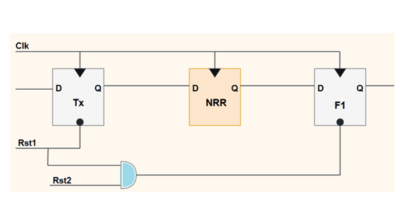
Different reset domains do not automatically imply a functional RDC hazard. Consider two registers operating on the same clock but driven by different asynchronous resets. At first glance, this looks like a textbook RDC violation. But suppose those resets themselves are generated synchronously within that same clock domain. Any reset-induced change reaching the receiver also occurs synchronously with the clock, eliminating the metastability concern. In this case, correctness depends on timing—not on RDC behavior. If static timing analysis (STA) confirms that the timing path satisfies setup and hold requirements, treating this as a functional violation simply creates unnecessary noise.
Smarter verification instead of more verification
Rather than suppressing warnings, we should ask a different question: “Can we classify them more intelligently?” The answer is to combine RDC analysis with design context and STA awareness. Instead of reporting every crossing as a violation, crossings that are functionally safe—but still require timing validation—are classified separately as STA-aware cautions.
This simple distinction makes a huge difference. Engineers immediately know:
- Which crossings require functional debugging
- Which crossings simply need STA confirmation
- Which paths can safely move out of the critical review queue
The goal isn’t fewer checks. It’s better classification.
The impact
To evaluate this methodology, we applied it to a real design containing nearly 296,000 register bits. Using conventional RDC analysis, the tool reported approximately 50,000 violations. After introducing smarter STA-aware classification, nearly 10,000 of those reports were identified as timing-safe and reclassified as cautions instead of violations.
The result:
- ~20% fewer RDC violations
- Thousands fewer false positives
- Faster debug cycles
- Greater confidence during sign-off
Most importantly, genuine RDC hazards continued to be reported exactly as before. The methodology simply removed the distractions that prevented engineers from focusing on the issues that truly mattered.
The bigger picture
Verification isn’t just about detecting problems anymore—it’s about delivering actionable information. As SoCs continue to grow in complexity, engineers don’t need more reports. They need better reports. Context-aware verification represents the next step in that evolution. By combining structural analysis with timing knowledge, RDC tools can distinguish real design risks from safe implementation choices, dramatically reducing verification effort without compromising quality. Sometimes the most valuable improvement isn’t finding more bugs. It’s knowing which ones aren’t bugs at all.
To learn more, please download our full paper on this topic: Refining RDC to catch missed STA scenarios.