Industrial AI jeopardy: the truth about inaction – Transcript
Listen to the podcast on industrial AI above. Or read the transcript below.
John Nixon: Well, hello and welcome, to today’s episode of the Industry Forward Podcast, where we explore the key trends, transformative technologies and real-world innovations that are reshaping fields from consumer-packaged goods (CPG), life sciences, energy and beyond. I’m your host, John Nixon, global vice president of Process Industries at Siemens Digital Industry Software. And today’s guest is Bill Hahn, director of Solutions Consulting at Siemens Digital Industry Software. Welcome to the show, Bill!
William Hahn: It’s great being here today.
John Nixon: Well, today, Bill, we are continuing our discussion on the impact of digitalization on process industries. Our focus will be, today, on AI (industrial AI), the dangers of inaction and how to get buy-in.
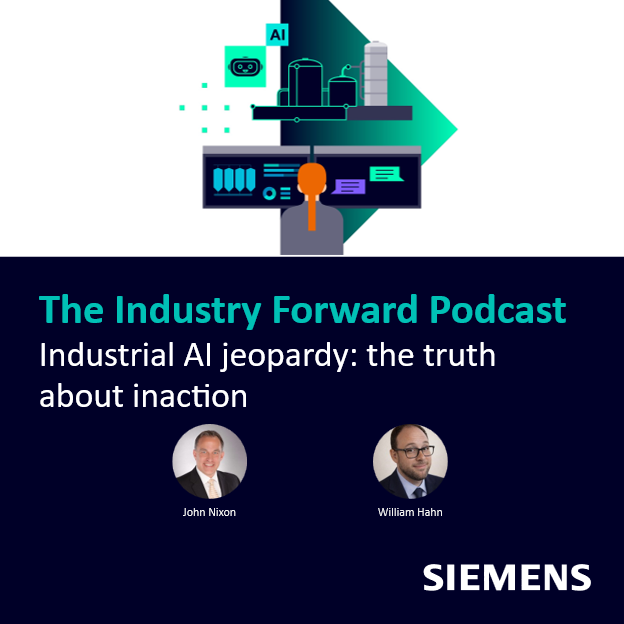
One of the things I’ve noticed, given my background in energies (oil and gas specifically), is that I found that industry always trailed behind manufacturing, automotive, for example, and aerospace. Because there was this, I don’t know if the word “fear” [fits]? But certainly, apprehension existed around technology of, “well, if it’s not broken, why fix it?”
But what we’re finding is that the changing needs of our species are becoming more and more rapid. And it is truly driving a different mindset around fear, that it can no longer remain this barrier that it’s always remained.
But before we address that, have you [Bill] experienced this same level of fear in other industries? And how do we assist our listeners in understanding that you need to turn that fear into opportunity?
William Hahn: Yeah, for sure, John. I think, I’ll say from a software perspective, “status quo is our biggest competitor,” right? Laughs. And I think fear a lot of times leads to inaction. And I’d argue that inaction is the worst competitor, right? If you make a decision, good or bad, you’re at least learning something, right? If you make a bad decision, you always say you learn from your bad decisions to help you make better decisions in the future. What do you learn from inaction? Absolutely nothing.
Both laugh.
John Nixon: Bill, I want to probe yet further the concept of fear, as it relates to our conversation today around data and AI (industrial AI).
I was in a meeting with several leaders from different process companies at one time, and I said something that seemed to resonate with many of them. I said, “when you’re going down the path and you feel you’ve got your data corralled together correctly, you’ve built the ontologies (or the relationships between the various sources of data). Why don’t you start with what I would call automating the mundane?”
Because the mundane is something that is repetitive. It’s maybe a low-level task. And I’m going to give an example of that. And you may find, though, that the mundane is still mission critical.
For example, you send somebody out in the field. You hire a new mechanical engineer. She’s brand new to the team. Well, the first thing you do in order to train that new engineer, you learn by doing. You send her out to the field. We’re going to do some inspections on some equipment.
Well, that’s pretty mundane work—but it’s mission critical—because you’re going out looking for asset integrity issues. And those asset integrity issues could lead to failure. A very mundane task to visually inspect, or perform some kind of instrumented task, as part of that investigation. But it turns out that that very mundane task has to be done in a very specific manner so that the data you collect is traceable and reliable, and you can then garner insights from it. Perhaps there’s visible signs of corrosion? What is that based on? We’re all in a war of oxidation with Mother Nature, right? That’s what we all have to deal with across all industries. It’s a very mundane thing, but it’s a very mission-critical observation, a very mission-critical insight. We need to draw from that very mundane task.
So, for me, when I look at AI (industrial AI) and I look at where do I start, [and] there’s apprehension around that. I say, “automate the mundane, bring AI (industrial AI) into that, and then build your confidence around that as you increasingly use AI (industrial AI) within your enterprise.”
Bill, your thoughts?
William Hahn: Yeah, and I think I’m going to start a little more basic than that, John. And I think you made one assumption in your talk track there that, “our customers kind of have all their systems in place.” And I’d argue [that] many of them don’t even have that, right?
So, step one, I’d say, “start with what you know.” We talked about that phrase, “we don’t know what we don’t know.” So, start with what you do know, right? Do you have the right systems in place? If you look across, we talked about the different life cycles, R&D, product development, manufacturing: do you have those sources of truth? [Do you have] those enterprise platforms that not only just do their job, but will actually support the next level of what you’re trying to do, right? Do they support AI? Do they support data fabrics? So on and so forth. So, you need to kind of take an inventory, right, of what you do know. And then start looking at, “do I need a more robust PLM system,” right? “Do I need a more robust system on the shop floor?” And so on, and so forth.
And then once you have [that], you’re right, John. Once you have that baseline source of truth of data in place, then start looking at A) the mundane automations, right? Repetitive tasks, right? Every time I do this, I have to do that. Can an AI agent just replace that, right? Where [things are] not really going to go wrong, there are enough checks and balances in place. It’s a very simple task and it’ll save a lot of users a lot of time, right? So, we look at these kind of agentic tasks of, every time I do this, AI (industrial AI) just do this other thing for me, right? Based on the data.
And then there’s also kind of the general, and we’re seeing this in just about every product, kind of your chat bot, right? It doesn’t really have a singular purpose, like a, you know, more task-based agentic work. But I just want a chatbot available to be able to ask it a question. And it’s going to provide me [with] a whole bunch of contextual information that would have taken me a long time to search for. And then just presenting that information to the user will in itself start stirring up use cases, right? That, you can build on just by having the conversation with AI (industrial AI) in the context of the data.
But I think getting back to basics, figure out what you do know first, and then start venturing into the: what you don’t know.
John Nixon: Right, Bill, your point about the basics is why I use the term automate the mundane as something to remember. And to ask yourself, to your point:
- What do you know,
- What do you have, and
- What can I do to automate the mundane today?
And then begin my adventure into what I don’t know and greater insights beyond that.
John changes the topic
You know, as we look at today’s modern technology, looking again at our past and our own anecdotes , what’s interesting is back then, and even today, we don’t know what we don’t know. You know, just as we think we’re experts at something, a new discovery comes along.
I’m excited about the pace of discovery, for us in process industries, that we’re going to now herald in with a lot of the investment we at Siemens are making and we as a species are now demanding from our technology.
You know, experts in, for example, in the process industry, and in this case, pharmaceutical or life sciences, what we know about the human body I hear it oftentimes, “we’re just beginning to understand. We’re just really making strides today.” You think about consumer-packaged goods, you know, the human health aspect of what we consume. We’re just really starting to make strides there.
And then with energy and infrastructure as part of process industries, Bill. Think about the renaissance we’re seeing in advanced nuclear and fusion energy. We’re actually inventing that technology as we go. It’s so exciting to see the headlines day by day around advanced nuclear fusion energy—and the human body. And it does bring back the point that “we just don’t know what we don’t know.”
You know, I would hate that we would ignore that statement and just [say], “well this is how we’ve always done things.” And I know we’re not doing that. I know we can’t do that. If we think about the digital twin, we think about AI, think about the role it plays right now in uncovering what we don’t know. (Bill: Right) What are your thoughts on that?
William Hahn: Yeah, I think, you know, John, the natural reaction to any change is fear. Laughs. That’s just how we work as humans, right? For the most part, we’re resistant to change. And we turn to fear when we don’t understand something. If there’s one place [where] we should have fear, I think it’s in the quality of data and where we’re storing our data—not the new technologies that are coming out.
I think, if you don’t—as a company, speaking to our customers—if you don’t really embrace AI, for example, and digital twin and physics-based analysis, for example, your competitors will, right? And at the pace that AI (industrial AI) is moving, you will be so far behind your competition in a matter of years that you’ll never be able to catch up because AI is moving … exponentially faster, right, in terms of capability.
So, you have to adopt AI. It’s not a question of “if you’re going to adopt it,” you have to adopt it. So where should you place your fear? It’s on how much you trust that AI [tool], right, in terms of having it drive your business. And the only way you’re going to have any level of trust in AI (industrial AI) and these technologies is by being confident in your data that we’ve talked about, which is, having that FAIR data, having that single source of truth, and being able to trust the data sources that AI (industrial AI) and digital twins are going to use as their baseline.
So, if you’re going to be afraid of change, be afraid of the quality of your data today. And, start focusing on how you can start those foundational elements to make sure that baseline of data, that’s going to feed the inevitable AI (industrial AI) and digital twin capabilities you’re going to have as a company. Make sure you can trust what that baseline of data is providing.
John Nixon: Bill, as you mentioned fear, it reminds me of history. Kerosene streetlamps eclipsed whale oil fueled streetlamps. And then kerosene lamps were replaced by electric lamps. Then electric lamps, which were incandescent at the time, were eventually replaced by LED. And now we have entire networks of streetlamps. And grids that support that and the intelligence in that grid. And so progressively, yes, the whale oil supplier may have found themselves in a bit of a different market as kerosene came online. And then, you know, the same with kerosene suppliers who then see electricity coming online.
But I see this as an opportunity for our species to become ever more sophisticated. So, the person who’s servicing streetlamps today is an electrician, which requires a great deal more sophistication than, say, someone who was applying whale oil in a lamp. So, for me, when you talk about fear, I think opportunity. Yes, there’s initially fear, but there’s also opportunity here to become more sophisticated and grow with the technology.
And I think that fear then gives way to wisdom that: the more we learn and the more you as a person learn, the more you realize “you know what you don’t know.” And it becomes this virtuous cycle of learning more and more because there’s always so much more to learn.
For me, Bill, and I’ll ask you for a final comment before we sign off. For me, AI isn’t. For me, AI (industrial AI) is a complement to our development as a species as we go forward. And it’s going to drive us to a new level of sophistication where I don’t see AI eclipsing us. I see AI (industrial AI) and humans working side by side to take on the greatest and most complex challenges we’ve ever faced as a species.
William Hahn: I agree, John. And also, I’ll say I don’t see it as a choice, right? I think this is one of those adopt or die moments, right? And I’ll use an analogy. Do you want to be BlockbusterTM or do you want to be NetflixTM, right? And I think you know how both of those stories turned out.
You’re either going to adopt AI (industrial AI) and adopt it in a way that grows your business, or you’re going to go out of business. I don’t think there’s much of a choice.
John Nixon: That’s a good point, Bill. Thanks for joining us today.
William Hahn: As always, it’s a pleasure.
John Nixon: Well today we talked about the fear of adopting AI (industrial AI) technology. We argued that the status quo and the quote “this is how we’ve always done things” mentalities, that can be detrimental to companies, today.
Additionally, we discussed how to get started implementing AI (industrial AI) in your organization. Start with what you know by ensuring data is optimized and trusted before the training process. We then discussed how using AI (industrial AI) to automate the mundane is an excellent way to get buy-in with the technology. Once confidence in AI (industrial AI) is strong, within the organization, then it is best to use AI (industrial AI) to discover the aspects of your lifecycle where “you don’t know that you don’t know.”
Well, that’s it for today. I want to thank our audience for joining us on the Industry Forward Podcast. I hope this episode helped you process your process industry knowledge. I think you guys are getting so tired of me being so pun-tastic, ha! Please join us next time as we continue to explore technologies and ideas that are shaping the future of industry. Take care.

John Nixon – Global Vice President of Process Industries at Siemens Digital Industries Software
As Group Vice President for Process Industries at Siemens, John leads a global team that helps process industries leverage digital solutions that enhance efficiency, accelerate innovation and achieve sustainability goals.
John has over three decades of experience in strategy, operations and technology deployment for energy, chemicals, life sciences and CPG. He is well versed in the operational and business pressures of industry, including regulatory demands, decarbonization, talent gaps and the push for innovation.

William Hahn, Director of Solutions Consulting at Siemens Digital Industries Software
As Director of Solutions Consulting at Siemens, Bill leads the digital transformation initiatives for large enterprise clients across life sciences, CPG, energy, chemical and infrastructure industries.
Bill has over 18 years of experience in digital strategy development, systems engineering, and business process optimization. He specializes in end-to-end software development, and implementations, that aligning technology solutions with business objectives like risk management, compliance and operational resilience.
All trademarks are property of their respective owners.