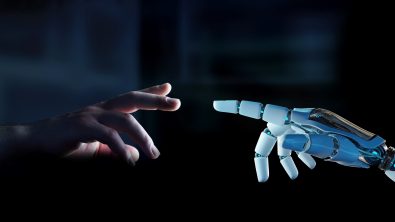
Humanoids are needed today

Humanoid robots were once considered nothing more than science fiction, a technology reserved for fantastical and far-future settings. Tomorrow’s humanoids will be able to navigate complex shop floors, manipulate tools, learn intricate tasks and integrate into production environments with surprising ease. And this great leap in advancements is due to converging technologies that will enable machine builders to design, produce and deploy them at scale.
Humanoids are uniquely primed to augment human labor compared to most advanced autonomous robots due to the ease of integration as well. Over the last few centuries, humans have designed everything around the human form; from workstations and assembly lines to drawers and stairs the world has been built around human geometry. Due to this, deploying humanoids in human-centered fields will be relatively painless, especially with the correct enabling technologies.
In an Industry Forward Podcast episode, Dale Tutt and Rahul Garg discuss the rise of humanoid robots, their role in manufacturing, and the technologies enabling their adoption. The conversation focuses on how humanoids differ from traditional automation systems and why they are becoming increasingly important for modern factories.
The humanoid form factor
Two of the most substantial characteristics of the humanoid robot are its humanoid form and adaptable capabilities. These two aspects set humanoids apart from other autonomous robots for several reasons—the chief of which being the ability to complete several different tasks. AGVs and AMRs typically must follow pre-determined paths and are specialized to complete a narrow category of tasks. Meanwhile, humanoids emphasize flexibility, dexterity and even intelligence in some cases. As well, humanoids boast flexibility in both movement and operational capabilities. Freed from fixed infrastructure humanoids move, adapt and perform varied tasks rather than single, repeated motions.
Because humanoids are both adaptable and well-suited for human-oriented tasks, they will be especially useful in brownfield factory environments. Reconfiguring factories to accommodate new technologies can be costly; and despite the ROI digitalization guarantees in the long run, redesigns can potentially be unfeasible. Humanoids can blend into existing factory workflows with minimal disruptions, functionally bringing automation to more traditional factories.
Retrofitting for automation
Humanoid robots are not a one-size-fits-all solution, but they represent a significant advancement in flexible automation. Their ability to function within environments originally designed for people makes them particularly well-suited for brownfield manufacturing facilities and other human-centric workplaces, especially as industries face ongoing labor shortages and increasing pressure to reduce operating costs.
At the same time, the convergence of multiple technologies is accelerating the development and deployment of humanoid robots, with the digital thread and digital twin serving as key enablers of this integration. As humanoids move beyond pilot projects and demonstrations into real-world production environments, shipment volumes are growing rapidly, with expansion currently limited more by manufacturing capacity than market demand. Organizations that invest early in digital twin and digital thread capabilities will be better positioned to capitalize on the widespread adoption of humanoid robots as they become an increasingly common part of industrial operations. If you would like to explore how Siemens can help get your company ready for humanoids, please consider tuning into our Industry Forward podcast.
Siemens Digital Industries Software helps organizations of all sizes digitally transform using software, hardware and services from the Siemens Xcelerator business platform. Siemens’ software and the comprehensive digital twin enable companies to optimize their design, engineering and manufacturing processes to turn today’s ideas into the sustainable products of the future. From chips to entire systems, from product to process, across all industries. Siemens Digital Industries Software – Accelerating transformation.