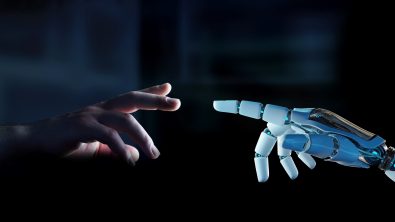
AI is powering smarter, safer human-aware humanoids- transcript

Dale Tutt: Welcome to the Industry Forward Podcast, where we explore the technologies shaping the future of engineering, manufacturing, and innovation. In today’s episode, we’re diving into the next evolution of automation: humanoid robots in real-world environments. From factory floors to human-centered spaces, these robots are no longer confined to controlled settings. Humanoids are learning, adapting, and working alongside people.
We’ll explore how breakthroughs in AI, software-defined systems, and digital twins are accelerating robot training from years to weeks, and how advancements in semiconductor technology and compute power are making real-time decision-making possible. But with that progress comes complexity. How do robots safely interact with humans, respond to unpredictable situations, and continuously learn from experience without introducing risk?
Joining us is Michael Munsey, Vice President of the Semiconductor Industry at Siemens, as we unpack what it really takes to design, train, and scale humanoid robots, and what it means for the future of work.
One of the things that we were talking about earlier is that these humanoids, as they fall off the stage, they were getting bumped by somebody or they were running into somebody or they’re tripping over a cord in their environment. As we think about a lot of the places where these are being designed for, they’re going to be interacting with people all the time, whether they’re in a restaurant or in a manufacturing facility, a factory, or maybe they’re out in other places in the environment. They’re interacting in an environment that has been designed around humans.
As we talk about prioritization of software, I know I’m falling down, so I should do something, and you were talking a little bit about how AI is handling this. How do you see is teaching a safety analysis, or maybe safety analysis is not the right word, but how do we teach it to interact better in the environment with people and operate in a safe manner around those people to know that you can’t drop it on their foot, whatever. And maybe part of that, you started to talk also about systems engineering. How do you see the safety aspect as it’s interacting in this environment with humans and how are companies going to resolve that with the software?
Michael Munsey: The minute you put these in with people, you know, people are the largest wild card. It’s the most unpredictable part of the system, right? The humanoid’s going to have a specific task that it needs to accomplish, right? But you’re going to have to have this failsafe mechanism of like, do not hurt the humans, right? At the same time, do not break what I’m working on, right? If you have a humanoid in a semiconductor fab that’s walking around with a couple hundred thousand dollars worth of wafers, and yes, a human might be backing up and bump into it, and it may have to fall over, but it might have to fall over in such a way that it doesn’t hurt the human, but at the same time protects the wafers that it’s carrying it at the same time, right?
And this goes back to that software workload that needs to be handled by the processing capabilities, right? Because you need the ability to jump out of your tasks that you’re in right now, move quickly to a different task, which is Don’t hurt the person, don’t hurt the product, right? And find some fail-safe mechanism. This is just yet another layer in terms of the entire system that needs to be handled and handled in some type of fail-safe way, right? We’re already dealing with it. If you look in autonomous vehicles, I was on a plane one time talking to somebody that was working in ADAS software, right? And he said, you know, his job went from being fun to being very serious all of a sudden because they were dealing with situations where if I’m going to crash and I’m surrounded by people, how do I crash in such a way to kill the least amount of people, right?
These are questions and tough questions that have been asked already in different industries, right? And it’s just that extra layer that needs to be able to be probably If you had a rank order, it may be the most important and highest layer of software, which is the protection of people and the protection of the environment around you that these are going to be able to have to handle and probably the most important part of the entire system.
Dale Tutt: Yeah, maybe it goes back to Asimov’s three laws of robotics that shouldn’t hurt anybody and then through your inaction shouldn’t allow anyone to be hurt. It’s kind of interesting. I love that example that you give about the ADAS software and the criticality of that and that decision making of there’s the little kid running across the street chasing a ball. You have to make a decision that avoidance causes you to crash into something. And how do you prioritize that? And so, and then maybe part of that is, as well as the shared learning, if you’re in a manufacturing system, you have a lot of humanoid robots that as one starts to learn, how do they then translate that learning of, I interacted with my environment in a different way across all the robots maybe in your factory? Maybe it’s like an update to the core operating system.
I can imagine that you have learning that’s happening with AI, but is it always what you want to have go across everything else? When is it good learning? When is it like, hey, we really wish it had reacted differently?
Michael Munsey: A perfect example is that, you know, you may program the humanoid to know I am moving down a hallway and I see a human, so I need to give some amount of safety zone as I walk around the human, right? But then once the humanoid passes the human, right, maybe all of a sudden it says, okay, I’m clear, but it doesn’t account for the fact that that human might back up accidentally and bump into you, right?
The robot could learn from that, right? And then the robot could say, hey, we have to update our algorithms, just not account for when we see the human, but realize that the human is still in our vicinity even though we can’t see it anymore and could accidentally bump into us from behind, right? And that would become somewhat of a learning mechanism that could be shared amongst the humanoids in that type of environment.
Dale Tutt: I envision that you have a Digital Twin of how it operates and You have a systems engineering process, a lot of requirements, and you have this continuous learning going on. You want to optimize the workflows. Where do you see with companies potentially that they’re learning on their own? You can be hands off versus any learning has to go back through some sort of review process. You know, like the ADAS software, I’m sure that if you’re before you update it out in the cars, or if it’s aircraft data around flight control systems before you actually make those updates, there’s I guess I’d just say checks and balance in the process.
Do you have any insight into how maybe companies are looking at that, especially when you start talking about software defined products and the role of AI?
Michael Munsey: Yeah, so I think it comes down to… There are going to be KPIs for the operations that these human nodes are doing, right? And you’re going to move so many parts, inserts so many fasteners, right, in a certain amount of time. You know, the idea of, all right, so my programming tells me to go to the parts bin and pull out a bolt and pull out a nut and do it, and then I do it again a second time. Well, maybe there’s an efficiency of If I grab two bolts and two nuts at the same time, I save the opportunity of moving back there, right? And if that improves the overall assembly time that you’re measuring, that could be one thing that probably, you know, wouldn’t need the same amount of review as opposed to something that was more safety critical, right?
That’s in terms of whether there’s opportunity to injure or damage something, right? Those become more safety critical. So then it goes back to, you know, prioritizing Can I improve what the task is in a way that’s safe? And then that is something that then could go on and be shared with other humanoids and they could learn from it versus something, oh, I have an idea of doing something, but it could possibly lead to an accident or something that a real bad situation that might need more of a review step in the process moving forward.
Dale Tutt: Yeah, well, I can also envision the It picks up two bolts and then 20% of the time it drops one of them and has to pick it up. I learned that the robots would report out. Like I learned something new today and then there’s a process that reviews that before you implement it. Sticking kind of on this theme of when do you actually want to update the robot? The disruption, you probably don’t want to have them updating every day.
You have to have a schedule of when you would actually do either an operating system update or even just an application software update. to the rest of the team. I’m going to call it a team, the robot team. Certainly a lot of considerations for companies in their ads on how they manage those updates, probably systems.
Michael Munsey: Absolutely. In your point about dropping it, keep in mind that the guy that probably programmed the humanoid in the 1st place was the guy that originally picked up two bolts and always dropped one. He said, okay, I’m going to solve that problem along the way, right? You know, think about Star Trek and the Borg, right? You have this idea of where they go back to regenerate and that’s when they share their day’s experiences amongst each other, right? That hive mentality, right? The team of humanoids, right? But the whole idea here is that you have to give them the opportunity through AI to actually improve what they’re doing and improve it in a timely manner as opposed to going through like too many steps getting in the way of actually making the improvements.
Dale Tutt: Absolutely. you went to the board. I had been thinking about the matrix.
Michael, we’ve been talking a lot about the software and what is required to have these humanoids to be able to do all these different functions. the basic operations of walking or moving, if maybe it’s an AGV with a humanoid top form with arms and dexterity that it needs for those functions. But there’s the basic movement and then there’s the operations and then there’s going to be the learning that’s happening along the way. You know, as we’ve talked about AI and its role with the software, certainly, you know, there’s other aspects with the physical AI.
And, you know, as I said at the top of the show that, you know, one of the technologies has been semiconductors and the ability to shrink the and they’re using less power, which also helps by way of batteries and all that. Just the amount of computing power that you talked about that these humanoid robots would need. If you go back 50, 30, 40 years ago, the size of the electronics for the humanoid robot would be huge. And now just the amount of compute power you have in your smartphone that all of us carry around every day is 10 times what was on the Apollo rockets, probably more than 100 times, I don’t know.
Michael, your background semiconductors and as someone that has parts on two planets, which not a lot of people can say, what do you see as the convergence technologies from the semiconductor perspective that’s really humanoids possible. There’s been so many advancements.
Michael Munsey: You really kind of nailed the crux of it right now is that we’re at a point right now because of the number of transistors that we could fit on a chip is so large now, it’s just increasing the compute power that we can handle, right? And this is why you kind of seen like an explosion now with AI, right? It’s because we’ve kind of hit an inflection point in processing power within the devices. And then the fact that we could shrink them down and we could also go to a key term in the software-defined vehicle is the zonal architecture, right? Think about having a zonal architecture also in a humanoid where you could actually move the processing around, right?
We’re finally at the point when I talk about compute platforms and talk about the software workload that we’re at a point where we could do things we could have never done before because of the amount of software that we can actually run. But there’s also, I’d say, technology is starting to find the right application that’s needed right now. You know, when we talk about GPUs and CPUs, we talk about, you know, traditional von Neumann architectures, right? Where you have a central processing unit and has the math unit and the logic unit in it. And then memory’s always been separate and memory’s a shared resource.
And when we talk about, you know, multi-core chips, you still have the idea of a shared resource of memory and everything. There’s been this notion of neuromorphic processors. It’s actually something Carver Mead came up with in the 1980s because Carver Mead had an encounter with a biotechnologist and really got interested in the way the human brain works. And the way the human brain works is very different from a processor. The human brain basically does all of its data manipulation in memory, as opposed to a Von Neumann architecture where you move something from memory into the processing unit, you do something on and then you move it back out to memory, right?
There’s certain tasks that are much more efficient in that type of architecture than in a von Neumann architecture. You know, what you’re running your cell phone and what you’re running your laptop is perfect for a von Neumann architecture. But if you talk about a humanoid now where you’re doing a quick feedback loop between manual tasks and slight changes in the way something feels, that you want a quicker loop in terms of how you process that information. And also you want it done in a way with you don’t have to go outside the humanoid to a cloud and then back as well. These neuromorphic processes are perfect for this, right?
You’re starting to see a whole new series of startups as well as companies like IBM and Intel that have been experimenting with these but never found the right application yet that these things are going to support. Now, of course, now a processor that’s kind of built around the way the human brain works, maybe a humanoid robot is the perfect application for that type of processor, right? Given that we’re trying to have it do tasks that we do on a daily basis, but do it better, right? You’re going to see a lot more from these neuromorphic processors and probably within a year or two, start seeing humanoids with neuromorphic processors in them only because they’re more efficient at doing the compute that humanoids would need moving forward.
Dale Tutt: I’m going to have to have you go back and maybe describe a few things, because maybe not a lot of our listeners have heard the term neuromorphic processors before. When you talk about the von Neumann and everybody understands that taking out of memory processing and then putting it back, that process sets kind of the historical context of the computers. But then think about what the companies were starting to do, Apple was doing with their, how they were designing their processors and they’re putting the memory in. But I think the distinction you made is that’s still not neuromorphic.
Can you maybe give a little bit more of an explanation around that and then compare and contrast that with the semiconductor devices that are in some of the modern computers today so that there are maybe between where we were and where we’re going, especially in the context of humanoids?
Michael Munsey: Sure, yeah, without getting, you know, into too many geeky details here, right? If you think about a traditional processor today, you have memory, you actually have different layers of memory, right? You have large amounts of memory that’s very slow, and then you go to smaller amounts of memory that are very fast, and then you have the fastest memory, which are actually registers within the processor where the immediate transactions happen, right?
What’s happening is that you’re moving data from the slower memory into subsequent faster memories until you get to the point where it needs to be operated on, and then it gets moved back out to memory. Now, the memory itself is really fundamentally not organized other than a big pile of information stored that’s out there. It’s up to the processor to keep track of where the memory is being written to and back and forth.
And that’s where a lot of the latency comes in. Now, when you’re doing highly repetitive tasks like Excel spreadsheets, right? You’re able to organize the data in such a way that that’s the idea of moving it in chunks from slower memory to faster memory, that the information you need immediately is always usually in a fast memory, and that’s where traditional processors get their compute platform. Now, think about the way the human brain is structured. You got prefrontal lobe, you got the frontal cortex, and they’re all actually, they store different types of memory.
The brain itself also does different processing in different parts of the memory, where you have your eyesight and where you start processing images you see versus things that you hear versus… older memories like things like smells that you might recognize, right? They’re all stored in different parts of the brain, but well-defined parts of the brain. For example, your eardrums connect to a certain part of your brain, your nerve from your eye to your brain goes to a certain part of the brain. A neuromorphic processor basically is organized that way where instead of having to move data around, you process the data where you know where it is in its storage structure. And then that allows for things to happen very efficiently because I’m not taking a piece of data, moving it somewhere, adding something to it, and moving it back. I’m actually reading it and updating it all within that part of the brain. And that happens very, very fast.
Now, what’s that good for? Well, that’s good for where you’re having to do very different tasks all the time. You’re taking in a bunch of sensory input from different sensors. that do different things. So the humanoid robot may be looking, I’m using the air cords when I say looking at something to see where something is, right? But then its hands are going to have to go now operate on that. And the thing that controls the hands are in a different part of that memory, right? You’re processing the image, but controlling the hands in a parallel way where you’re not having to swap data in and out in context, right? It leads to highly parallel tasks on immediate data.
And this is where a lot of the advancements, and this is where you’re going to think about things like agility, right? And you can have physical agility, you can have mental agility, right? This comes from the fact of having the processing done localized in very specific parts of the overall architecture. what a neuromorphic process is doing, right?
And that’s why when I kind of joke saying, well, a humanoid robot is probably the perfect place for this, because it’s trying to mimic what we’re doing in our own human brains and separating out motor tasks versus comprehension versus hearing little things, right? Perfect example when we talk about safety, right? Our ears developed over time to hear a twig snapping, right? Because you wanted to protect yourself from somebody sneaking up from you. Those highly specialized things that sets off the fight or flight mechanism are refined over time.
This is what you get out of a neuromorphic processor. So even going when we start talking about things like safety, well, maybe there’s a whole separate part of the processing that handles that safety over or above the task that you’re operating on at any given time.
Dale Tutt: Wow, what an explanation. Thank you, Michael. We’ve seen how humanoid robots are rapidly moving from concept to reality. Powered by AI-driven learning, digital twin simulation, and next-generation semiconductor architectures, humanoids are close to achieving human-like perception and responsiveness. But perhaps most importantly, we explored the challenge at the heart of it all: building systems that can safely and intelligently interact with the unpredictable human world, balancing performance, adaptability, and trust.
As these technologies evolve, the question isn’t just what robots can do but also how we design them to learn, improve, and collaborate with us at scale. Thanks for listening. If you enjoyed this episode, be sure to subscribe and join us next time as we continue to explore the innovations shaping the future of industry.
Siemens Digital Industries Software helps organizations of all sizes digitally transform using software, hardware and services from the Siemens Xcelerator business platform. Siemens’ software and the comprehensive digital twin enable companies to optimize their design, engineering and manufacturing processes to turn today’s ideas into the sustainable products of the future. From chips to entire systems, from product to process, across all industries. Siemens Digital Industries Software – Accelerating transformation.