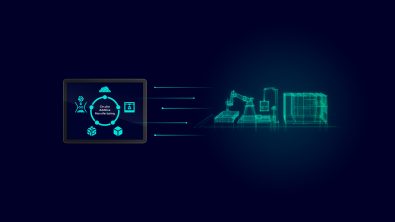
Born on a digital thread: how AI and the Digital Twin redefine additive manufacturing- transcript

Dale Tutt: Obviously we talk a lot about the comprehensive digital twin and how companies are using that to design their parts and manufacture the parts. And one of the attractions I’ve always had about additive manufacturing is that there’s almost a direct transfer from the engineering into the printing process. But when you think about your company, when you think about the comprehensive digital twin, what does that mean in practical terms for your company and how you’re doing your work? And how is it used? How’s a digital twin used at Haddy to support the design operations? You’ve touched on this a little bit, but really what makes it comprehensive?
Jay Rogers: There are so many things that you can learn by hanging out with 3,000 users of Siemens tools. And one of them is the way in which many people think about twinning or the digital twin, the comprehensive digital twin. And what I would say that I’ve learned the most during this last couple of days here at Realize Live is that our product, the products we make, are born on a digital thread. They were meant to be twinned. They don’t suffer from taking things that were analog or had to have a human modeled, all of which can be twinned, and they were made to be made by a robot.
In some senses, it’s unfair because they’re easier to twin. They never got off the twin, so they can just stay on the digital twin. And so in a sense, the digital twin is watching the robot make a physical twin. And that’s kind of fun to think about, but that’s exactly what’s happening. And I’ve realized that there are so many people that don’t have that. So twinning for them is a much more essential endeavor or hard to do, but it needs to be done. Whereas for us, it’s sort of native.
Like it’s almost like, why wouldn’t you? Like you would, because you’ve already decided you’re going to make it digitally. And now that you can simulate and know so many things about the end product, you just want to know when you make it. What are all the inputs you need? How many people would need to be in the factory? How much material would you need to bring in? And what’s your energy requirements? And what is the space requirements that would be needed to move the parts around as you do it? And therefore, how much CapEx are you going to spend on your factory when you stand it up with eight robots or 10 robots? And when can you pay it off? You can know all of those things.
Dale Tutt: Yeah, okay. So sometimes people, I think when they think of the digital twin, they might think of a simulation model or 3D geometry. And I tend to think about it, well, it’s also thermal models and all of the analysis data that you need, structural models, you evaluate the structures. How much does the different aspects of the digital twin, you have a 3D model, but you also have a thermal model. Do you have to do a modeling of the manufacturing process to assess how the final parts are going to turn out as you’re preparing for engineering? I’m sorry, as you’re preparing to go into the manufacturing process?
Jay Rogers: We do. We do. And these are areas that still need to be defined, some of them. For example, there is no incredible model for the thermal definition of a product when it’s being printed out of a new material and with new requirements from a designer who just changed it. Those thermal models still need to be defined and developed. And when they are, then they will be excellent to twin with. Until that time, we may still make some mistakes. And when we make those mistakes, we re-granulate, and then we print again, and we train the thermal model to be better.
Right now we’re doing reinforcement learning on 4 foundational models and geometric deep learning models, thermal models, what I would call anomaly detection, visual anomaly detection generally in that case, and then process improvement models.
Dale Tutt: One of the things that I’ve been thinking about is Some of the additive manufacturing projects that I’ve seen in the past, but they’ve usually been with metal, which I was kind of intrigued when you talked about, well, I’m using polymer, and here’s the advantages of using the composites in the polymer. But I have seen in the past some of these additive manufacturing prototypes in these stories will start to stall. and they don’t see the benefit or they maybe lose interest in it or they, in some of the aerospace industries where they are in, some of the regulated industries, they decide they run into some regulatory walls, seen that a few times.
But what did Haddy have to do in order to, figure out how to move from doing demos into making it repeatable and reliable production? And I think you’ve started to talk about that where you’re talking about the machine learning models and everything, but not to lead the witness here or anything, but how are you moving from demos into production? What are some of the lessons that you guys are learning along the way?
Jay Rogers: Speed you must be fast, and so it’s critically important that you don’t get on the train of printing things perfect and slow, because things that are perfect and slow end up becoming trailer queens they end up becoming things that are just… unusable and people start to look at the thoughts that are going through an engineer’s head are like, oh my god, this is incredible. Look at what I just printed. Oh my god, my boss is never going to let me make it this way because it takes so long. Oh my gosh, I’ve got other things I need to do. And then the printer sits on the shelf.
Those are sort of the things that happen over years when things are going. A number of people that walk into a room with me and they’re just like, okay, when are you going to stop prototyping? But if you are fast and structural, then you never stop prototyping because you never prototyped in the 1st place. So for us, what we do about it is we print fast. What that also means, I could say sort of like in a spicy way, we print ugly, which means that we just don’t go for the surface variety that a small nozzle 3D printer would try to do in approximating a smooth surface, because what we want to do is if it needs to be smooth, we’ll just mill it.
But it’s way faster to put down the material very fast, and it is way more structural to put down the material very fast with a lot of heat than it is to do these really, really thin walls that aren’t structural. So make it fast, make it structural, and if you need to make it smooth, mill it.
Dale Tutt: Yeah, well, and actually, you would say the chairs that I sat in had a nice aesthetic appearance, and it makes a lot more sense to print with 1/4 inch bead than a 40,000 speeds.
Jay Rogers: 100%.
Dale Tutt: It’s going to take you 6 times longer.
Jay Rogers: Yeah, if you’re printing the 40,000s, you’re going to be there all day. And it’s going to take you 6 times longer, 10 times, 20 times longer. For us, there is a form that follows function. And so that means that if you’re printing and people begin to use it and they see it, like you sat in the chairs and they’re really comfortable, they also, those ones have no composite fiber in them so that they rock and they move back and forth. And it’s really comfortable. Yeah.
Dale Tutt: Oh yeah, that was comfortable actually. Yeah, it’s very comfortable. Yeah, we kind of enjoyed it.
Jay Rogers: We think a lot about the process or the enthalpy. We think a lot about the process energy that’s required to make a cubic unit of our material. And we have the lowest process energy of any made material out there using 3D printed polymer composites.
Dale Tutt: Yeah, I could see that. And actually, to build on that, it’s And I don’t know what the current aluminum prices are, but we would pay $5 a pound to buy the aluminum and then we’d recycle it.
Jay Rogers: Well, it’s all blocked off in the Strait of Hormuz right now. I mean, really, legitimately, a lot of aluminum is made in the Gulf, and so it’s gotten more expensive.
Dale Tutt: That is true, but the economics even before that was, you’d pay $5 a pound to buy the billet, and then you’d recycle it $0.20 a pound. The economics are completely upside down on that. But even if you have to do the milling of the part after you’ve machined it, when you’ve printed it, the amount that you’re milling off is probably less than 5 to 10%.
Jay Rogers: You’ve got a near net shape. So you’re making a near net shape. And then the other thing that we’ve done, which is logical, is since it was born digital, we like to keep the physical product, we call it phygital, which basically means that we’ll put an RFID tag on it so that when you tap your phone on it, because we have RFID readers everywhere now because of our phones, you can now find out what robot made it, what material was in it, when it was made, which factory, micro factory it was made in.
And then what it also does is it can report on the back end and just and say, hey, you’ve got 10 pounds, 20 pounds, a million pounds of material in this general area, sold by these four customers, enterprise customers, do a deal to get that material back. Because just like aluminum, the recapture price of this polymer composite is a lot less than the net new price of buying new polymer composites. So we think we can recapture at 80 cents a pound, and we might pay somewhere between $2 and $4 a pound.
Dale Tutt: That’s fascinating. Obviously software is a big part of what you do. Software, the term software-defined automation, software-defined manufacturing, those terms get thrown around a lot and kind of means different things to different companies depending on who you’re talking to. But when your company uses that phrase or similar type phrases, what does it actually mean inside a Haddy and how you do business?
Jay Rogers: We absolutely need to be software-defined product makers from the beginning to the end of the product. We need to be able to virtualize because it is what gets the best efficiency out of the process. And I think when I look at the descriptions on stage, for example, when we were talking about pave today or when we were thinking about some of the other tools that are available, you want to be able to virtualize stuff that doesn’t exist yet. You want to be able to know like when it’s there, how would you use it, and you want to be able to define like what’s its heat out content, how much is it going to weigh all the components that you’re holding on board.
A software-defined system, take like an airplane, in that particular case, like you have structures, aero structures, you have all of the different fluid dynamics problems associated with the multi-physics problems there. Then you have payload considerations and like what’s my powertrain going to be, and then therefore what’s the interfaces with that powertrain, what’s its heat, what’s its fuel requirement, what effect does it have inside the system, vibration, other things like that, sound.
And all those things are software-defined parameters and both the usage of the moving parts in the thing that you’ve printed and the electronics. electronic parts which aren’t necessarily moving, they’re moving electrons. All those things can be software-defined. They can make for a much more laminar process of making things.
Dale Tutt: You know, having come in out of the aerospace industry and actually evaluating products. through simulation, through the digital world, knowing that it might actually work when you’re going to start building it, before you start investing in 10s of millions of dollars of tooling, really was a huge impact for us. And it’s the same thing, I think, when you are looking at your factory, you want to make sure you get it right and print the first time.
Jay Rogers: I also want to note, we make a lot of aircraft using tools, using jigs and fixtures. And when we’re jigging up, we have internal jigs and a wing, they’re called spars, and so they define the shape of the wing. We also have external jigs for forming things, for plates and composites and layups and other things like that. If you’re doing the center fuselage of a 787, you’re filament roving something over a mandrel. And so that’s a tool. And even the machine that makes it is pretty specific.
What I like about 3D printing is it gives you the elasticity, the plasticity, to not have a tool and to change things. If you want to change a wing shape, you can print a new wing next time. And so not waiting to amortize a tool that cost a lot of money. And then the jigs and fixtures. In the aerospace world, there are lots of jigs and fixtures, like wing bending fixtures. Those are football fields long, and they grab all the way down the different parts of the wing. You can print those things. You can print them to the shape of the wing, and that allows you to be able to, and then people don’t know how important that is.
There’s lots of stuff that can be done for the management of aero structures that isn’t just printing the aero structure itself.
Dale Tutt: Yeah, no, I agree. Well, you know, one of the other topics that a lot of people seem to be talking about nowadays is AI and how AI is being used in designing products and building the products, sustaining them. You talked a little bit about the machine learning that you’re applying. Can you elaborate a little bit more on how you’re using AI to design and manufacture your products?
Jay Rogers: We use artificial intelligence throughout our business, and I’ll be really specific about that. We use robots right now, and they break. And the manuals can be voluminous. So we’ll use retrieval augmented generation to train the vocabulary that’s in the manual so that when blows 10 codes, you can actually find out in English or whatever language you speak what’s gone wrong with the robot. That’s using, retrieval augmented generation isn’t in itself training an LLM, but what it is, it’s utilizing the capability of an LLM with a vocabulary that’s been improved. That’s one way we use AI. Then we use AI to train foundational models, which do specific things on polymer composites to help better define the physics of what you’re going to print. That’s really kind of core.
So we’ve designed and built our own harness so that we think of the factory and the sensors at the edge, and they are data collectors. Sometimes they don’t collect data as much as they’ll do the edge analysis and then they’ll send a defect back. But what we’re looking at is we’re looking at what are the things that happened, and then how can we interpolate what was the thing that made it happen, and then how can we do it better in the next print. And so those things from a thermal perspective need to be watched, and from a profile perspective and a visual defect perspective, and all of the optimization that you can make.
We’re training those. And then I think the other thing that’s a little more obvious is once you have those things right, you know how to repair the machines and do it as fast as possible, and you know how to print things that are going to be the most optimized, then you can start to return to the LLMs or the stable diffusion models, and you can say, if you have an idea, you could kick out an STL from that idea, because that already happens today, and it’s sort of like the solid model version of a stable diffusion output. Then you can run that against the physics solver, and you can say, is it printable? Is it not? Even if you could print it, would it hold together or not? And then you could go back and do it again. So, I think in the next two years, famous last words, I think you’re going to be able to speak a physical product onto a robot within like 15 seconds. And then I think that robot’s going to be able to print something really big, and you’re going to be able to have it. And if it didn’t work, you can chop it up and do it again, and it’ll learn.
Dale Tutt: Yeah. Talk about transformational.
Jay Rogers: That is disruptive and transformational.
Dale Tutt: Yeah. I always like it when we work with, Siemens gets to work with companies like yourself that’s really working on, I think, cool stuff in the 1st place. Transformational, it’s changing the way people think about how you manufacture products, how you design products. And I like the focus that you have on sustainability. And so, as you’re working with us, maybe can you talk a little bit about the role that we play in helping you with your design and your automation and the production, so the tools, how you’re using digital twin and the digital tools?
Jay Rogers: I think that’s a really great segue or a question, an answer. It gives me the opportunity to answer something that’s very near and dear to my heart in what we build, and that is that America as an economy has fallen off the manufacturing as a percent of GDP substantially. It’s about 10% now, manufacturing as a percent of gross domestic product, and it has dropped substantially in the last two decades, since 2005. And so that is a huge, has a huge effect on national surge capacity to build things like drug development, or to build things like infrastructure, or to build things for the Department of War, or other things like that.
A lot of people wring their hands and gnash their teeth, and they’re like, how do we catch up? Well, in many ways, if you think about it, we’ve already caught up. And that may sound Pollyanna, but it’s not. We already caught up because we don’t have to go hire a lot of cheap labor to do it again. The robotics are capable of doing many of these processes. And what they take is capital. Well, America has a ton of capital to be able to do those things. But what they’re missing is the chutzpah, I think, to be able to do it. And Siemens provides that chutzpah. That’s what I like. That’s the way that I would put it, is that the robots are there.
Like I said, in 2015, we were already looking for a robot that could be accurate and could be software corrected. We were looking for the R parameters that are already coming out of Sinumeric or out of the PLCs. We were looking for the things that are already there, just putting it together. It’s non-trivial to be able to do it, but it’s there. And the thing I like about it is that Siemens has grown a portfolio, especially in the sort of wake of the demise of General Electric in the U.S. and other things like that. Siemens has grown a foundational set of tools that make it possible for serious manufacturers to be able to deliver on the promise of robotic-based manufacturing.
And the application of AI to that manufacturing, not just LLMs, not just stable diffusion models, but the building of physics-based models, is something that needed the tools that Siemens provides to be able to get there. It’s like a hand in glove relationship and it’s been waiting to happen. It’s like almost like hiding in plain sight. It’s sitting right there. I like to think of companies like Haddy and Haddy as like use case inspirers. Like we have come along and we’re organizing a sales chain to be able to do that. Siemens has lots of other companies that are their customers like PepsiCo and other things like that make, they are use inspired companies that say you want a drink, you want a food, these are the things that we can make with it and we use the best tools to deliver it safely and efficiently and low cost and on time and all that kind of stuff.
And the tools are sitting there in plain sight. You just have to organize them to be able to use them. And we couldn’t do it without Siemens having built those tools, literally, which would be impossible to be able to do it. It’s not that Siemens is our only provider either. Like we couldn’t do it without the polymer composite industry. And that is the composite, the fiber, and the polymer. We couldn’t do it without good power. And sometimes that requires cleaning the power, battery backups, other things like that, sometimes Siemens is in that business. The basic tools on the digital chain, the digital industry software chain, are hiding in plain sight for this kind of use.
Dale Tutt: You know, that’s a really good point. The whole discussion around capitalizing manufacturing in the US is we don’t need to recapitalize how it’s being built elsewhere. Those are the factories of 20 years ago. And so we have the opportunity, as you say, the technology’s on the shelf, whether it’s the digital solutions, the automation devices, the building technology that you would use to build a micro-factory, when I think about how you’re approaching it, it’s a transformative way of putting the pieces together, the systems together that you’re thinking about in a way that’s different than actually can help you go faster and help companies go faster as they stand up new factories.
Jay Rogers: I think that’s totally true. I also want to make a call out to the CEOs and the strategists of these future companies that use these tools. Work your sales team very hard, because the thing is that it’s not just selling. The sales team actually has to interpret the differences that are going to happen in the product. They have to say to the customer, the enterprise customer, specifically, like, you’re not making things the way you used to make them and your government relations folks, like they need to get out there and they need to say, I know that you wanted a certification on this part, but that certification is irrelevant when we’re thinking about things this way.
It can be a fire certification, it can be a structural certification, it could be lots of different things. The certifications were built by the tyranny of the regulated. Tesla went through this. They showed up with their first vehicle and they couldn’t get it into a port because it’s like you couldn’t report how many cylinders were in the engine. Nobody ever thought about a car that didn’t have cylinders in the engine. You couldn’t import the car you couldn’t properly fill out the paperwork. These are maybe not apocryphal stories of the things that happened. They are very real.
I think that what we’ve seen is that regulators only know to ask what they knew might have gone wrong. And in today’s world of digital manufacturing, there’s a whole new world of things that don’t go wrong and new things that do go wrong. That those are the things, the sales team needs to be more aggressive, the government relations team needs to be much better at communicating the things that need to be regulated, and we need to figure out how to build those supply chains to be close by.
Dale Tutt: Yeah, absolutely. No, really good point. Thank you, Jay. Really appreciate your time today. This has been a great discussion, and I have to admit, I learned a lot, and I hope our listeners learned a lot as well. And to our listeners, consider subscribing to the Industry Forward podcast. We’ll talk soon. Thanks.
Jay Rodgers: I hope so too. Thank you.