Scaling assembly simulation: Intelligent geometry management for product-level analysis in Simcenter STAR-CCM+
Ready to simulate at product scale?
For decades, simulation workflows have focused primarily on small assemblies and subsystems, allowing engineers to simplify product complexity before analysis. Today, as simulation becomes a central pillar of product development, organizations increasingly want to evaluate complete products in their true engineering context and understand performance at a system level rather than in isolation.
However, workflows that work well for subsystem-level analysis often break down at product scale. Geometry preparation effort, memory consumption, assembly management, and model quality challenges grow nonlinearly as assembly size increases, creating significant barriers to simulation productivity.
A new scale of complexity
Modern products challenge the limits of traditional CAE workflows. Modern automotive assemblies can exceed 40,000 parts, while rail and marine products may contain 90,000+ components, creating challenges far beyond the capabilities of traditional simulation workflows. At this scale, complexity is no longer defined solely by part count. The effort required to prepare, manage, repair, and maintain simulation-ready geometry can quickly outpace the scalability of traditional workflows.

Assemblies of this scale introduce significant challenges in memory consumption, visualization performance, geometry preparation, and overall workflow efficiency. Addressing these challenges requires technologies specifically designed for product scale simulation.
Traditional geometry preparation workflows were primarily designed for individual components and small assemblies. As assembly sizes grow into tens of thousands of parts, manual geometry preparation, repeated repair operations, and loss of assembly context can become significant barriers to simulation productivity and scalability. What may take hours for a small assembly can become days of repetitive geometry preparation for product scale models.
Product scale assemblies need intelligent assembly management, high-performance visualization, support for collaborative workflows, and the flexibility to represent less critical regions with lightweight convergent models while preserving B-Rep accuracy where it matters most.
While managing model complexity is critical for product scale assemblies, geometry quality can be equally important. Imported assembly data frequently contains open sheet bodies, gaps, and other inconsistencies that require repair before simulation can begin. As assembly size grows, manual correction becomes increasingly time-consuming, highlighting the need for automated geometry preparation workflows. The capabilities discussed later in this blog help streamline this process and reduce manual effort.
Managing complexity with instancing
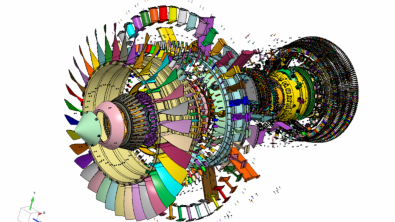
Product scale assemblies often contain thousands of instances of repeated components, such as turbine blades, fasteners, heat exchanger fins, or solder balls in semiconductor packages. Duplicating the geometry for every occurrence can quickly consume memory and degrade performance. Instancing addresses this challenge by storing the geometry only once and reusing it wherever needed throughout the assembly.
The result is dramatically lower memory consumption, faster loading times, improved visualization performance, and the ability to interactively work with assemblies containing tens of thousands of components.
By eliminating duplicate geometry storage, instancing enables engineers to efficiently manage product scale assemblies that would otherwise be impractical because of memory and performance constraints.
For simulation engineers, this means product scale models remain interactive and manageable without sacrificing assembly context.
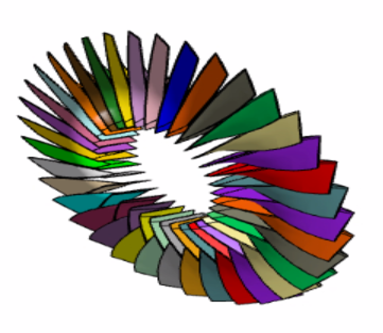
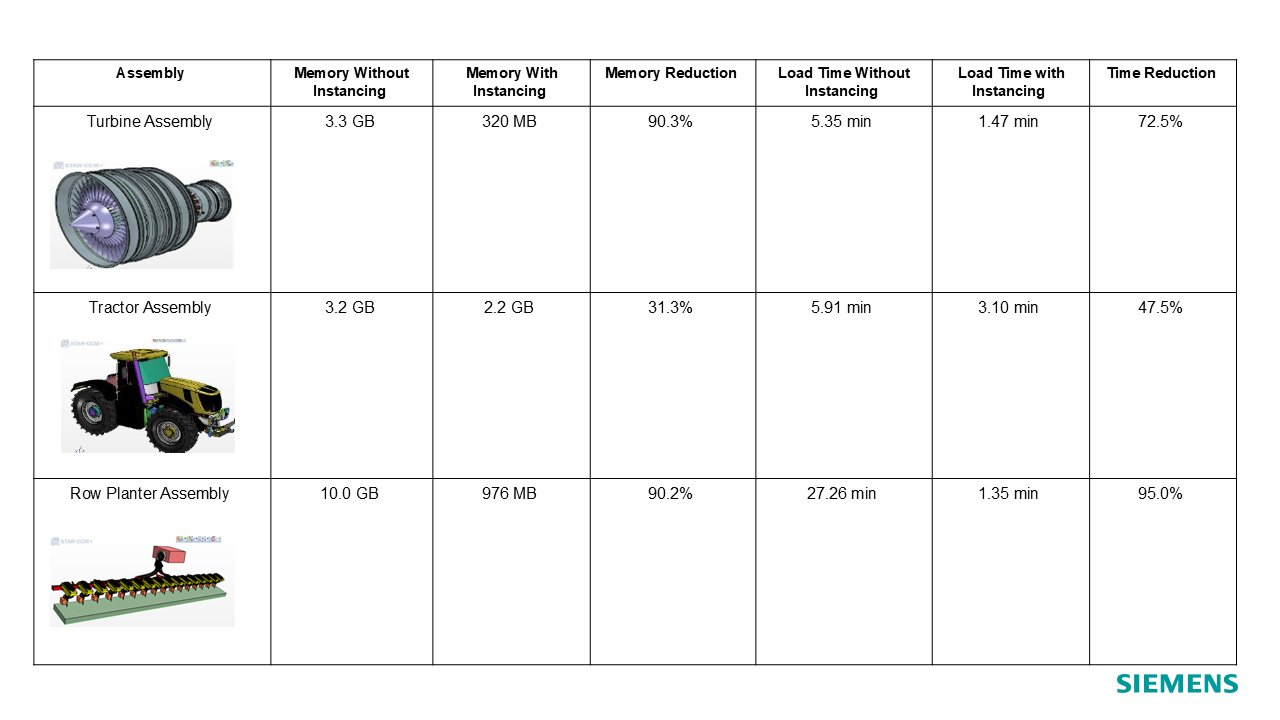
The benefits of instancing scale with both the amount and complexity of repeated geometry within an assembly. Assemblies containing repeated complex components often realize greater memory and performance improvements than assemblies containing large numbers of simple repeated parts, because geometric representation is stored only once and reused across all instances.
In highly repetitive assemblies such as the turbine and row planter assemblies, memory consumption was reduced by more than 90%, while assembly loading times improved by up to 95%. Even assemblies with fewer repeated components benefited from reduced memory footprint and faster loading while preserving complete assembly structure and engineering context.
Case study: Leveraging instancing for scalable geometry repair
Repairing a single component is straightforward. Repairing hundreds of identical instances individually multiplies effort without creating additional engineering value and increases the risk of inconsistencies across the model.
This case study demonstrates how a single exhaust instance in a vehicle assembly can be repaired and the changes propagated across all identical components. The user first de-instances one exhaust component and performs the required geometry repair operations. The repaired body is then used to replace all remaining instances, ensuring consistent geometry throughout the assembly.
For assemblies containing hundreds or thousands of repeated components, instance-aware repair workflows can significantly reduce geometry preparation effort while ensuring consistency across the entire product assembly.
While instancing helps engineers manage assembly size and repetition, geometry quality remains another major barrier to simulation readiness. Imported CAD data often requires geometry repair and closure operations before sheet bodies can be converted into simulation-ready solids. The following case study demonstrates how automated sewing addresses this challenge.
Case study: Converting sheets to solids accelerating simulation readiness through automated sewing
For product scale assemblies, geometry quality issues are rarely isolated. Small gaps, tolerance variations, missing connections, and imperfect model closure can cause many components to be imported as sheet bodies rather than watertight solids. While acceptable for design, sheet bodies create challenges for downstream simulation workflows that rely on watertight solid geometry. As assembly size grows, manually identifying and repairing these issues becomes increasingly time-consuming and error prone. What initially appears to be a complete assembly can quickly become a geometry repair exercise when large numbers of components fail closure requirements needed for simulation.
To bridge this gap, users commonly employ the Sew operation, which not only stitches sheets into solid bodies but also automatically repairs small gaps and tolerance-related defects. This simple yet powerful capability significantly reduces geometry preparation effort and accelerates simulation readiness for complex assemblies.
While automated repair operations help prepare imperfect geometry for simulation, product scale workflows also require efficient ways to identify and target the right components for those operations.
Case study: Metadata-driven selection for automated geometry simplification
Product scale assemblies often contain thousands of parts, making it difficult to manually identify the components that require specific geometry preparation operations. Metadata provides an efficient mechanism for classifying and locating these components across large assemblies.
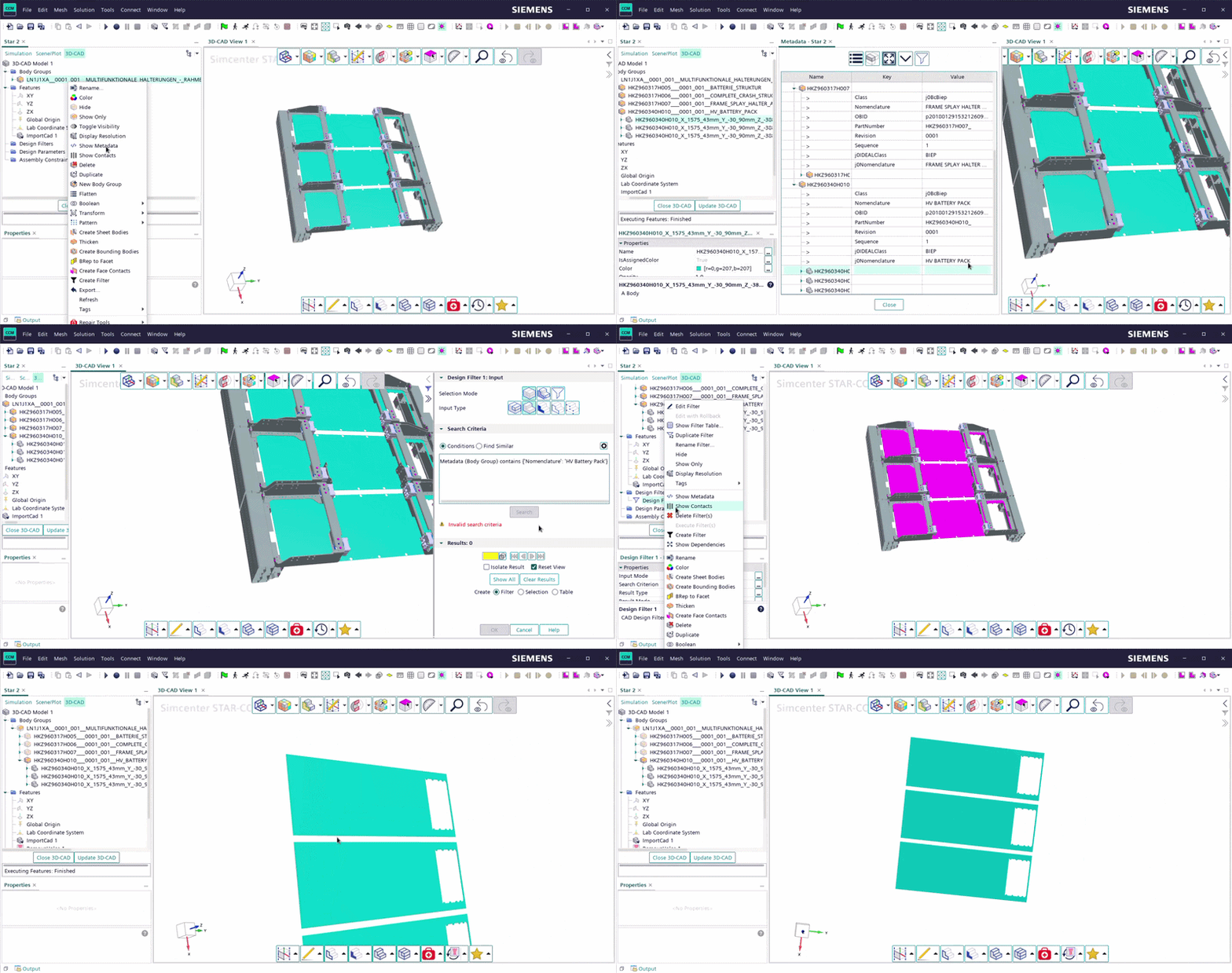
Engineers can use the Metadata Browser to explore metadata attributes, validate part classifications, and quickly identify components of interest within large assemblies. Once the desired criteria have been identified, a Metadata Predicate can create a reusable query that automatically selects matching parts. These query-based selections can then be consumed directly by downstream CAD operations, eliminating the need for manual selection and making workflows more robust to design changes.
In the example shown below, the resulting query is used by the Remove Holes feature to automate defeaturing across a large assembly. This approach enables consistent, repeatable defeaturing workflows across large assemblies while significantly reducing manual model preparation effort. This metadata and query driven approach lays the foundation for future agentic simulation workflows, enabling intelligent agents to autonomously identify, prepare, and configure simulation-ready models.
Beyond metadata-driven and query-based workflows for assembly understanding, Simcenter STAR-CCM+ 2612 introduces AI-based part classification, which automatically identifies, groups, and classifies similar components in product-scale assemblies. Together, AI-driven classification and query-based automation further advance the vision of agentic simulation workflows by enabling intelligent systems to identify, prepare, and configure simulation-ready models with minimal user intervention.
For additional details on AI-based part classification, see the Simcenter blog post:
AI-based part classification: because no engineer wants to sort bolts all day
Hybrid geometry: Precision where it matters
Applying full B-Rep fidelity to every component in a product scale assembly may appear desirable, but it often creates unnecessary computational cost and memory consumption. Much of the assembly contributes little to the engineering question being investigated. As assembly size grows, maintaining high-fidelity geometry everywhere can limit scalability and reduce simulation efficiency.
Rather than maintaining full B-Rep fidelity across every component, simulation engineers increasingly adopt a hybrid approach that balances geometric accuracy with computational efficiency.
- High-value regions are retained as precise B-Rep geometry for accurate geometry preparation and simulation.
- Less critical regions can be represented using convergent models or lightweight tessellated representations to reduce memory and computational overhead while maintaining the overall assembly context.
This hybrid approach allows engineers to focus computational resources on simulation-critical regions while preserving full product context, enabling practical simulation of assemblies that would otherwise be prohibitively large.
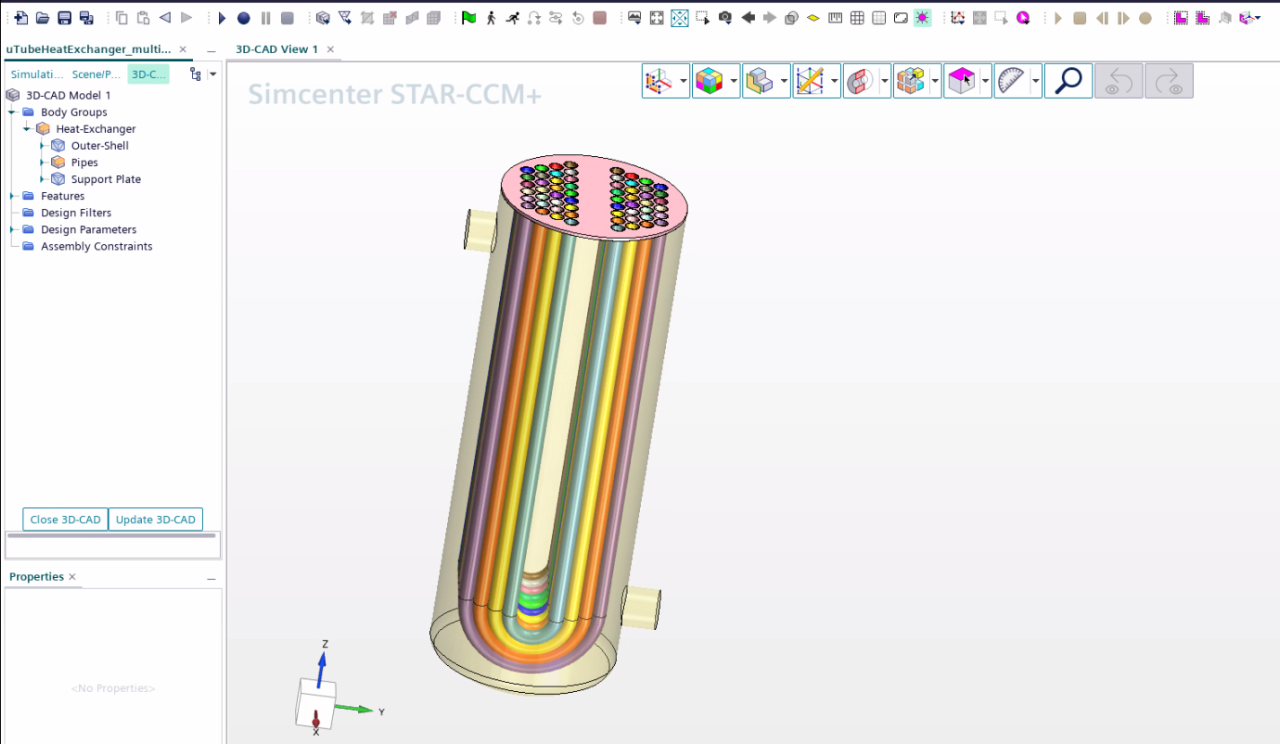
Simcenter STAR-CCM+ embedded geometry preprocessor for product scale assemblies
The preceding examples demonstrate how product scale assembly preparation requires more than efficient geometry representation and visualization. Engineers must be able to manage repeated components, automate geometry repair operations, and intelligently identify the components that participate in downstream workflows. The Simcenter STAR-CCM+ embedded geometry preprocessor brings these capabilities together in a unified environment for scalable and automated simulation preparation, enabling users to work seamlessly with assemblies originating from virtually any CAD system.
With a single integrated environment, simulation engineers can eliminate time-consuming CAD rework, reduce data preparation effort, and maintain engineering context throughout the simulation process. This allows simulation teams to spend less time preparing geometry and more time generating engineering insight.
Key capabilities of the Simcenter STAR-CCM+ geometry preprocessor
Assembly management
- Direct import of product scale assemblies from leading CAD systems, while preserving assembly structure and engineering context.
- Native assembly creation and management within the embedded geometry preprocessor environment.
- Assembly constraints for accurately positioning and aligning components without requiring external CAD tools.
- Instancing for efficient management of repeated components, reducing memory consumption and improving scalability.
- Metadata-aware assembly organization and search, enabling efficient classification, filtering, and identification of components within large assemblies.
Instancing-aware workflows
- Selective de-instancing, giving users the flexibility to convert specific instances into independent geometry when unique modifications are required.
- Pattern and copy operations for efficiently creating repeated structures and assembly features.
- Instancing-aware modelling, enabling efficient creation and management of repeated components while allowing modelling operations on instances.
Simulation preparation
- Instance-aware repair workflows, allowing changes made to a master component to be automatically reflected across all its instances, significantly reducing geometry preparation effort for highly repetitive assemblies.
- Geometry repair and modelling tools that work directly on instanced assemblies, allowing geometry preparation without disrupting assembly relationships.
- Simulation-aware metadata management, supporting metadata-driven component identification, reusable query-based selections, automated region and boundary creation, and streamlined downstream meshing and physics setup workflows.
- Automation and intelligence: Combine query-based selections, metadata-driven rules, and macro-driven automation to streamline repetitive preparation tasks across thousands of components, reducing preparation effort, improving consistency, and laying the groundwork for future agent-assisted simulation workflows.
- A streamlined end-to-end workflow, allowing engineers to move from CAD import to simulation-ready geometry entirely within STAR-CCM+.
As organizations advance toward simulation-led engineering and digital twin initiatives, the ability to efficiently work with product scale assemblies is becoming increasingly important. Accurate digital representations require geometry, metadata, and assembly context to remain connected throughout the simulation workflow.
By combining scalable geometry processing, assembly management, instancing-aware workflows, geometry repair, and metadata propagation and AI based Part classification within a single integrated environment, the Simcenter STAR-CCM+ geometry preprocessor enables engineers to transform complex CAD assemblies into simulation-ready digital representations. The result is a faster, more efficient path from product design data to engineering insight.