AI for AI factories: AI-powered data centers with system digital twins and intelligent control
The next frontier of AI factories is not compute. It’s control.
The AI race is driving an unprecedented explosion in data center power consumption. Direct-to-chip liquid cooling, CDUs (cooling distribution units), chillers, cooling towers, pumps, heat exchangers, and thermal storage systems must work together flawlessly to maintain uptime while minimizing the energy consumption.
At the same time, operators face constant pressure to reduce the PUE (Power Usage Effectiveness), lower operational costs, improve sustainability, and maximize computational output. The challenge is no longer simply cooling the facility. The challenge is to continuously adapt the power to the strongly variable demand of AI racks, with potentially thousands interacting variables
Traditional liquid cooling systems are primarily controlled through PID algorithms that react to thermal changes only after they occur. To guarantee safe operation during extreme conditions, cooling power is typically overprovisioned and sized for worst-case scenarios. This conservative approach leaves valuable power capacity stranded, preventing data centers from maximizing their available compute resources.
Reinforcement Learning (RL) changes the game. By continuously learning and adapting, AI-powered cooling agents dynamically coordinate power distribution across both the cooling and IT systems. Power is safely unlocked to generate tokens rather than being used for cooling margin, so that it could be used to implement more IT hardware capacity instead.
The impact goes well beyond energy savings. Although energy optimization remains a core objective, AI-driven cooling solutions contribute to sustainability goals through lower carbon emissions (CO2). The result is a smarter, more productive, and more sustainable data center.
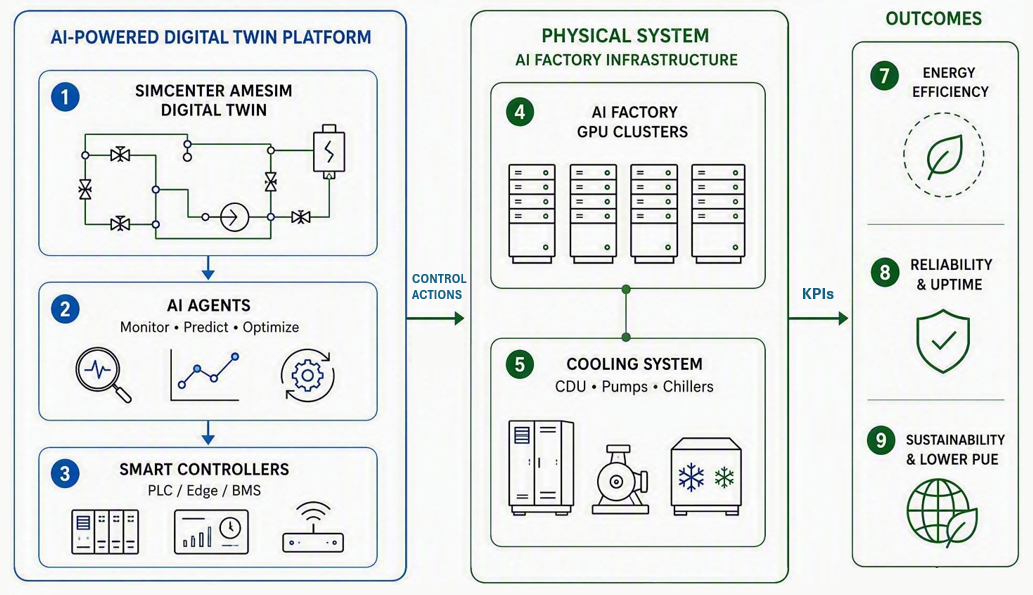
Let’s investigate how it works practically combining successfully two Simcenter tools by Siemens:
▪️ Simcenter Amesim | 🎨⏱️ | Physical digital twin of the Data Center / AI Factory
▪️ Simcenter Studio | 🧠🔮 | Physics-informed AI with Reinforcement Learning to generate optimal controllers
Physics-based agentic AI powered by system simulation
By combining Simcenter Amesim for high-fidelity digital twins with Simcenter Studio for Reinforcement Learning-based optimal controls, operators can move beyond traditional automation and into a new era of autonomous, self-optimizing operations.
Most cooling systems today still rely on predefined rules, schedules, and PID controllers. While effective for stable operating conditions, they struggle when faced with rapid AI workload fluctuations or multiple interacting cooling loops.
A modern AI data center can contain thousands of sensors and dozens of controllable assets. Every decision impacts multiple KPIs (key performance indicators) simultaneously like the cooling efficiency, the PUE, the energy consumption or the water consumption. While traditional controls operate locally, the AI factories require optimization globally.

Before AI can optimize a facility, it must understand it. This is the role of the Simcenter Amesim digital twin with system simulation. Simcenter Amesim creates a physics-based representation of the complete cooling ecosystem, including direct-to-chip liquid cooling (D2C), cooling distribution units (CDUs), chillers, pumps, heat exchangers and controls.
Because the model is multiphysics, it captures the dynamic interactions between thermal, hydraulic, electrical and control systems under realistic transient conditions. You can then use it for Virtual Commissioning as a virtual lab to investigate a Software-In-the-Loop setup.

Unlike spreadsheets or static calculations, engineers can simulate:
- Changing GPU workloads
- Control concepts in normal and failure conditions
- Different working modes, in normal and emergency conditions
- Future capacity expansions
- Seasonal weather variations
Long before the physical facility exists.
The result is a virtual AI factory where engineers can safely explore opportunities worth millions of dollars before making real-world decisions.
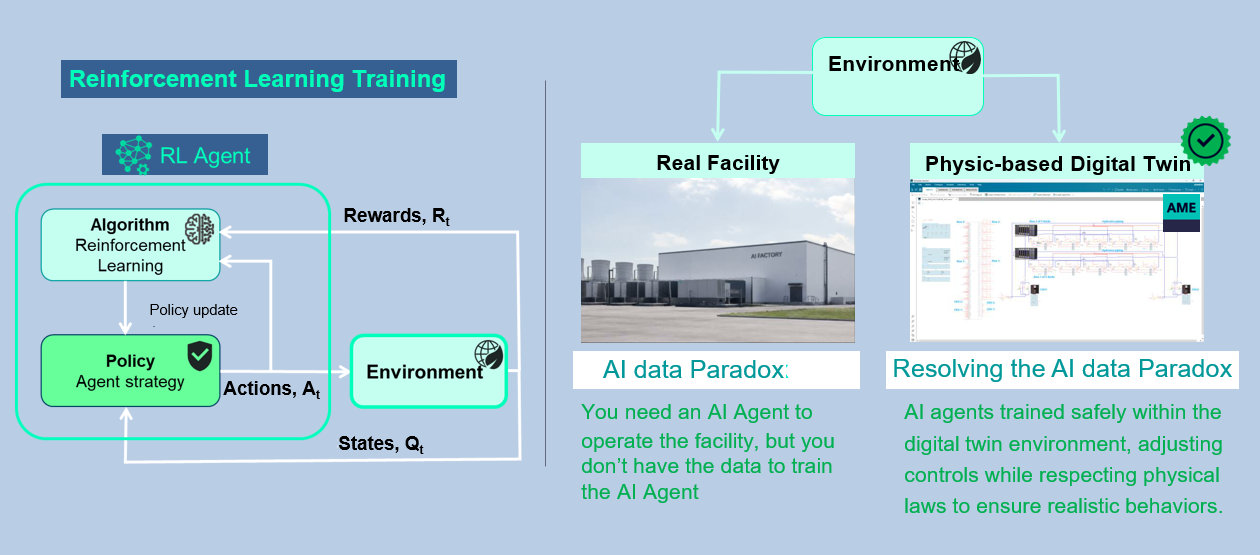
The AI data paradox
Many companies are excited about applying AI to optimize industrial facilities. However, they quickly encounter a fundamental problem. To create a good AI-based controller, you need operational data. But to obtain operational data, the controller must already be running. Siemens refers to this challenge as the AI Data Paradox.
In mission-critical AI facilities, nobody wants an experimental algorithm learning through trial and error on infrastructure worth hundreds of millions of dollars. A single mistake could impact cooling performance, energy costs, or uptime.

The safest and smartest solution is to train the AI agent with a reliable predictive digital twin. Once the cooling infrastructure has been modeled in Simcenter Amesim, the digital twin becomes the training environment for AI.
Training the optimal controller with Reinforcement Learning
Using Simcenter Studio, engineers can develop Reinforcement Learning agents that learn how to optimize the data center automatically. “Reinforcement Learning is a type of Machine Learning in which agents take actions in an environment aimed at maximizing their cumulative rewards” (NVIDIA).
Instead of manually programming thousands of rules, engineers simply define objectives such as:
- Minimize PUE
- Reduce energy consumption
- Maintain safe temperatures
- Reduce water usage
- Maximize cooling efficiency
- Protect mission-critical hardware
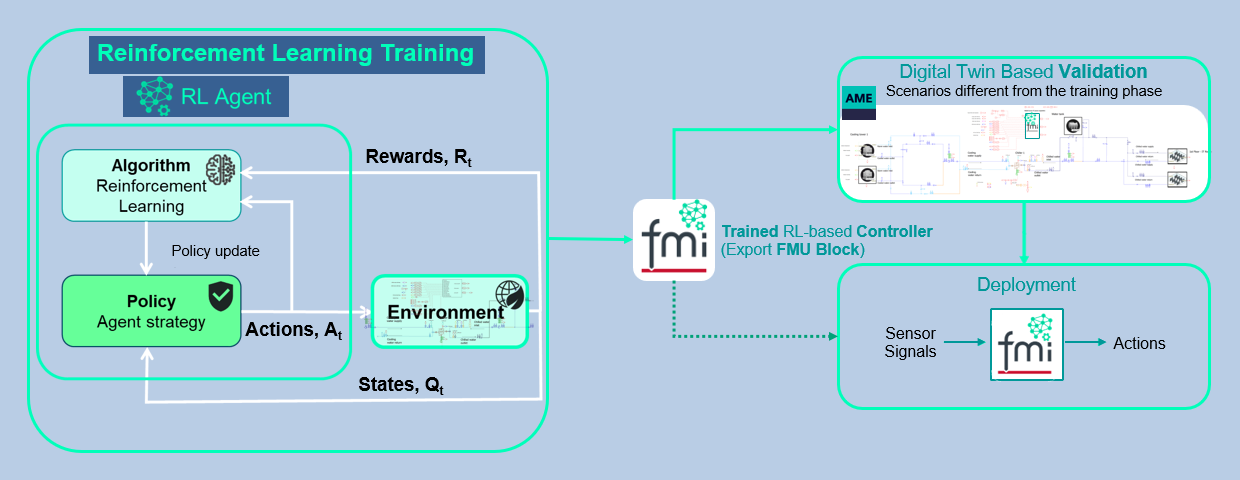
The AI agent then performs millions of virtual experiments inside the Simcenter Amesim digital twin. It continuously learns which pumps to adjust, which compressors to accelerate, how setpoints should evolve, how to react to changing workloads while meeting the defined targets.
Most importantly, every learning cycle remains constrained by real engineering physics and operating conditions. This is not AI guessing. This is AI learning from a realistic representation of the physical world.
Better than AI alone: physics-informed agentic AI
The market is increasingly discussing concepts such as Agentic AI, Autonomous Operations, Industrial AI Agents, AI Co-Pilots or Self-Optimizing Facilities. We have investigated the implementation of a RL-based controller for a Data Center cooled by CRAHs (Computer Room Air Handlers). This example is taken for illustration since it has no IP related data.
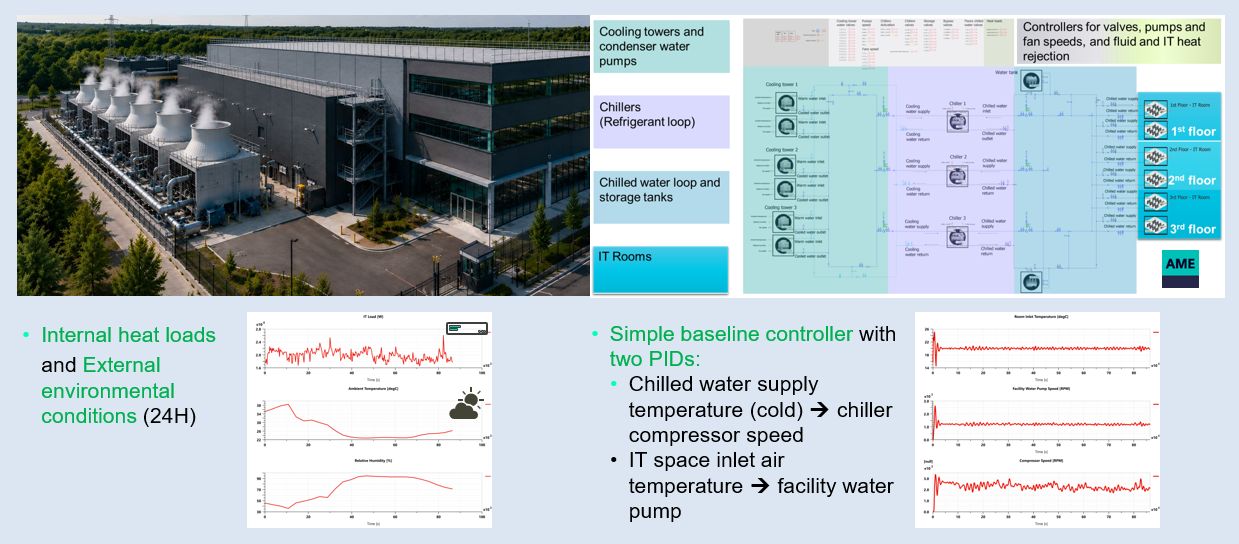
The Reinforcement Learning agent in Simcenter Studio is trained by a Simcenter Amesim simulation model (i.e. digital twin) with 2x IT rooms (1 floor), 1x chiller and 2x evaporative cooling towers.
We can observe that the Reinforcement Learning agents can continuously optimize such industrial facilities and deliver significant energy savings through autonomous control. Siemens with such a Physics-based learning approach adds a critical layer that dramatically accelerates and de-risks the data center build. Let’s deeper inside to better understand how it works.
Physics-based learning
Rather than relying exclusively on operational data, agents can learn inside a high-fidelity Simcenter Amesim digital twin before deployment.

This allows faster agent development, a reduced deployment risk, a safe exploration of rare operating scenarios, the validation under extreme conditions. To finally get an improved trust in your system with its final controller behavior.
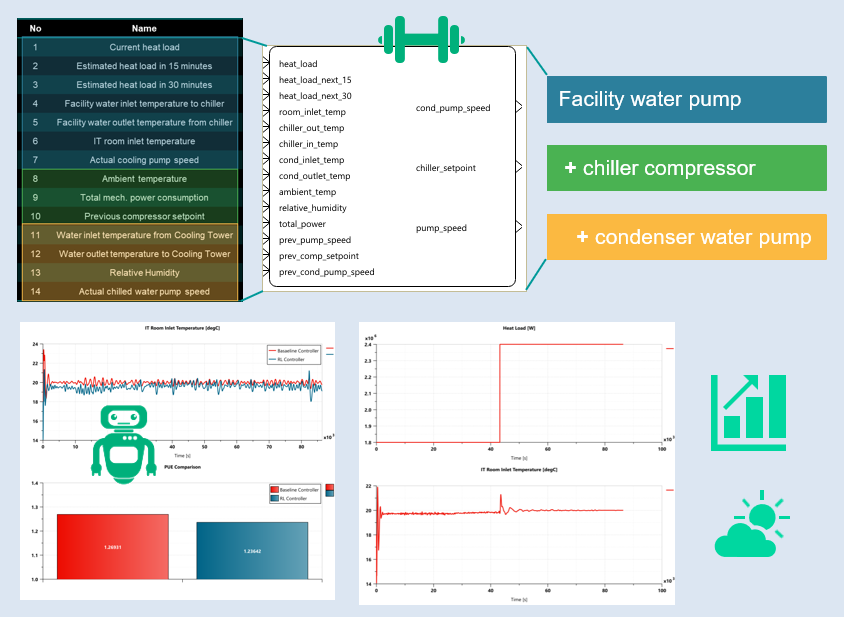
Selecting the appropriate inputs for the selected actuators leads to better PUE values. Also the RL agent is trained with different environmental variabilities: winter, summer and very wet summer. Finally the RL-based controller can keep the targeted IT room temperature range with better PUE. The RL controller is able to keep the temperature within the boundaries, even with a sudden step of the heat load. While we can imagine performing further optimization to reduce the small oscillations.
The result is what could be called: Physics-Informed Agentic AI. It’s an intelligent agent that combines some AI learning capabilities with an engineering knowledge, thanks to System Simulation digital twins, to continuously optimize the facility operations.
Unlocking millions of dollars in operational value
Let’s estimate roughly the economics of AI-driven cooling. For hyperscale AI facilities, even small improvements in cooling efficiency can create surprisingly large financial impacts. The reason is simple: cooling systems operate 24/7 and often represent 20% to 40% of the total facility energy consumption, depending on the cooling architecture and climate. As AI workloads continue increasing rack power densities, cooling becomes one of the largest operational expenses of the entire data center.
Assumptions (illustrative only):
- AI data center IT load: 100 MW
- Annual operation: 8,760 hours
- Baseline PUE: 1.25
- Electricity price: $0.08 per kWh
- Cooling optimization achieved through AI-driven controls: 2% to 5% reduction in cooling energy consumption
- Thermal constraints fully respected through digital-twin validation
Baseline annual energy cost
Total facility power: 100 MW × 1.25 = 125 MW
Annual energy consumption: 125 MW × 8,760 h = 1.095 TWh
Annual electricity cost: 1.095 billion kWh × $0.08 ≈ $87.6 million/year
Potential savings
| Cooling energy reduction | Annual electricity savings |
| 2% | ~$1.8M/year |
| 3% | ~$2.6M/year |
| 5% | ~$4.4M/year |
For a 500 MW AI campus, which is increasingly common among next-generation AI factory projects, equivalent savings could exceed $10M to $20M annually, depending on energy prices and cooling architecture.
The key point is not a specific percentage. The key point is that a Reinforcement Learning agent never gets tired, never stops optimizing, and continuously evaluates operating decisions across thousands of variables that would be impossible for a human operator or traditional PID loops to manage manually.
Indeed the Reinforcement Learning agent is first pre-trained in a virtual environment using a data center digital twin, reducing deployment risk. It can then be refined using real operational data to adapt to evolving conditions and account for differences between physical assets through fingerprinting.
The end vision: autonomous AI factories
The future AI Data Center will not be managed through static setpoints. It will operate through continuously learning AI agents.

We can easily imagine a cooling system that automatically predicts thermal demand hours ahead, coordinates chillers, pumps and cooling towers, continuously learns from operational feedback and maintains uptime without constant human intervention This is the promise of Agentic AI. And the fastest path to achieving it starts with physics-based simulation.
Bringing together the best of simulation and AI
The winning strategy for next-generation AI factories is not simulation alone. And it is not AI alone. It is the combination of both.
Simcenter Amesim provides the engineering truth through a high-fidelity System Simulation digital twin of the cooling infrastructure.
Simcenter Studio provides Reinforcement Learning technology capable of discovering optimal control strategies automatically.
Together they create a powerful framework for:
- Commission faster and safely : Verify controls before deployment.
- Operate autonomously : Deploy AI-powered optimal controllers.
- Enable agentic AI : Create self-optimizing AI factories powered by physics-informed intelligence.
The future of AI infrastructure will not simply be digital. It will be autonomous, intelligent, and simulation-driven. And the journey starts with Simcenter Amesim and Simcenter Studio.
All this great work was completed by Simcenter Engineering Services.
Learn more about Simcenter Amesim
Simcenter Amesim is the leading integrated, scalable system simulation platform, allowing system simulation engineers to virtually assess and optimize the performance of mechatronic systems.