From Apollo to Artemis: How the digital twin is accelerating lunar rover development

This article from our guest blogger, Maya HTT explains how aerospace engineers and mission planners use integrated digital twin simulation to accelerate lunar rover development by enabling multidisciplinary thermal, structural, and thermo-mechanical analysis before hardware is built.
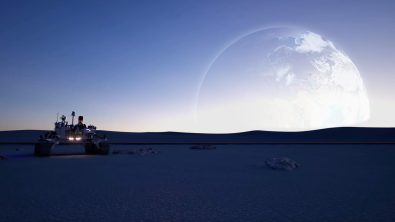
As the anniversary of the first Moon landing approaches, humanity is entering a new era of lunar exploration. Unlike the Apollo Program, today’s missions are no longer driven exclusively by government agencies. National space organizations, commercial launch providers, robotics companies, and emerging space startups are collectively building the technologies that will enable a sustained human and robotic presence on the Moon.
This renewed ambition brings new engineering challenges. Lunar systems must survive launch, landing and years of operation in one of the harshest environments encountered by any engineered product. Success depends on making informed design decisions early, before hardware is built. That is why simulation and the digital twin have become essential components of modern spacecraft development.
A digital twin for lunar mobility
Developing a lunar rover requires close collaboration between mechanical designers, thermal engineers, structural analysts, electronics specialists and systems engineers. Working in disconnected tools often results in duplicated effort, model translation errors and lengthy update cycles.
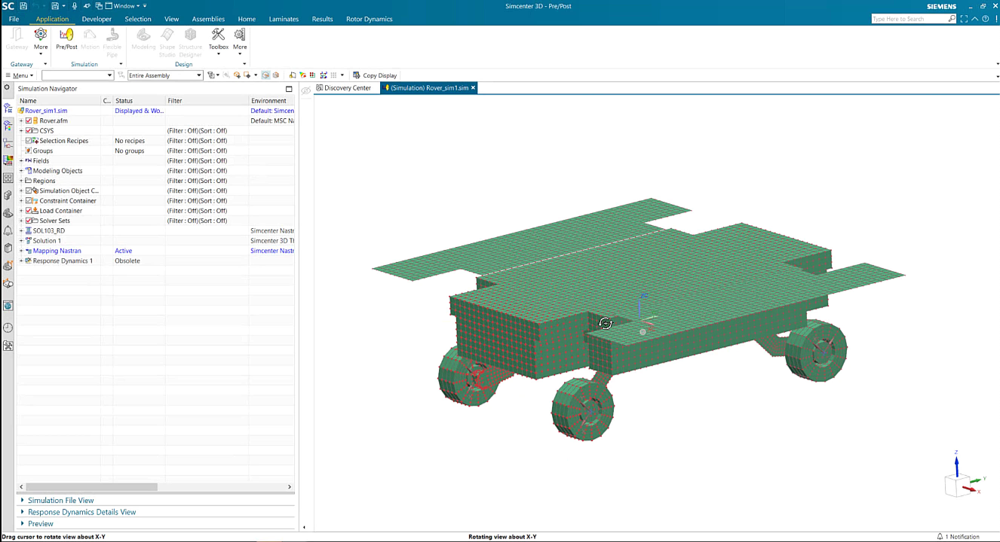
Simcenter software addresses this challenge through an integrated digital engineering environment where multiple physics disciplines share a common product definition. Starting from a single CAD assembly, engineers generate discipline-specific simulation models while maintaining associativity with the original design. As the design evolves, meshes, boundary conditions and analysis models update automatically, dramatically reducing manual rework.

Engineering for the lunar environment
The lunar environment combines severe dynamic and thermal loading. During launch, the rover experiences random vibration and acoustic loading generated by the launch vehicle. Following touchdown, it must operate through approximately fourteen Earth days of continuous sunlight, followed by fourteen days of darkness. Temperatures can exceed +120 °C during the day and fall below −170 °C at night.
These conditions affect batteries, electronics, mechanisms, materials and structural integrity simultaneously. Consequently, structural, thermal and thermo-mechanical analyses must be considered together rather than independently.
Verifying launch survival
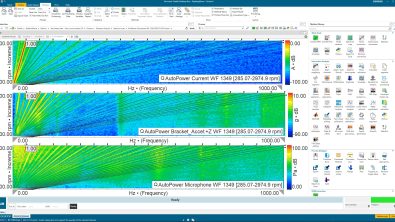
Random vibration analysis verifies that the rover can withstand launch environments before qualification testing. Using Power Spectral Density (PSD) inputs representative of launch conditions, Simcenter Response Dynamics computes modal responses, peak stresses, displacements, PSD curves and margins of safety. Engineers can quickly identify critical locations and evaluate design alternatives while benefiting from solver technology optimized for large aerospace models.
Thermal simulation across an entire lunar day
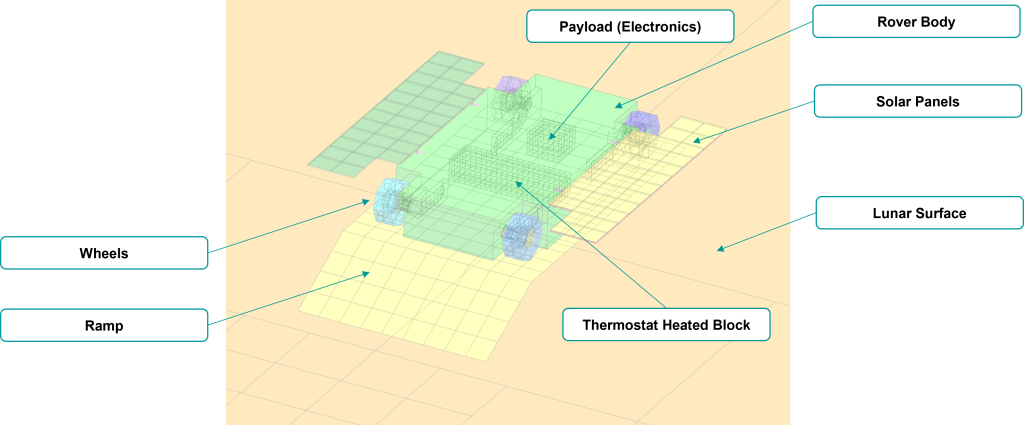
Simcenter 3D Space Systems Thermal models the complete thermal behavior of the rover throughout the mission. Dedicated capabilities for space applications, such as solar heating, planetary radiation, articulating mechanisms and advanced radiation analysis, allow engineers to reproduce realistic operational scenarios.
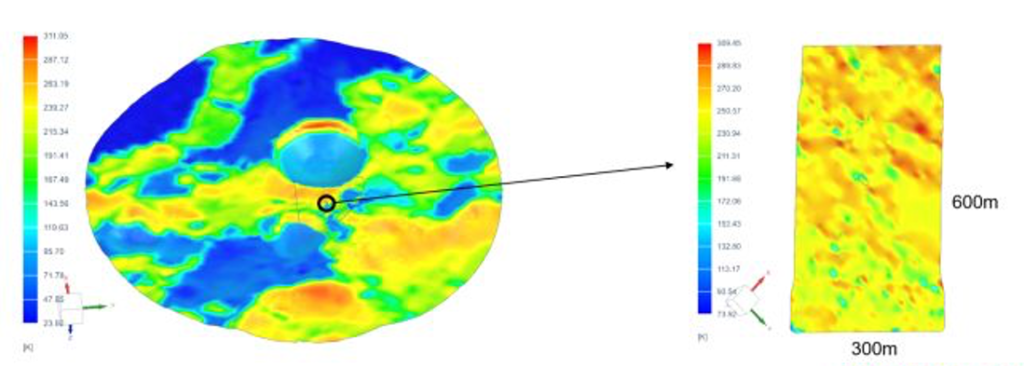
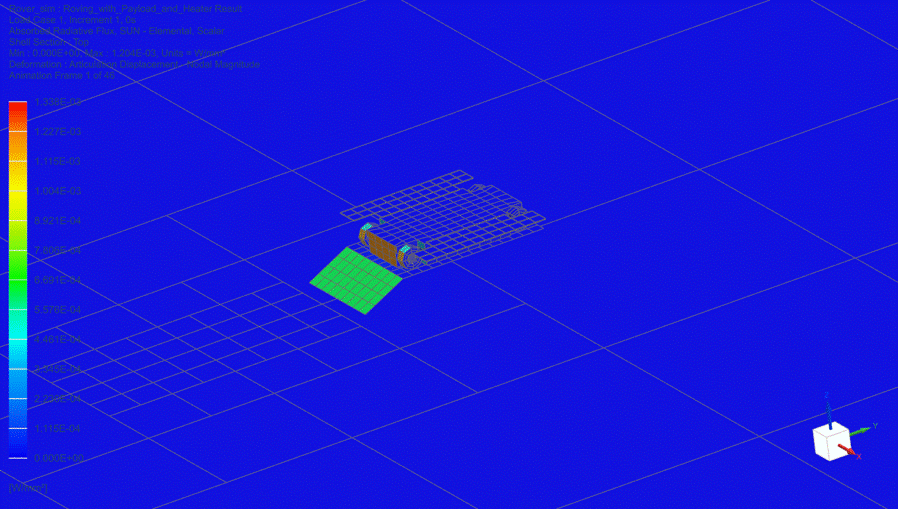
The model includes wheel deployment, rover motion away from the lander, multiple landing latitudes, thermostat-controlled heaters and expression-driven payload activation once sufficient solar energy has been collected. These operational behaviors are evaluated directly within the simulation rather than through external scripting.
From temperature prediction to mission decisions
Thermal simulation is valuable not only for predicting temperatures but also for informing mission operations. Engineers can monitor accumulated solar energy, heater duty cycles, battery usage and absorbed solar flux while verifying that critical hardware remains within allowable limits. Such information supports both hardware design and operational planning.
Closing the loop with thermo-mechanical analysis
Thermal results can be automatically mapped onto structural finite element models, even when the thermal and structural meshes differ. Engineers can therefore evaluate thermal stresses and deformation alongside mechanical loading without rebuilding analysis models. This integrated workflow enables rapid iteration while maintaining confidence in the results.
Why integration matters
Perhaps the greatest advantage of an integrated simulation environment is the reduction in engineering effort. Instead of maintaining separate CAD, thermal and structural models, engineers work from a common digital twin. Design modifications propagate automatically, allowing teams to spend more time evaluating performance and less time recreating models.
As commercial lunar exploration accelerates under initiatives such as Artemis, shorter schedules and increased mission complexity make this level of integration increasingly valuable.
Looking beyond the first moon landing
The Apollo program proved that humans could reach the Moon. Today’s challenge is building systems capable of operating there repeatedly, economically and reliably. The digital twin and multidisciplinary simulation provide the confidence needed to meet that challenge, enabling engineers to validate designs virtually before committing to hardware.
Whether developing robotic explorers, scientific payloads or future lunar infrastructure, integrated simulation is becoming a cornerstone of modern space engineering.
Author’s note
This article is adapted from a Realize LIVE presentation by Adam Martin of Maya HTT demonstrating multidisciplinary lunar rover analysis using Simcenter 3D, Simcenter Space Systems Thermal, Response Dynamics and Simcenter Nastran.
Spacecraft Thermal Simulation – Where would you park your best spacecraft?
Read more about how Simcenter Space Systems Thermal is used to determine the Goldilocks zone via thermal simulation, to land a spacecraft on the perfect spot on the moon.