Stop over-engineering! Transform your test bench measurements into immersive virtual driving experiences
Automotive NVH engineers often struggle to determine whether a component improvement will make a meaningful difference once vehicle background noise is taken into account. Siemens has developed an automated workflow that transforms component NVH test bench measurements into immersive virtual driving experiences by combining automated component characterization, virtual prediction and realistic NVH simulation and engineering. This enables engineers to immediately evaluate the impact of design changes in realistic driving conditions and make confident decisions without relying on physical vehicle prototypes.
Imagine this: you just spent a few days measuring a new component design on your NVH test bench. The results show that the new design is 2 dB (A) quieter than the previous design. Great!
Except… Is that enough? Will the driver still notice your component in the vehicle, or will it be completely masked by tire-road and wind noise in typical driving conditions? If not, where and how much should you further improve the design?
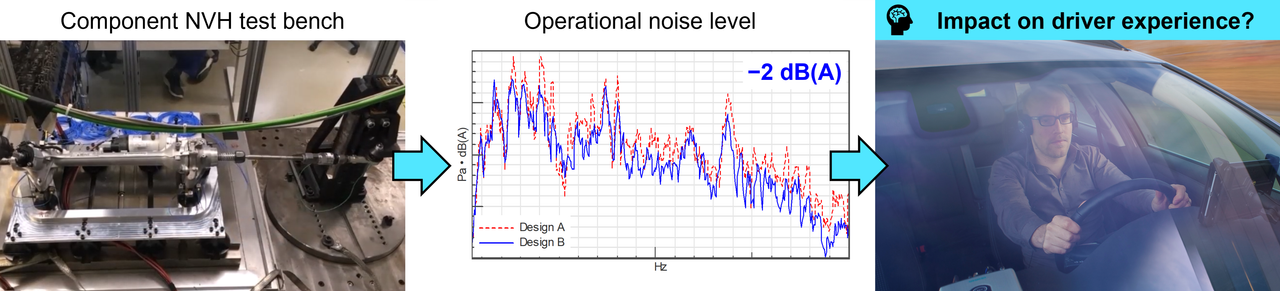
These questions are daily headaches for automotive NVH engineers in the era of electrification. Without the acoustic masking of an internal combustion engine, auxiliary components such as steering racks, compressors, and wiper systems are being exposed as prime sources of cabin annoyance. How should NVH engineers approach integrating such problematic components?
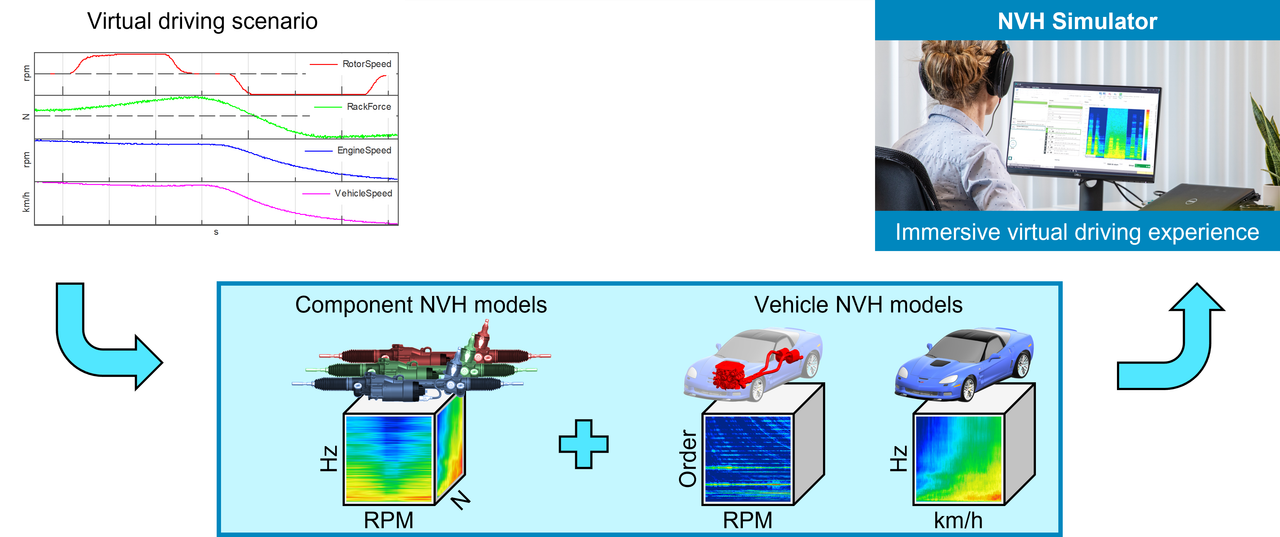
The current trend is that physical vehicle prototypes are no longer available until the final stages of development (if ever), so direct validation measurements are not an option. Instead, the answer lies in building virtual vehicle prototypes in which components are characterized by invariant quantities (blocked forces, Frequency Response Functions (FRFs)) and then mathematically combined using dynamic substructuring techniques to predict their in-vehicle NVH performance without physical assembly. These prediction results can then be combined with other noise sources in an NVH simulator to evaluate NVH performance under realistic driving conditions.
At the recent ISMA 2026 conference, Siemens presented a state-of-the-art automated workflow that industrializes this process, delivering efficient and reliable results1. First, an automated component characterization in terms of ISO-compliant blocked forces and interface FRFs is performed directly on an NVH test bench using a new solution called Automated component model extraction (AutoCMX). These invariant component models are then used to build virtual vehicle prototypes and predict their NVH performance using Simcenter Testlab Virtual Prototype Assembly (VPA). Finally, the predicted NVH performance is evaluated in a realistic full-vehicle context using the Simcenter Testlab NVH Simulator.

As a result, NVH engineers can validate component design changes in realistic driving conditions immediately after a component NVH test bench measurement. No more waiting for a physical vehicle prototype that may never arrive!
Curious to learn more? Let me take you through the workflow step by step.
Automated component model extraction
ISO 20270 describes a standardized workflow for in situ characterization of blocked forces on a test bench or vehicle receiver. This workflow has been successfully applied for a wide range of automotive components, but remains cumbersome to apply at an industrial scale due to three main bottlenecks:
- Even experienced users typically need 3–5 days to measure and process a single component
- Only trained engineers can interpret and act on the multitude of required quality metrics
- Manual execution introduces an operator-dependent level of uncertainty due to human error
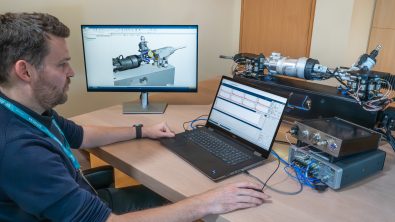
Siemens has joined forces with Bosch to develop an integrated hardware-and-software solution that completely eliminates these bottlenecks: Automated component model extraction (AutoCMX). AutoCMX replaces the conventional manual execution of ISO 20270 with a fully automated workflow:
- The component is mounted to a self-measuring fixture that is permanently equipped with all shakers and accelerometers for ISO 20270 and integrated into a standard NVH test bench
- An automated FRF measurement routine is executed by sequentially exciting at each shaker position
- Operational vibrations are measured while running the component using the standard NVH test bench
- The resulting dataset is automatically processed into blocked forces and interface FRFs in 6 Degrees of Freedom (DOFs) at each connection interface
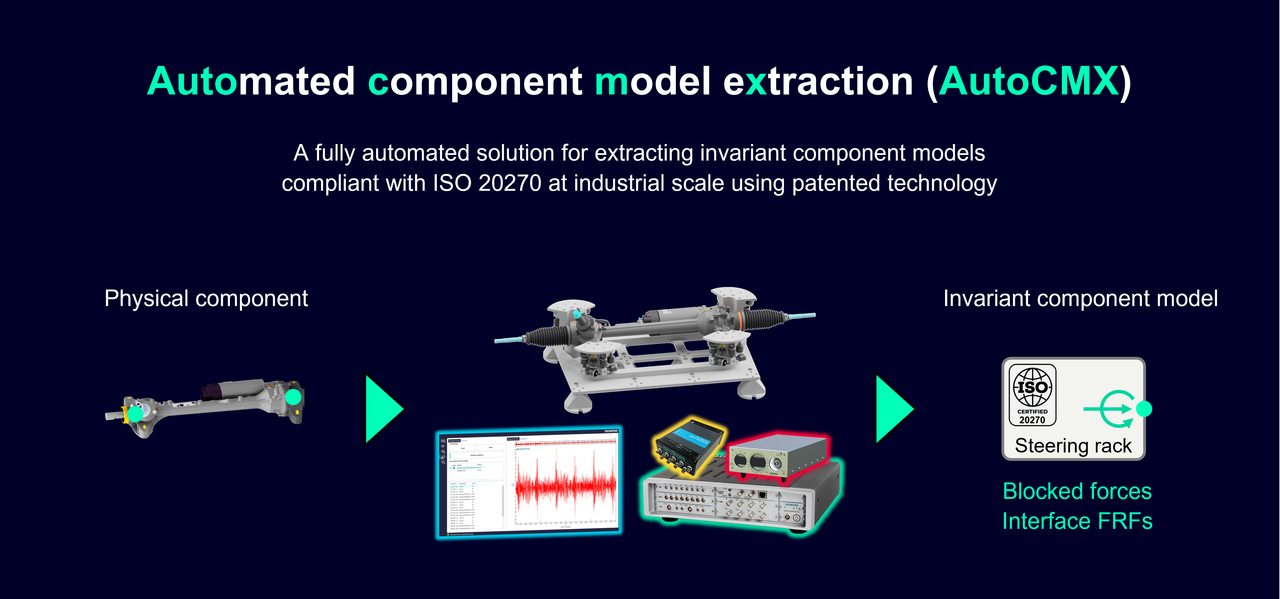
AutoCMX enables any operator to obtain ISO-compliant invariant component models with 100% repeatability and a proven 93% reduction in time compared to conventional roving impact testing2.
Immersive auralization in a full vehicle context
Measuring invariant component models is only the starting point. Now these models need to be translated into predicted full-vehicle NVH performance. This is where Simcenter Testlab Virtual Prototype Assembly (VPA) comes into play.
In VPA, virtual vehicle prototypes are assembled by mathematically coupling invariant source and receiver component models using Frequency-based Substructuring (FBS). In this case, the source component models are provided by AutoCMX, and the receiver component models contain FRF data either measured on a benchmark/prototype vehicle or simulated using a vehicle Finite Element (FE) model. The NVH performance of the resulting virtual vehicle prototype can then be predicted at any full vehicle NVH target (e.g., driver’s ear sound pressure) for any operating condition of the source component.

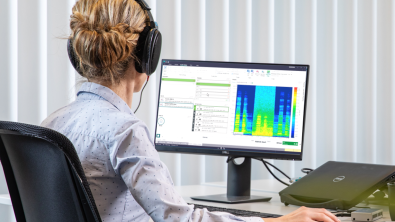
The next step is to place the predicted NVH performance in a realistic full-vehicle context to enable confident design decisions towards the final product. Simcenter Testlab NVH Simulator completes the workflow by adding real-time synthesis of NVH performance from multiple simultaneous noise sources in any virtual driving scenario.
In the NVH Simulator, the predicted NVH performance from AutoCMX is overlaid with NVH models representing the vehicle background noise from road, wind, and powertrain contributions. A simple method to obtain such NVH models uses top-down decomposition of operational measurements with a benchmark vehicle.
Case study: electric power steering system variants
To put our automated workflow to the test, we evaluated three variants of an electric power steering (EPS) system: a baseline design (EPS A), a refined design (EPS B), and a faulty design (EPS F). Each EPS variant was characterized using AutoCMX, assembled into a virtual vehicle prototype, and layered with a realistic full-vehicle context using a background noise model measured on a benchmark vehicle.
The real-time NVH performance synthesis was then repeated for each EPS variant using a virtual driving scenario representing a roundabout entry maneuver. First, the steering noise was auralized in isolation, then the full vehicle context was added to judge the acoustic masking effect of the background noise.
This comparison confirms that the refined design performs better than the baseline design, but the differences are greatly exaggerated when considering only the isolated steering noise. In realistic driving conditions, much of the spectral content is actually masked by the vehicle background noise.
This conclusion is further supported by post-processing the synthesized NVH performance into sound quality metrics using Simcenter Testlab Process Designer. Such metrics allow NVH engineers to objectively quantify the subjective differences between the EPS variants.
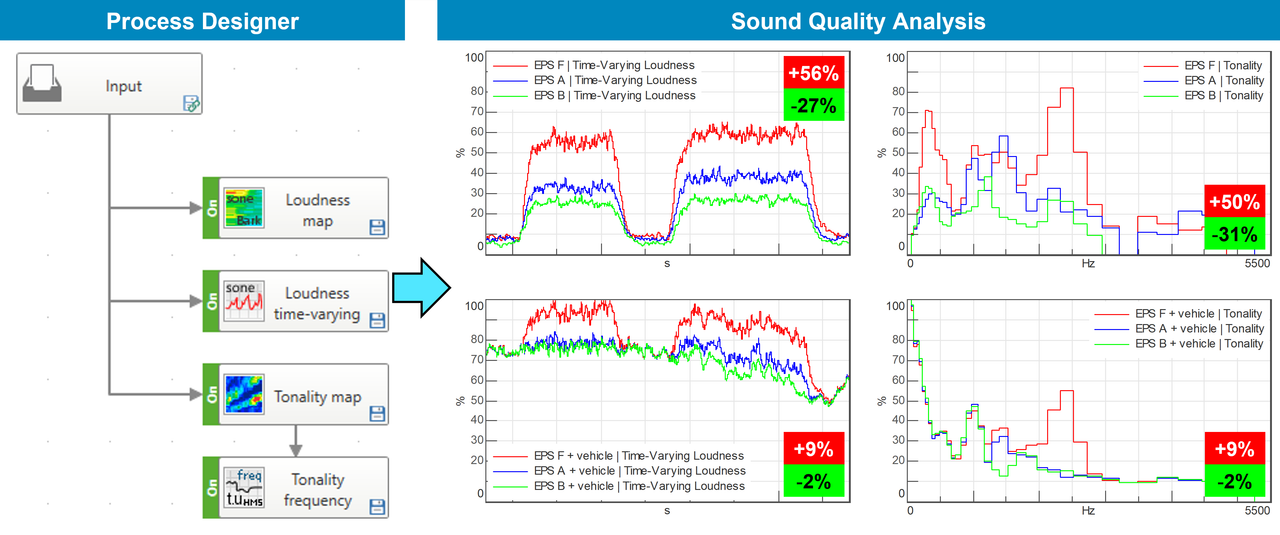
With this information in hand, NVH engineers can see exactly how much further a component needs to be developed before it risks being over-engineered.
Conclusions
Siemens has developed an automated workflow that efficiently transforms component NVH test bench measurements into immersive virtual driving experiences. This workflow enables NVH engineers to immediately evaluate the impact of a component design change on the final vehicle in realistic driving conditions and make confident design decisions without depending on scarce physical prototypes.
Looking for more details? Read our full papers, which will be made available in the conference proceedings below. Or, check out our solution guide for a comprehensive overview of Siemens’ solution offering for Transfer Path Analysis.
- E. Sorber, M. Brandstetter, K. Wienen, M. Sturm, “Automated blocked force characterization for contextually realistic auralization of component variants in virtual vehicle prototypes”, in: Proceedings of the 32nd International Conference on Noise and Vibration Engineering (ISMA), 2026. ↩︎
- M. Sturm, K. Wienen, M. Brandstetter, E. Sorber, et al., “Automating Component NVH Characterization: A Systematic Approach for Component Test Bench Characterization”, in: Proceedings of the 14th International Styrian Noise, Vibration & Harshness Congress (ISNVH), 2026. ↩︎
Explore Simcenter physical testing resources below: