Redefining the backbone: How body engineering becomes the structural intelligence layer for faster, more confident decisions

In the traditional automotive world, a three-year development cycle was considered a luxury. Engineers had the “breathing room” to iterate, test, and refine. But today, that luxury has evaporated. We are now living in the era of the 24-month baseline.
For the body engineering team, this isn’t just about working faster; it’s about working differently. The body-in-white (BIW) is the structural foundation of the vehicle. It dictates safety, NVH (Noise, Vibration and Harshness), weight, and ultimately, the car’s sustainability footprint. When you cut a year off the schedule, you can’t afford a single guess. You need a digital thread that connects every decision back to the original target.
To explore what this shift means in practice, we spoke with three experts who bring complementary perspectives to the discussion: Steven Dom, Simcenter Automotive Director, on the broader automotive transformation; Pierre-Edouard Rousseau, Global Manager Simcenter C123, on the technical challenges and trade-offs behind modern vehicle structures; and Theo Geluk, Siemens Engineering Services Expert, on how teams can translate these methods into scalable, real-world engineering workflows.
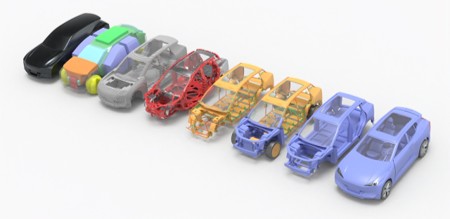
Want to hear this discussion in action?
Watch the live webinar “Redefine body engineering excellence” where Steven Dom and Pierre-Edouard Rousseau dive deeper into these strategies and answer live questions from the automotive community.
What is body engineering really about?
To frame the broader industry shift, Steven Dom, Simcenter Automotive Director, describes body engineering as one of the most critical integration challenges in vehicle development. The body is where many of the vehicle’s most important attributes come together – safety, stiffness, NVH, weight, cost, manufacturability, and sustainability.
At its core, body engineering is the discipline of managing trade-offs between competing requirements:
- Weight vs. safety: How do we reduce mass to improve range and efficiency without compromising crashworthiness?
- Cost vs. performance: Where do advanced materials such as high-strength steel or aluminum deliver the most value without exceeding budget constraints?
- Innovation vs. manufacturability: Can a new structural concept, such as a slimmer pillar or optimized load path, be produced reliably at scale?
“The body is the backbone of the vehicle. Getting the structure right early gives every vehicle attribute a stronger foundation to build on.”
Steven Dom
This is why body engineering has evolved far beyond designing the vehicle shell. It is now about creating a structurally intelligent foundation that connects requirements across disciplines from the earliest concept stages. In a 24-month development cycle, that means moving away from fragmented workflows and toward a unified, simulation-driven approach where trade-offs are visible earlier, decisions are better connected, and structural integrity is built in from the start.
Moving structural intelligence upstream
For Pierre-Edouard Rousseau, Global Manager Simcenter C123, the shift is clear: structural integrity must move from downstream validation to early-stage design intelligence.
“Body engineering decisions have the greatest impact when made early. By understanding load paths, energy absorption, and vehicle-attribute support from the earliest concept stages, teams maximize optimization potential. Once the design is locked, every structural correction carries a penalty.”
Pierre-Edouard Rousseau
The key to meeting aggressive development timelines is to shift critical decisions earlier in the process. By embedding the Simcenter C123 methodology directly into the master scenario workflow, teams can establish a structurally efficient vehicle architecture from the very first design concepts.
Rather than treating body integrity as something to validate later, this approach builds it into the design from the start – creating a digital twin that is continuously refined as targets, constraints, and design choices evolve. It is important to emphasize that the optimization is performed at the system level, thereby unleashing the full potential of the Body-in-White structure.
C1 Topology & load paths
The workflow begins long before a CAD model exists. In the C1 phase, engineers use topology optimization to define the “ideal” structural layout.
- Benchmarking & Analysis: We start by identifying weak points through body deformation decomposition. We ask: Where does the energy flow during a front-offset crash? Where does the body flex during high-speed cornering?
- Load Path Definition: C1 allows us to strip away the “noise” and see the raw structural requirements. By starting from the package and letting optimization drive the most efficient structural layout, we create the right body architecture from the beginning, avoiding the costly addition of reinforcement patches later in the program.
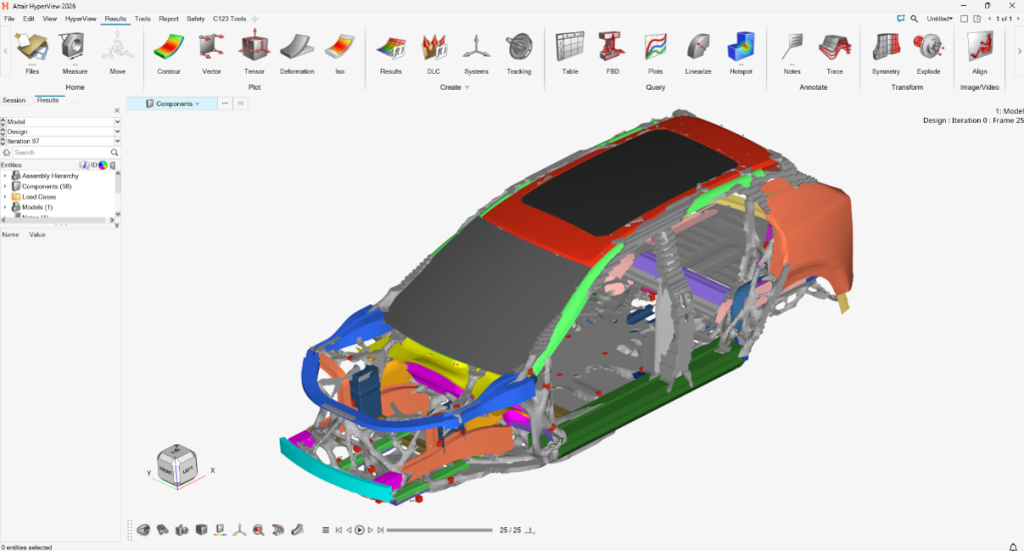
Following performance-driven optimization within the package space, this final C1 step gets interpreted into a structural skeleton. By assigning sections and joint envelopes, we lock in the load paths, providing the precise baseline for C2 sizing and packaging.
C2 General sizing & packaging
Once the skeleton is defined, we move to the C2 phase. This is where the structural concept meets the reality of vehicle packaging.
- Digital Attribute Balancing: This is the “meat” of the layout phase. Using the digital twin, teams run thousands of optimizations to balance NVH, durability, and crash performance simultaneously.
- Trade-off Analysis: C2 is about finding the “sweet spot.” If the styling team wants a thinner A-pillar for better visibility, the C2 sizing optimization tells us exactly how much material is required to maintain rollover protection. We are balancing mass, performance, and cost in real-time.
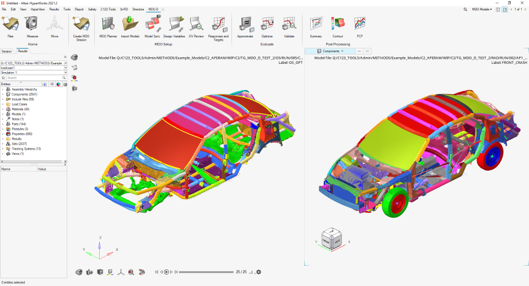
Building on the C1 layout, the sizing phase performs iterative balancing between competing attributes. By linking linear stiffness with Simcenter OptiStruct and nonlinear crash performance with Simcenter Radioss, we evaluate thousands of design variables to identify the optimal structural sizing before proceeding to detailed C3 design.
C3 Detailed sizing & manufacturability
In the final stage of the C123 workflow, the C3 Phase provides further optimization refinement and increased focus on industrialization.
- Mature conceptual design: C3 models are using a more detailed/conventional mesh representation. Design freedom is reduced, and the optimization variables are primarily thickness related.
- Virtual Validation: By the time we reach physical validation, the “surprises” have already been engineered out. The C3 phase ensures that the final design is not only high-performing but also optimized for the assembly line.
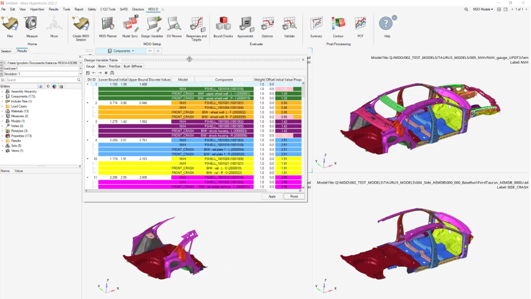
The C3 phase leverages high-fidelity BIW and crash subsystems to enable further refinements and multi-disciplinary optimization. This iterative MDO loop ensures that every structural detail meets NVH, safety and durability targets simultaneously, creating a definitive digital twin that is “right-first-time” for production.
Deep dive into target setting
If the workflow is the engine, target setting is the navigation system. In a 24-month vehicle program, speed is not the hardest part – staying aligned at speed is. When targets are vague, disconnected, or open to interpretation, teams may move fast, but not necessarily in the same direction. That is when late-stage compromises begin to appear: extra weight, missed stiffness targets, unexpected NVH behavior, or costly redesign loops.
This was one of the key messages shared by Theo Geluk, Engineering Services Expert, during a recent automotive conference in China. For Theo Geluk, target setting is not a box-ticking exercise or an administrative handover between teams. It is the discipline that turns ambition into executable engineering decisions.
“The faster the development cycle, the more disciplined target setting needs to become. Clear, cascaded, and traceable targets help teams move quickly without losing control of vehicle performance.”
Theo Geluk
Target cascading: the top-down architecture
Target setting in modern body engineering is a cascaded hierarchy. It starts at the vehicle level (e.g., “The car must achieve a 5-star Euro NCAP rating and a 500km range”), and from there, these high-level goals are broken down into system and sub-system targets:
- Torsional stiffness: What does the vehicle body need to contribute to the handling feel?
- Mass targets: Exactly how many kilograms are allocated to the floor pan vs. the roof structure?
- Energy absorption: How much load must the A-post carry in a small-overlap crash?
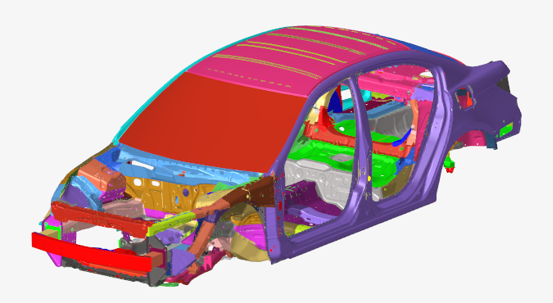
Before structural optimization begins, we identify critical Body-in-White modes and link them to trimmed body performance requirements. This step translates high-level vehicle goals into precise NVH and structural targets, providing the foundational parameters for the C123 workflow.
Parameter management & the digital thread
The secret to successful target setting is parameter management. By using tools like Teamcenter, these targets are not just static documents; they are “live” parameters linked to the CAD and CAE models.
If a weight target is exceeded in the door assembly, the system immediately flags the impact on the overall vehicle range. This real-time visibility allows engineers to make informed trade-offs instantly. Instead of discovering a weight problem during the first physical prototype build, the team sees the “red flag” in the digital twin and corrects it in days.
The data bottleneck: from management to automated understanding
While parameter management ensures that every target is traceable, it also creates a massive influx of data. In a traditional workflow, an engineer would have to manually inspect hundreds of simulation results to understand if a mode shape or deformation pattern truly aligns with the vehicle’s “DNA.” As Theo Geluk highlighted in his presentation on Concept Body Methods, this manual inspection is the hidden bottleneck of the 24-month cycle.
To stay aligned at speed, we need to move beyond just tracking parameters to automatically recognizing structural behavior. By using automated mode shape recognition, enabled by an AI-based region-aware approach that captures a body engineer’s expertise, we can bridge the gap between the digital thread and the solver. This automation is the essential “data fuel” that allows the next generation of AI tools not just to process numbers but to understand the physics of the body in real time.
The AI Revolution: From raw speed to system-level intelligence
While leveraging the right fidelity at the right time enables greater design exploration, they also generate an unprecedented volume of data. The challenge is no longer just running simulations quickly but efficiently transforming results into actionable engineering insights. AI addresses this challenge by providing automated structural intelligence, enabling body engineering teams to rapidly interpret simulation outputs, streamline post-processing activities, and accelerate engineering decision-making.
Beyond the component: AI as a system navigator
While AI can predict the stress on a single bracket in seconds, body engineering is fundamentally about optimizing the complete body system. The real breakthrough comes when we use AI to handle the massive volumes of data generated by our C123 workflow.
- AI-powered clustering accelerates crash DOE post-processing by automatically grouping simulation results according to structural behavior, enabling engineers to quickly identify feasible designs and desired deformation modes across large numbers of runs.
- AI-guided optimization improves design efficiency by predicting behavioral outcomes and steering the optimization toward target performance clusters, resulting in higher-quality solutions, clearer design direction, and faster engineering decisions.
The data factory: Leveraging C2 for machine learning
One of the most powerful applications of AI in body engineering is the synergy between fast-running C2 models and machine learning. By leveraging the right level of fidelity at the right stage of development, engineers can efficiently generate large volumes of high-quality simulation data. In this context, C2 models become a true data factory, producing the synthetic data required to train and deploy advanced AI solutions at scale.
- Synthetic data generation: The computational speed of C2 models enables the creation of massive datasets spanning a wide range of design variations and loading conditions, providing the foundation for robust AI model development.
- Predictive super-twins: These datasets are used to train PhysicsAI models capable of predicting full-system performance in real time. Engineers can instantly assess the global impact of local design modifications, enabling faster exploration of design alternatives and informed decision-making directly within the engineering workflow.
Simcenter PhysicsAI: A broad spectrum of capabilities
Beyond these specialized BIW applications, Simcenter PhysicsAI serves as a versatile powerhouse for broader automotive challenges. By using geometric deep learning to create Reduced Order Models (ROMs), it enables:
- The 1,000x speed advantage: Delivering predictions in seconds that traditionally took hours of HPC time.
- Real-time design exploration: As demonstrated by partners like Magna, this allows for the evaluation of thousands of design variants – from powertrain components to complex crash subsystems – shattering the traditional “stop-and-go” simulation loop.
- Democratized simulation: By providing near-instant feedback (like the “predicted vs. true” stress correlation shown below), it puts high-end physics into the hands of designers, ensuring “right-first-time” designs long before final validation.
Simcenter PhysicsAI predicts B-Pillar displacement across varying pole-impact scenarios in real time, enabling engineers to gain more design insights in less time.
The human interest: Empowering the engineer
Ultimately, this AI-driven approach returns something invaluable to the engineering team: Creative freedom. By removing the “drudgery” of manual post-processing and the “wait time” of traditional solvers, we empower engineers to be truly innovative. AI doesn’t replace the engineer; it acts as a high-speed co-pilot, allowing them to focus on the high-value, system-level decisions that define a world-class vehicle.
Conclusion: from ambitious to baseline
Body engineering excellence is no longer defined by the ability to solve a problem – it’s defined by the ability to prevent one. By integrating the C123 methodology into a front-loaded scenario workflow, leveraging precise target setting, and harnessing the lightning speed of Simcenter PhysicsAI, automotive teams can move from hoping to hit a 24-month target to making it their new competitive baseline.
The future of automotive is lighter, safer, and smarter. And it all starts with the body.
Ready to accelerate your body engineering program?
Read more
- Register for the body engineering webinar to discover more of this optimized-led approach and ask your questions live
- Download the body engineering Ebook for a deep dive into the C123 methodology
- Download the Simcenter PhysicsAI white paper to learn more about rapid design optimization
- Read the latest updates of Simcenter Mechanical, Modeling, Visualization and Manufacturing


