From 5 hours to 16 minutes: Automating blocked force testing for efficient NVH development
Picture this: you need to characterize the noise and vibration behavior of a new steering system. If you’ve done it with a roving hammer or roving shaker, you know the drill — careful repositioning, painstaking setup, a healthy dose of patience. It’s a tried-and-true approach, and for a one-off study or a deep diagnostic dive, it’s often exactly the right tool for the job. But multiply that effort by every design variant you need to test — baseline, refined, maybe a faulty sample to check your test sensitivity — and even the most patient engineer starts to feel like they’ve signed up for an endurance sport rather than an NVH campaign.
For those higher-volume, repeat-everything scenarios, it helps to have another option in your toolbox. Let’s talk about it.
The squeeze on NVH development
Electric vehicles don’t have an engine to mask the rest of the noise. That whine, rattle, or thump you could get away with in a combustion-engine car? In an EV, it’s the star of the show — and not in a good way. At the same time, development cycles keep shrinking, with some OEMs targeting 18 to 24 months from concept to production, down from 3 to 4 years. The industry’s answer has been to shift more and more testing from physical prototypes to virtual ones.
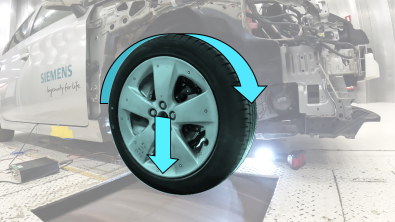
Component-based Transfer Path Analysis (C-TPA) is a big part of that shift. By characterizing a component’s vibration “activity” independently of whatever it happens to be bolted to — using what’s called a blocked force — you can predict how that component will behave in a vehicle before the vehicle even exists. Swap it into a different subframe, a different platform, even a purely simulated model, and the prediction still holds. Powerful stuff — in theory.
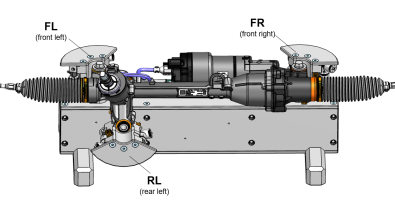
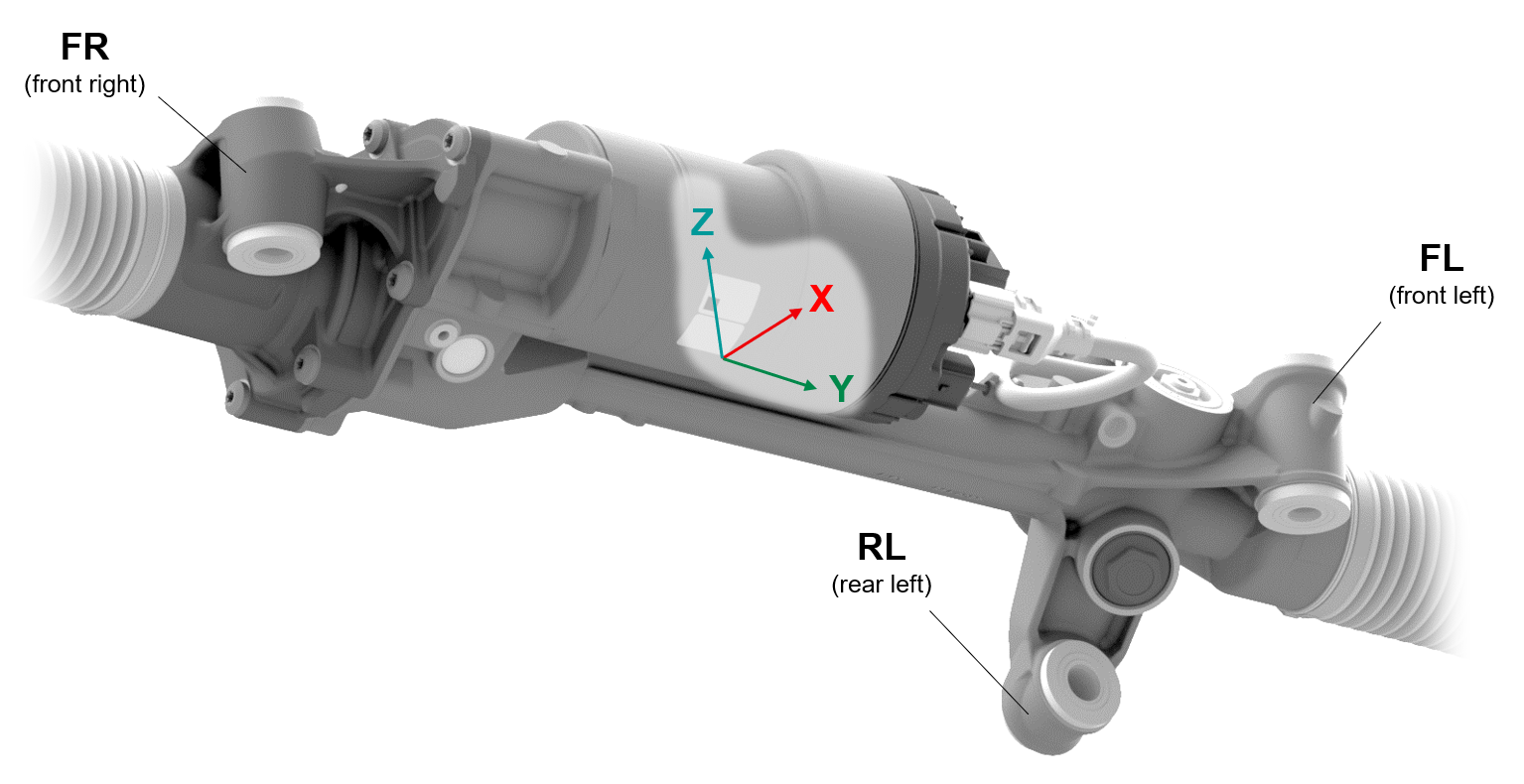
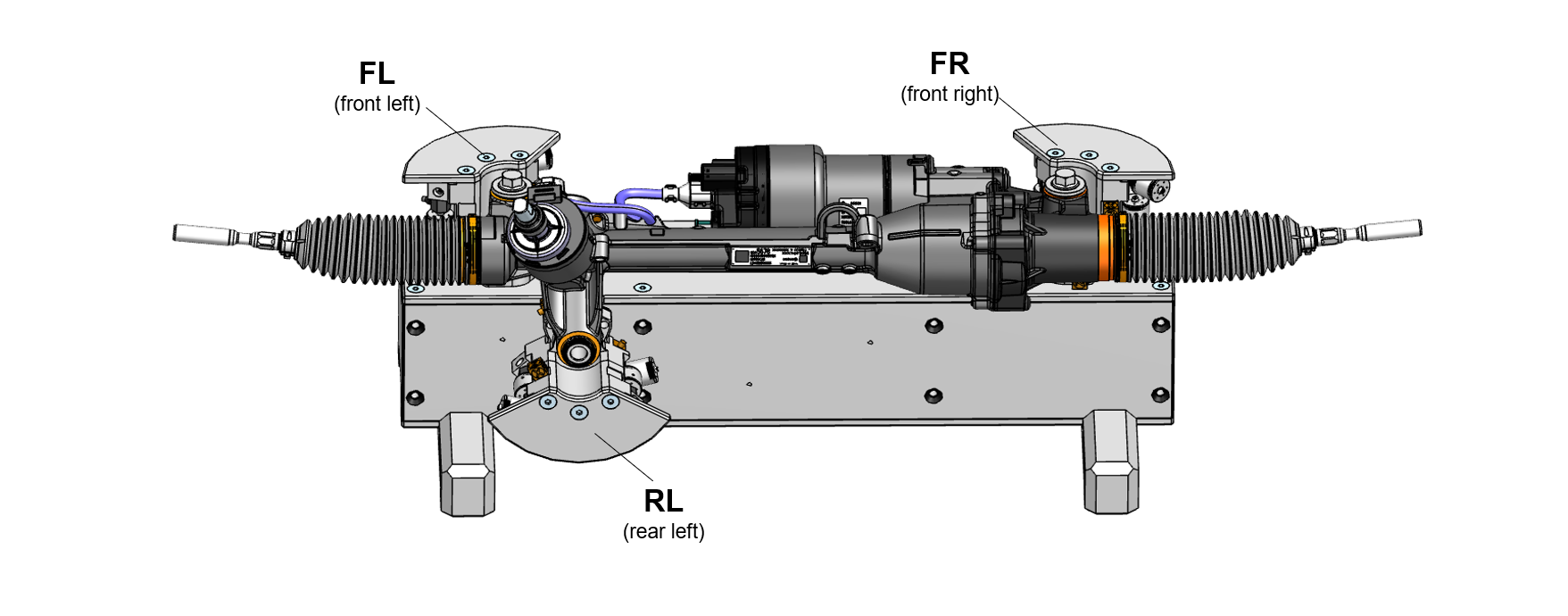
In practice, measuring blocked forces the traditional way (the in-situ method, standardized in ISO 20270) is a serious undertaking. It demands a skilled test engineer, careful setup, and a lot of patience. That combination has kept it mostly confined to one-off studies rather than the kind of routine, repeated testing you’d want across every production sample or design variant. Our steering system example below is typical: three mounting points, each needing a full six-degree-of-freedom characterization.
Enter AutoCMX
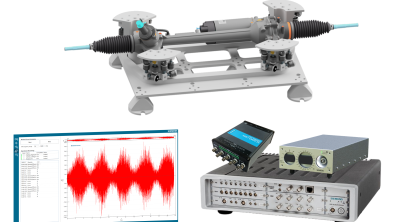
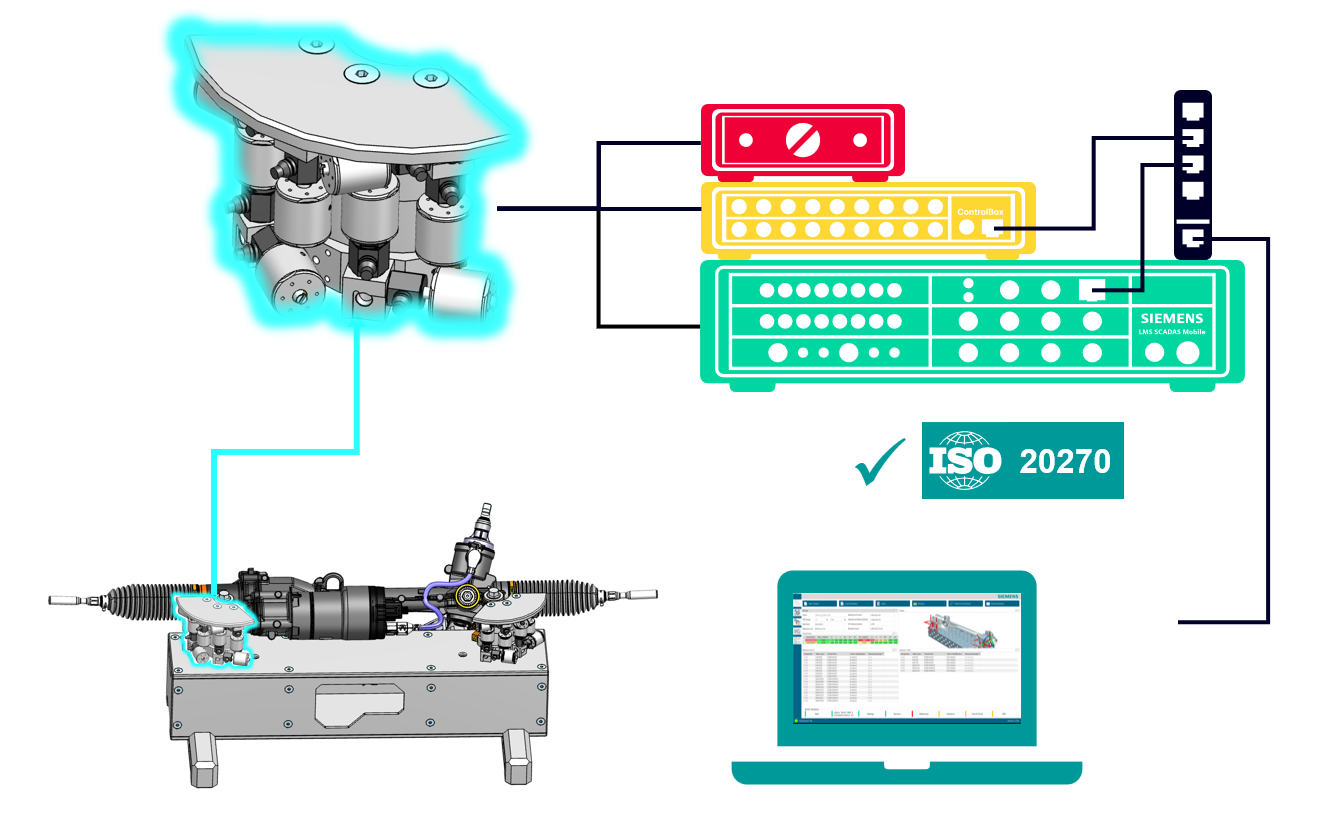
That’s the gap AutoCMX (Automated component model extraction) was built to close: a self-measuring test bench where rigid fixtures at each mounting interface come preloaded with shakers, force sensors, and accelerometers. You bolt on your component, hit go, and the system automatically works through every excitation needed to build up the blocked force model — freeing you from repositioning shakers or hammers by hand every time you need to run it again.
Because the instrumentation is permanently mounted on the fixture rather than on the part being tested, swapping in the next sample is as simple as unbolting one and bolting on another. That matters a lot once you’re testing dozens of samples for production spread, or tracking a component through a full durability cycle.
The numbers that make engineers sit up
For a typical three-mount steering system, a full six-degree-of-freedom characterization — 24 sets of transfer functions in total — takes AutoCMX about 16 minutes. A conventional roving shaker campaign — still a perfectly valid choice for a single exploratory test — takes roughly 4 hours and 48 minutes for the same job. Roving hammer testing takes around 4 hours, too, without even accounting for the accuracy trade-offs that come with impact excitation. Across these comparisons, automation cuts measurement time by more than 93%.
Speed is only half the story, though — repeatability is what makes the numbers trustworthy. Repeated measurements on the same steering system, reinstalled from scratch each time, showed a minimum correlation of 94.5% between runs. Even after deliberately modifying the receiver-side fixture to stress-test the method, the resulting blocked forces still agreed to within 92% — solid proof that what you’re measuring is a genuine property of the component, not an artifact of your particular test setup.
Putting it to the test: a real steering system
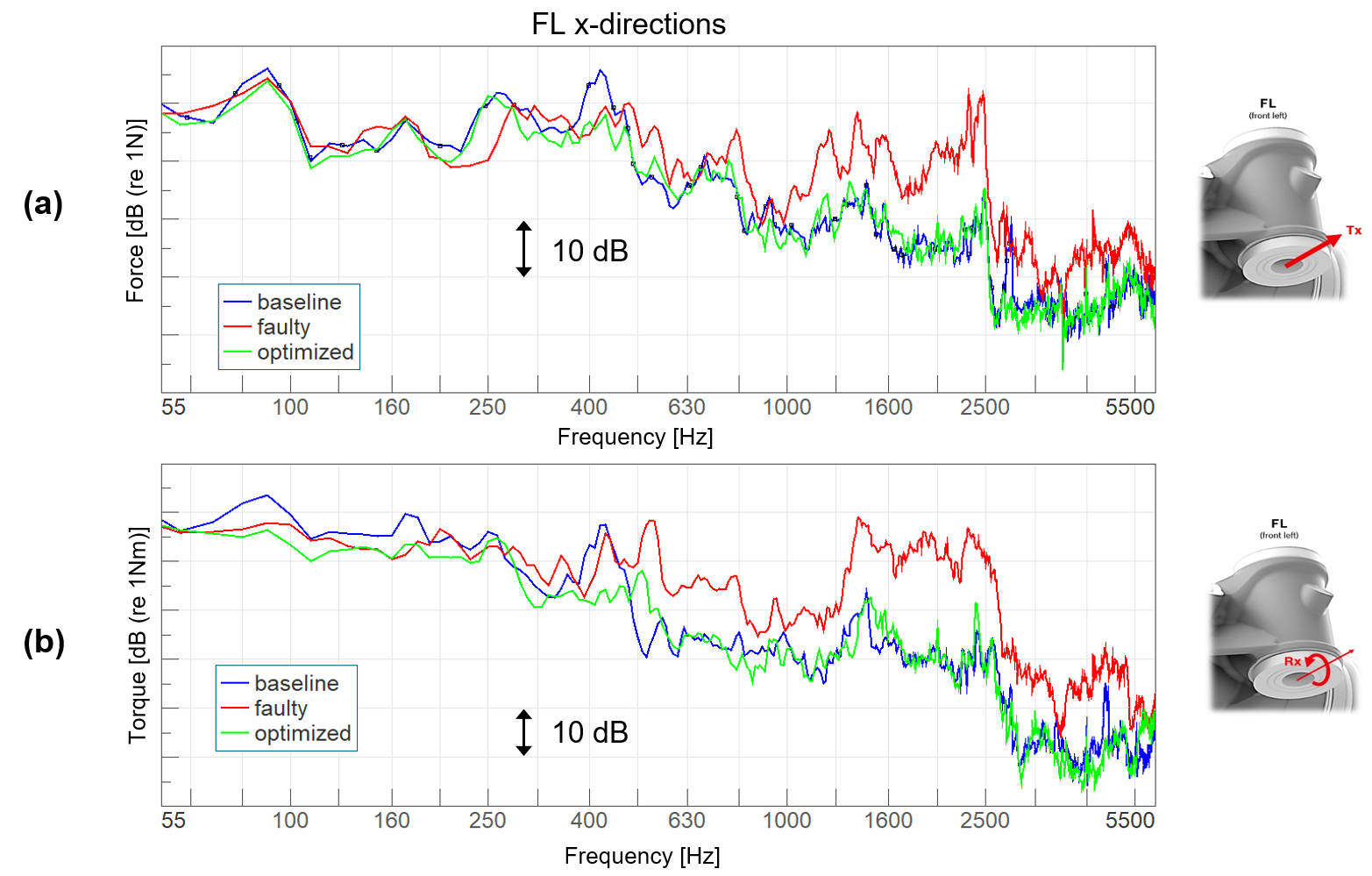
We ran AutoCMX on the EPS system shown above — measuring blocked forces at all three mounting points and comparing three units: a baseline, a refined production part, and a deliberately faulty one. Before trusting any of those results, though, we need to know the measurement itself holds up.
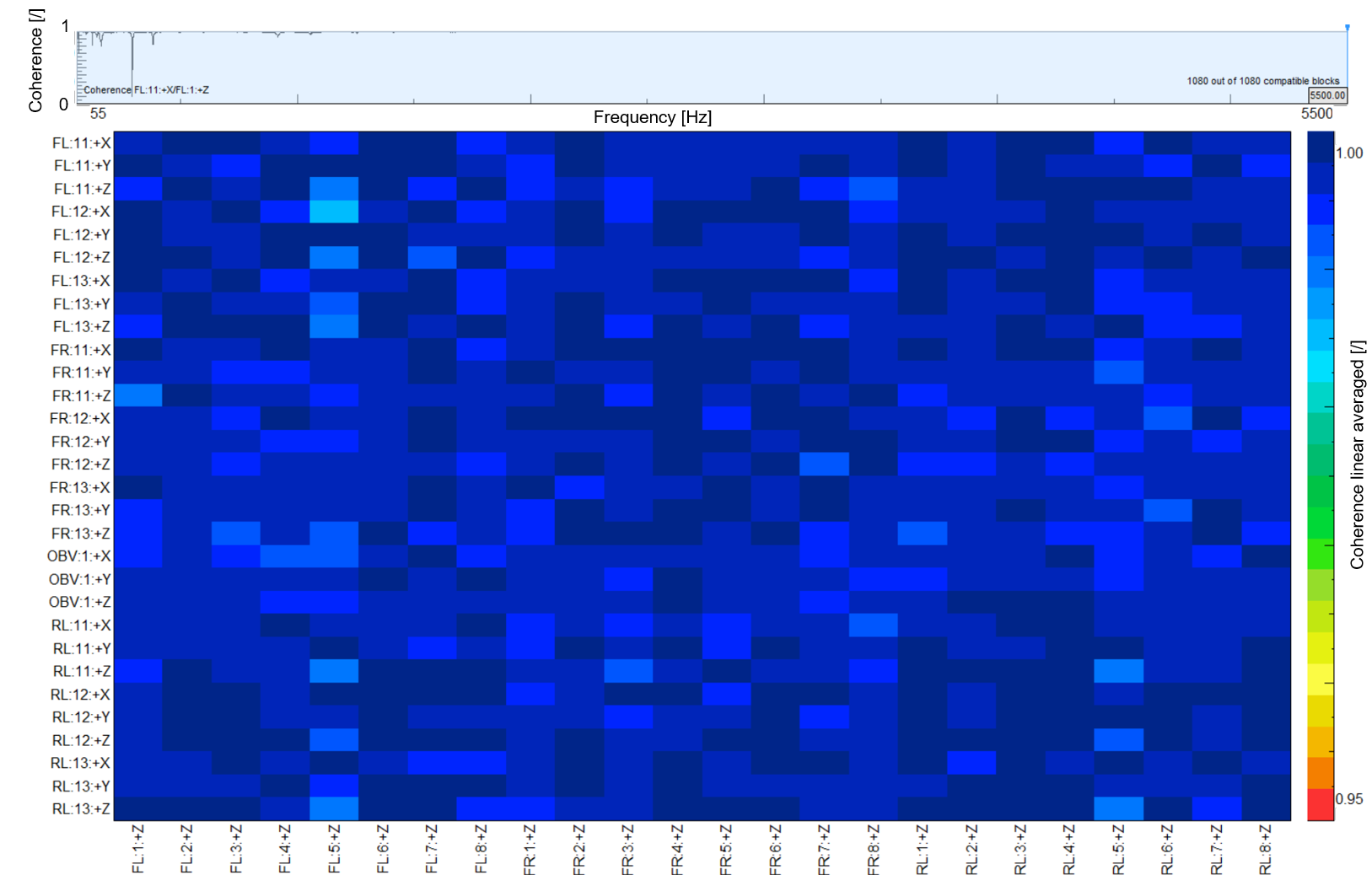
Every indicator FRF is automatically checked for quality before any blocked force is calculated — here’s the coherence across all the measured channels.
The next check is on-board validation: predicting the response at an independent point using the measured blocked forces, then comparing it against what was actually measured there. If the two line up, you know your blocked force model is physically valid — not just a mathematical artifact.
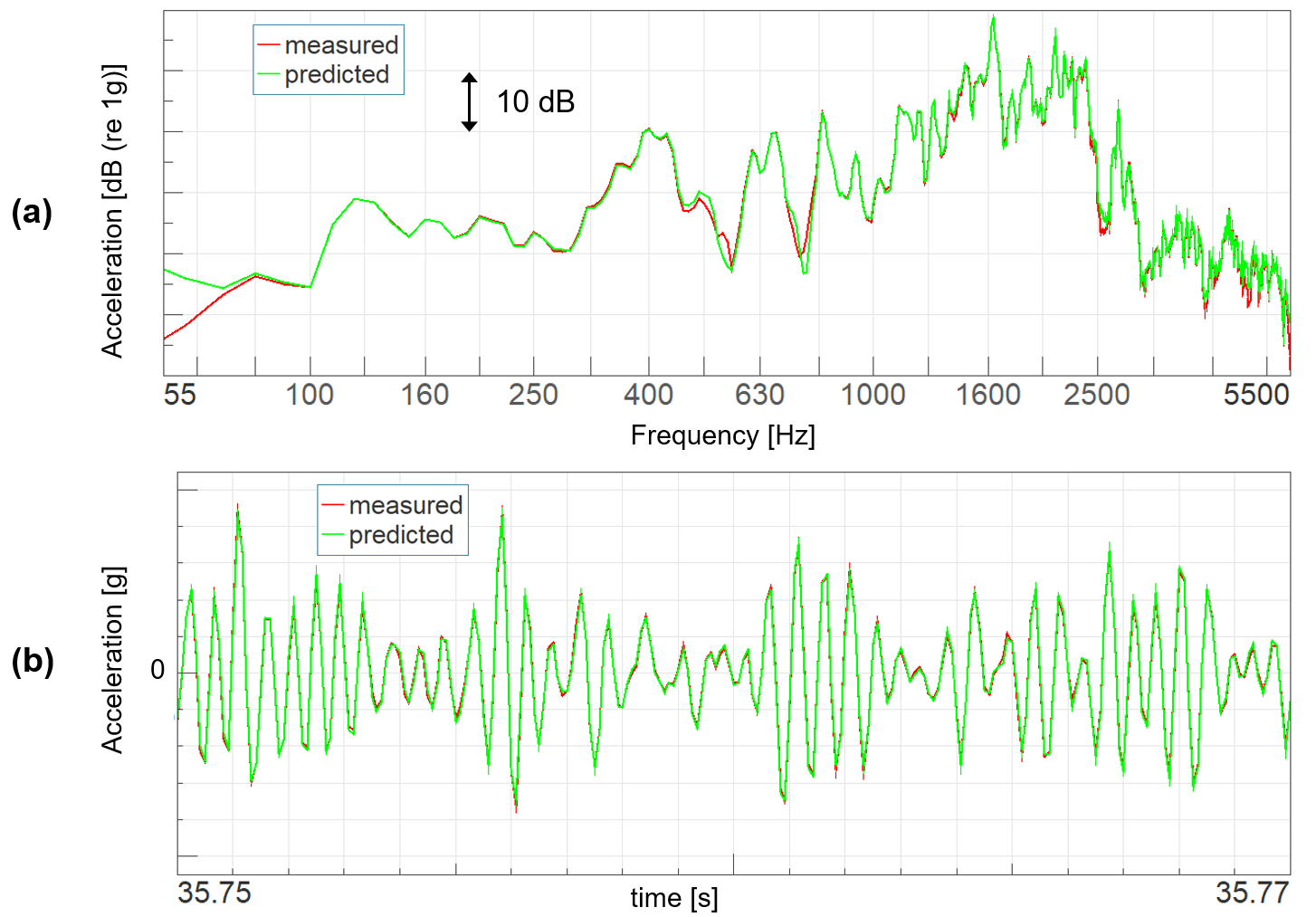
With the measurement validated, we could directly compare the three steering units. The results didn’t just repeat well — they were sensitive enough to clearly tell the three units apart, exactly what you want from a diagnostic and quality tool.
Finally, we applied the measured blocked forces to a vehicle model to predict interior noise and structural vibration — then checked the prediction against real in-vehicle measurements.
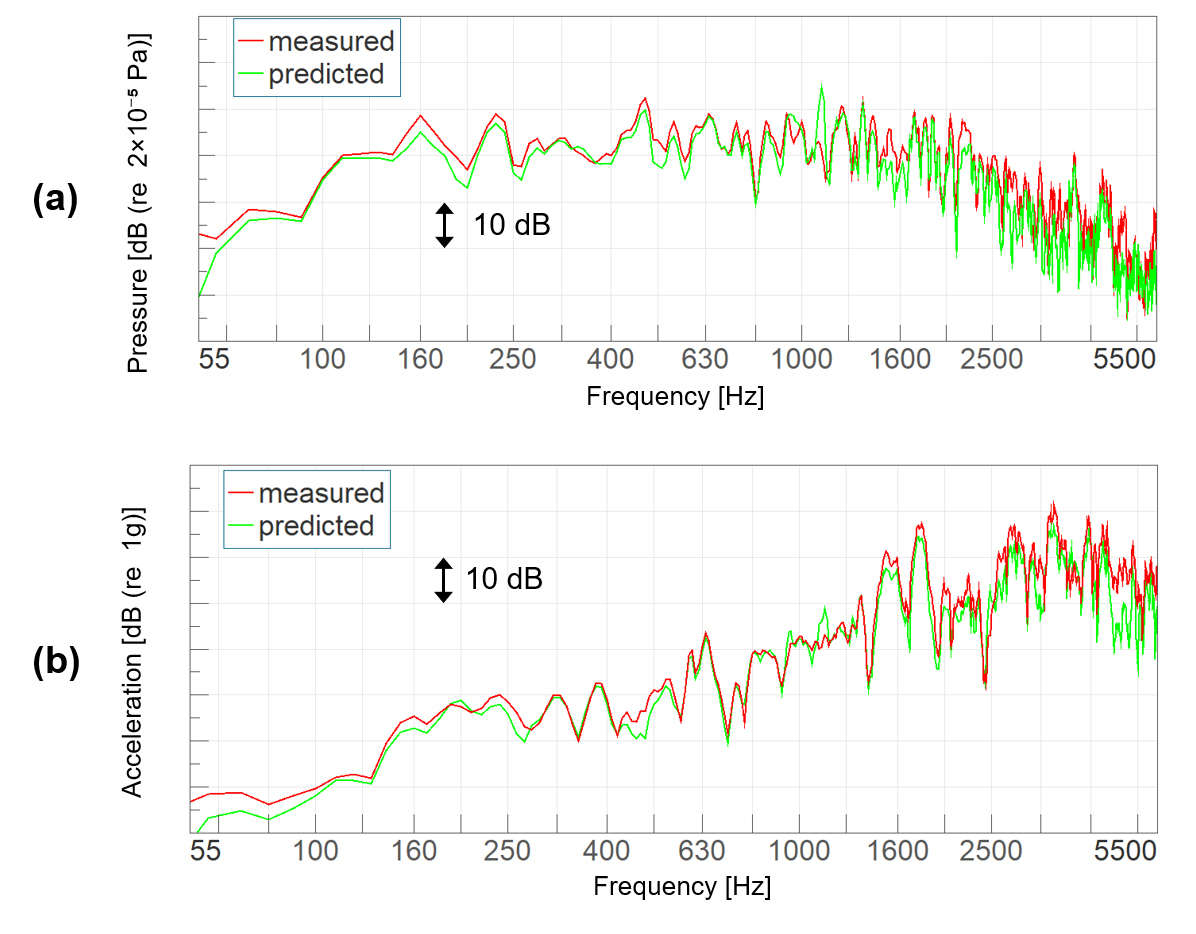
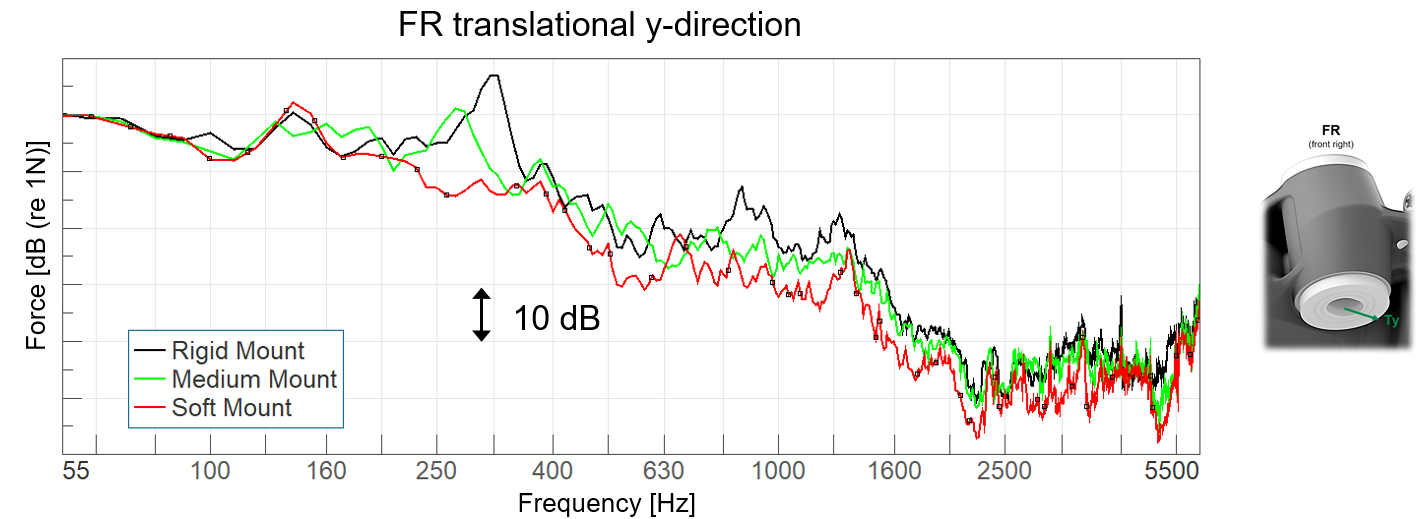
The agreement was excellent — close enough that we could confidently run “what-if” studies entirely on the bench. Swapping in a softer rubber bushing at one of the mounts, for instance, predicted a 4.15 dB average reduction in interior steering noise — a trade-off study that would normally require multiple full vehicle builds, now answered without touching a vehicle at all.
Closing the loop on data
Fast, automated measurement is only useful if you can keep up with the data it produces. Testing dozens of operating conditions across many component samples generates a large volume of raw signals that need to be converted into usable models — fast. That’s where automated post-processing comes in: tools like Simcenter Testlab Neo Process Designer and Simcenter Testlab Workflow Automation can pick up newly measured data automatically and turn it into ready-to-use blocked force models, with no manual intervention from raw signal to final result.
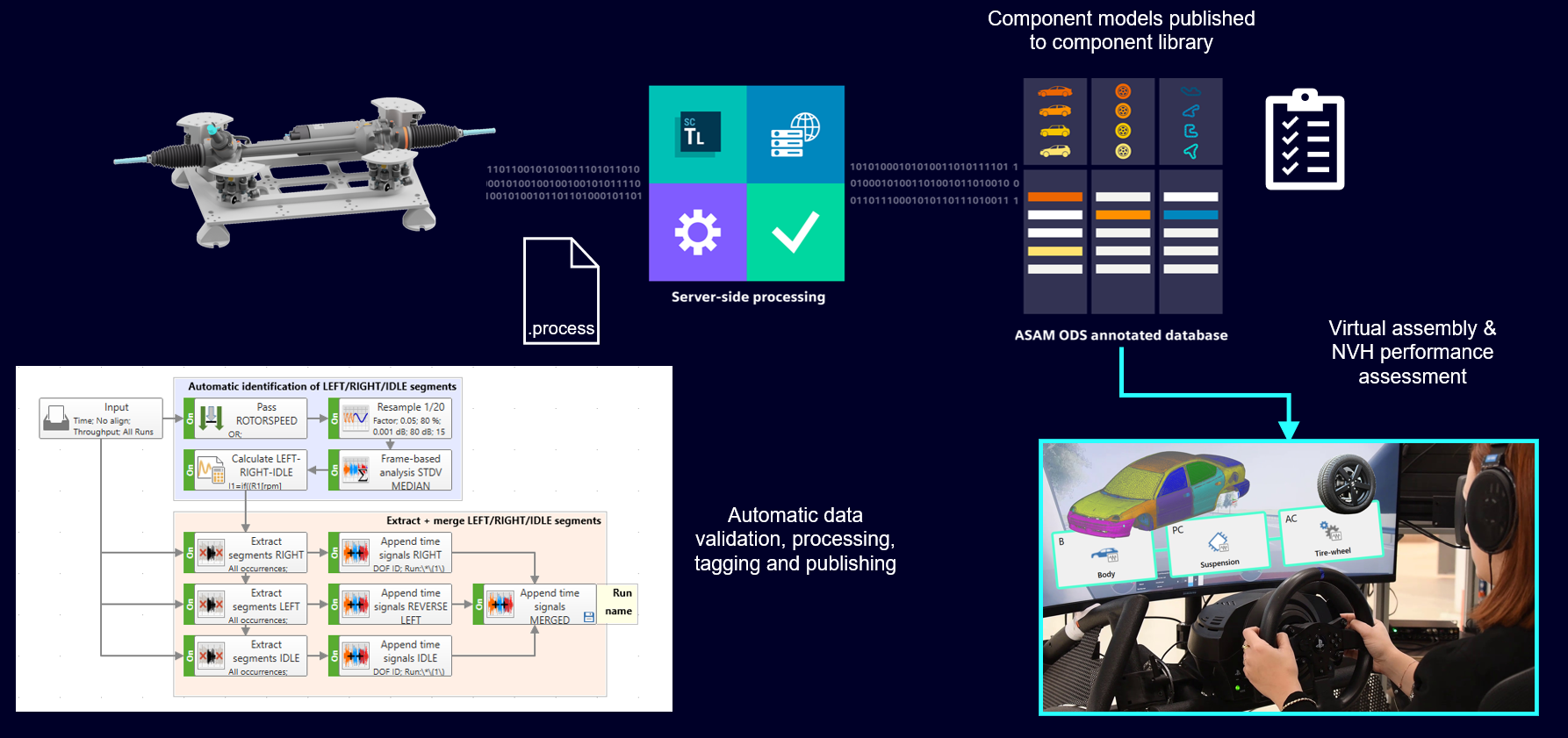
And once that data exists, you still need to be able to find it again. This is where Simcenter Testlab Data Management comes in: instead of scattered files, every measurement lands in a centralized, searchable database, automatically tagged with the metadata that matters — test engineer, component variant, operating condition. A specific dataset becomes a quick search away rather than a folder-hunting exercise, and it can be shared securely across teams and sites.
What’s next: giving components a voice
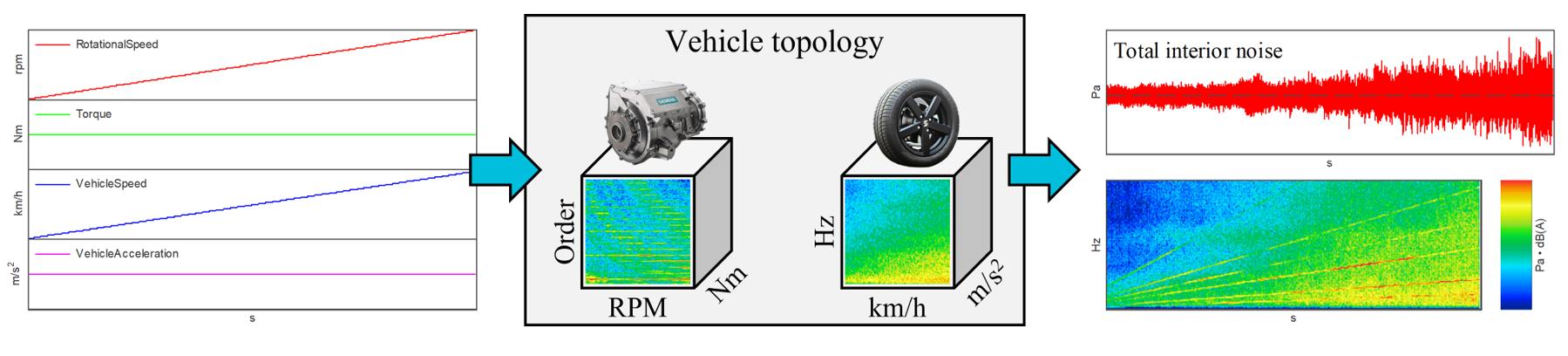
Measuring and predicting is one thing — but ultimately, NVH is about what people hear. In a follow-up piece, we’ll dig into how these automatically measured blocked forces feed directly into a full-vehicle NVH simulator, letting engineers listen to a component’s contribution embedded in realistic road, wind, and powertrain noise — not in isolation, where it might sound worse (or better) than it really is.
Stay tuned — we’ll show how it all comes together.
Learn more
1 Sturm, M., Wienen, K., Brandstetter, M., et al. “Automating Component NVH Characterization: A Systematic Approach for Component Test Bench Characterization.” Proceedings of the International Styrian Noise, Vibration & Harshness Congress (ISNVH), in press, 2026.
2 Wienen, K., Sturm, M., Zabel, D., and Alber, T. “Automated Transfer Path Analysis for Industrial-Scale Blocked Force Source Characterization.” Proceedings of the International Conference on Noise and Vibration Engineering (ISMA), 2026.
3 Sorber, E., Brandstetter, M., Wienen, K., and Sturm, M. “Automated Blocked Forces Characterization for Contextually Realistic Auralization of Component Variants in Virtual Vehicle Prototypes.” Proceedings of the International Conference on Noise and Vibration Engineering (ISMA), 2026.
Try it yourself
Whether you’re running roving hammer or shaker campaigns today or looking to add faster, more repeatable, operator-independent testing for higher-volume work, get in touch with the Simcenter Testlab team to see where AutoCMX fits into your NVH toolbox. You can also read more in this companion post on AutoCMX and explore the fundamentals of component-based Transfer Path Analysis on the Simcenter blog.