The future of industrial blocked force testing is here. Introducing Automated component model extraction (AutoCMX)
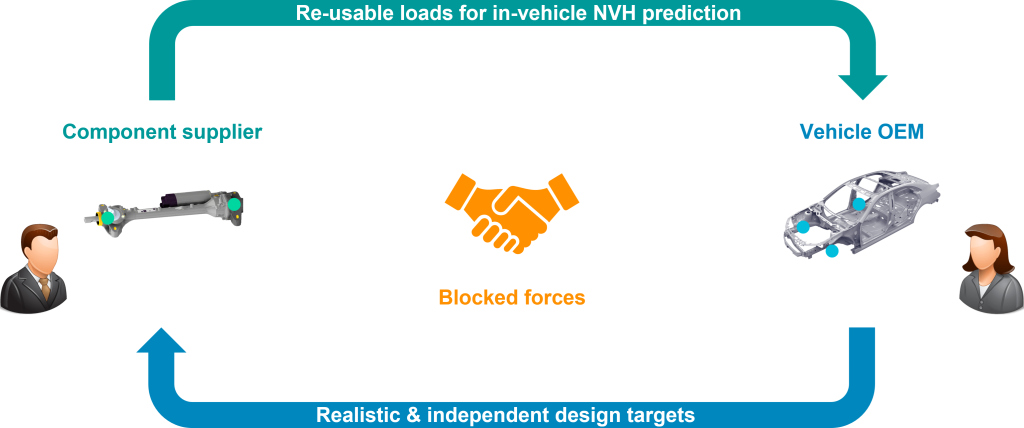
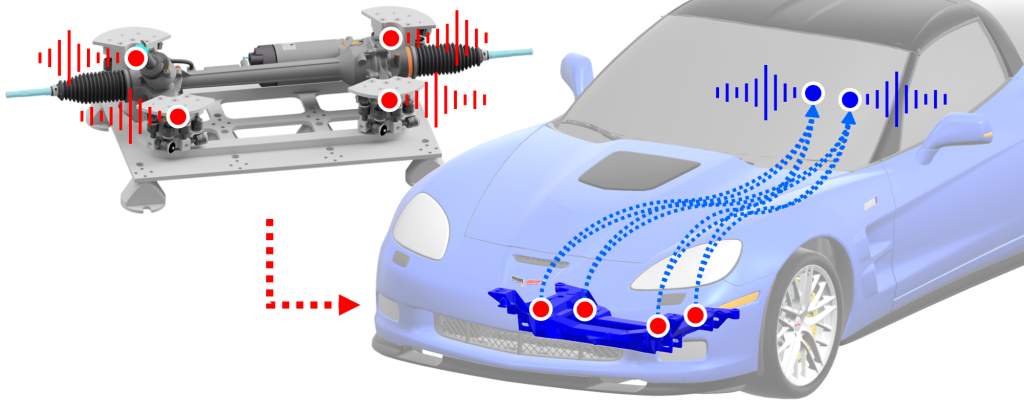
One of the most anticipated trends in NVH engineering is the adoption of blocked forces as the industry-standard method for OEMs and suppliers to digitalize the process of component integration. For suppliers, blocked forces are a receiver-invariant quantity that can be measured on in-house test benches to independently validate components against OEM design targets. For OEMs, supplier-provided blocked forces can be used to virtually integrate components and predict their contributions at end-user NVH targets without physical prototype assembly.
The accuracy of the blocked force approach has been widely validated in published research for a range of relevant applications, including tires, (electric) powertrains, steering systems and pumps/compressors. This has resulted in a joint effort by industry pioneers to develop a standardized workflow for in-situ blocked force testing in ISO 20270, which ensures the exchange of reliable results between suppliers and OEMs through traceable quality indicators. Early adopters of blocked forces have seen massive efficiency gains in their NVH development process, for example at Sanden:
The interface description at component attachment points is much more advanced with blocked forces. Thanks to Siemens, we have cut development time in half and saved hundreds of thousands of euros by avoiding additional development cycles.
Thomas Di Vito, Head of Research and Concept Development, Sanden
At this point, you may be thinking: “Wow, the industry must be scrambling to adopt this!”
Well, not quite. Despite this strong foundation, the reality is that wider industry adoption of blocked forces has been much slower than expected. Something is holding back this promising technology, but what? And can anything be done to move it forward? Let’s take a closer look.
Where do conventional methods fail?
In recent years, we have significantly invested in our Simcenter Testlab software platform to implement the latest blocked force testing methods in compliance with ISO 20270. While these new capabilities have been instrumental in pushing the boundaries of where blocked forces can be applied, conventional methods still rely on a manual execution of the ISO 20270 workflow using either impact hammers or shakers to measure Frequency Response Functions (FRFs).
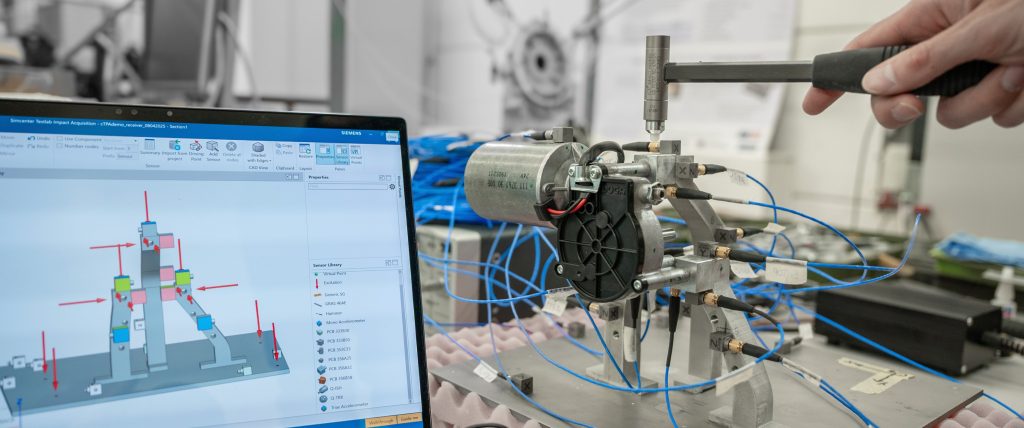
Manual execution is fine for blocked force testing of a few prototypes, but real-world vehicle development projects typically require up to hundreds of component prototypes to validate all design changes that are implemented throughout all stages of development. Conventional methods are impossible to scale up to this level of industrial usage due to three main bottlenecks:
❌ Labor-intensive
Typical execution times range from 3–5 days per component sample, with the majority of time lost on tedious tasks such as sensor instrumentation and data processing which must be repeated for each new measurement.
❌ Complex
ISO 20270 quality indicators can help identify low quality results, but do not guide the operator towards high quality results. Only experts with extensive training are therefore capable of correctly navigating the workflow.
❌ Operator-dependent
Differences in sensor placement and excitation positioning during manual execution lead to reduced confidence in the accuracy and repeatability of results obtained across operators and component samples.
Meet the future of industrial blocked force testing
As of today, the industry is ready to move beyond the bottlenecks of conventional methods. Siemens is launching a new solution that enables industrial blocked force testing for any component supplier and OEM: Automated component model extraction (AutoCMX).
AutoCMX is an integrated hardware and software solution for automatically extracting invariant component models compliant with ISO 202070. Developed in collaboration with Bosch, AutoCMX leverages Siemens’ industrial platforms for data acquisition and processing (Simcenter SCADAS hardware and Simcenter Testlab software) with Bosch’s patented predictiveVIA technology.

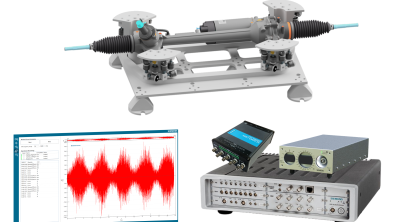
At the core of AutoCMX is a self-measuring fixture that is permanently instrumented with a complete set of sensors and exciters for ISO 20270 and designed to integrate with standard NVH test benches. The operator simply installs the component sample on the fixture and initiates a fully automated measurement and processing procedure that delivers exceptionally accurate and repeatable results up to 5000 Hz and in record time. Crucially, AutoCMX requires zero human interaction during execution, yielding a truly industrialized process:
✅ Efficient
The automated measurement procedure delivers an over 93% reduction in FRF measurement time compared to conventional roving impact testing, compressing typical execution from days to hours.
✅ Reliable
The permanently instrumented sensors and exciters deliver 100% accuracy and repeatability across operators and component samples, shifting execution capability from engineers to technicians.
✅ Scalable
Combining efficiency and reliability in a single workflow enables scalable testing of hundreds of component variants to validate each design change at each stage of development.
How does AutoCMX work?
After installing a component sample on the self-measuring fixture, the AutoCMX measurement procedure is executed in two stages. First, a full set of indicator FRFs is measured by sequentially exciting each connection interface at various locations with permanently instrumented compact shakers. Then, operational indicator responses are measured at permanently instrumented accelerometers while operating the component sample in all conditions of interest. Finally, the resulting dataset is automatically processed using Virtual Point Transformation (VPT) to describe each connection interface with up to 6 Degrees of Freedom (DOFs) and time-domain Matrix Inversion to estimate the blocked forces during any transient or (semi-)stationary operating condition.
The blocked forces can then be used to predict the component sample’s contribution to the NVH performance at end-user targets using a virtual vehicle prototype. To facilitate this, the uncoupled impedance FRFs of the component sample for virtual component integration using Frequency-based Substructuring (FBS) can also be calculated using AutoCMX via an FBS Decoupling approach based on a one-time calibration measurement of the self-measuring fixture. The resulting virtual vehicle prototype will be a high-fidelity approximation of the physical vehicle due to AutoCMX’s ability to deliver exceptionally accurate and reliable results in a wide frequency range.

Measured steering noise (reference)
Slow maneuver:
Fast maneuver:
Predicted steering noise (AutoCMX)
Slow maneuver:
Fast maneuver:
AutoCMX has been extensively validated in published research on steering systems123, but the approach can be applied to any component type compatible with ISO 20270 or FBS. Examples include electric motors, pumps/compressors, power braking systems, wiper systems, tires/wheels and even FRF-based characterization of passive components such as subframes and mounts.

What else can AutoCMX do?
AutoCMX is more than just a standalone tool. Rather, it opens the door to a wide range of NVH testing capabilities and synergies in our versatile Simcenter Testlab software platform available through a shared token-based licensing concept.
Use this flexibility to your advantage and accelerate your return on investment by leveraging seamless integrations between AutoCMX and other members of the Simcenter Testlab family:
Testlab Workflow Automation enables fully automated server-based processing of any measured data using our flexible and intuitive Process Designer toolbox. Transform complex operational measurements into actionable KPIs and reports with zero human interaction.

Testlab Data Management structures all measured component data in an annotated and openly-accessible ASAM-ODS database. Implement a future-proof data storage strategy to unlock custom AI model training and data-driven decision making.

Testlab Virtual Prototype Assembly provides an industrial workflow for predicting the NVH performance of hybrid (test-CAE) virtual prototypes. Frontload the identification of critical NVH issues and virtually explore component design changes without repeated vehicle build-up.

Testlab NVH Simulator enables immersive auralization of predicted NVH performance in a full vehicle context. Experience the impact of component design changes in realistic driving conditions with simultaneous contributions from other (masking) noise sources.

Conclusions
AutoCMX is a game-changer for industrial adoption of blocked forces. What previously took a trained expert days to perform, can now be completed in just a few hours by any operator with consistently accurate results. As a result, suppliers and OEMs can validate more design variants and make better-informed decisions in early development stages to truly digitalize the process of component integration.
Curious to know more? Check out our solution brief for a summary of the key facts and figures of AutoCMX, or our solution guide for a comprehensive overview of Siemens’ solution offering for Transfer Path Analysis.
Looking for a technical deep dive? We will present three conference papers on AutoCMX this year with in-depth validation results and use cases. We would be delighted to have your attendance! The full papers will be available in the following conference proceedings:
- M. Sturm, K. Wienen, M. Brandstetter, et al., “Automating Component NVH Characterization: A Systematic Approach for Component Test Bench Characterization”, in: Proceedings of the 14th International Styrian Noise, Vibration & Harshness Congress (ISNVH), 2026. ↩︎
- K. Wienen, M. Sturm, D. Zabel, T. Alber, “Automated Transfer Path Analysis for industrial-scale blocked force source characterization”, in: Proceedings of the 32nd International Conference on Noise and Vibration Engineering (ISMA), 2026. ↩︎
- E. Sorber, M. Brandstetter, K. Wienen, M. Sturm, “Automated blocked force characterization for contextually realistic auralization of component variants in virtual vehicle prototypes”, in: Proceedings of the 32nd International Conference on Noise and Vibration Engineering (ISMA), 2026. ↩︎