Intelligent Design Control for Medical Devices: Moving Beyond Disconnected Tools

How integrated design control helps medical device teams improve traceability, assess change faster, and maintain documentation readiness.
Medical device development teams are under pressure to move faster while maintaining control. Product complexity is increasing as software content expands, cybersecurity concerns rise, and regulatory scrutiny remains high. At the same time, the volume of evidence needed to support design decisions continues to grow.
In many organizations, the core elements of design control are still managed across disconnected tools, spreadsheets, documents, and email threads. The problem is not that the necessary artifacts do not exist. It is that the relationships between them are fragmented and difficult to maintain.
The result is friction. Teams spend time reconstructing context across systems, assessing the downstream effects of change, and assembling evidence for reviews or submissions.
The real problem is not missing data. It is missing relationships.
In many medical device organizations, the issue is not that design control artifacts do not exist. It is that they are disconnected. A requirement may exist, but the linked design input, risk control, verification method, and related evidence are not always easy to follow.
That is where disconnected design control becomes expensive. Engineers lose time hunting for context across systems. Quality teams spend effort maintaining traceability across boundaries. Regulatory teams depend on manually compiled evidence to demonstrate completeness. Documentation readiness becomes a recurring recovery exercise rather than a byproduct of disciplined execution.
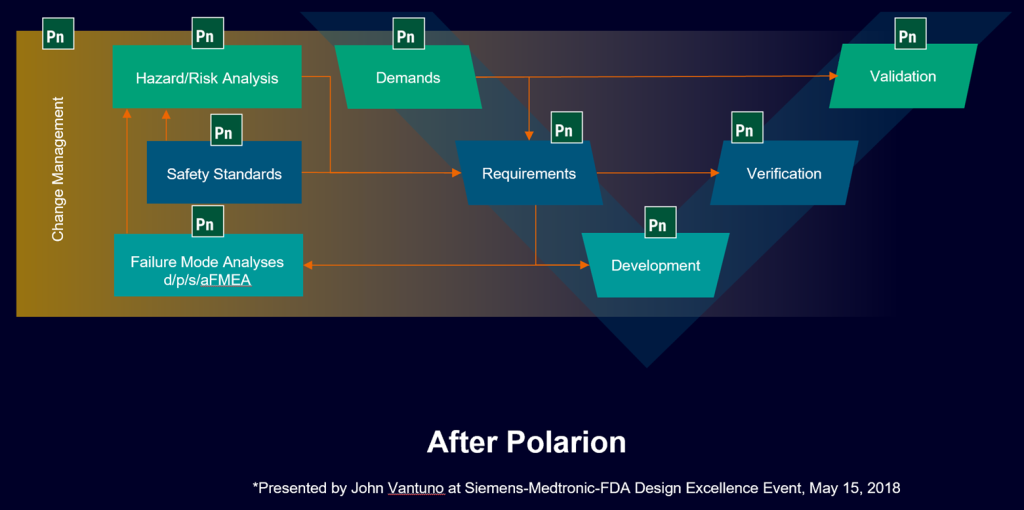
Integrated design control is an approach in which requirements, risk, design outputs, verification, validation, reviews, and related evidence are maintained as connected relationships rather than managed across disconnected tools and documents. In a more integrated model, those relationships are maintained within a common digital thread. Traceability stops being something teams rebuild after the fact. It becomes an operational capability teams can use to make better decisions, assess change faster, and maintain readiness as work progresses.
The difference between disconnected and integrated design control is not whether the artifacts exist, but whether their relationships are maintained continuously.
What changes when design control becomes integrated
Design control is fundamentally about relationships.
A user need should connect to the design input that refines it. That design input should connect to the design output that implements it. Risks should connect to the controls intended to reduce them. Verification should connect to the requirements and specifications being confirmed. Validation should connect back to the intended use and user needs that define success.
In a disconnected environment, those relationships often live in static traceability tables, manually assembled review packages, or in people’s heads. In an integrated design control environment, they become part of the system itself.
That shift has practical consequences:
- traceability stays current as work progresses
- impact analysis becomes faster and more reliable
- reviews use connected evidence instead of manually compiled snapshots
- downstream effects of change become easier to evaluate
- documentation can be generated from execution data instead of reconstructed at the end
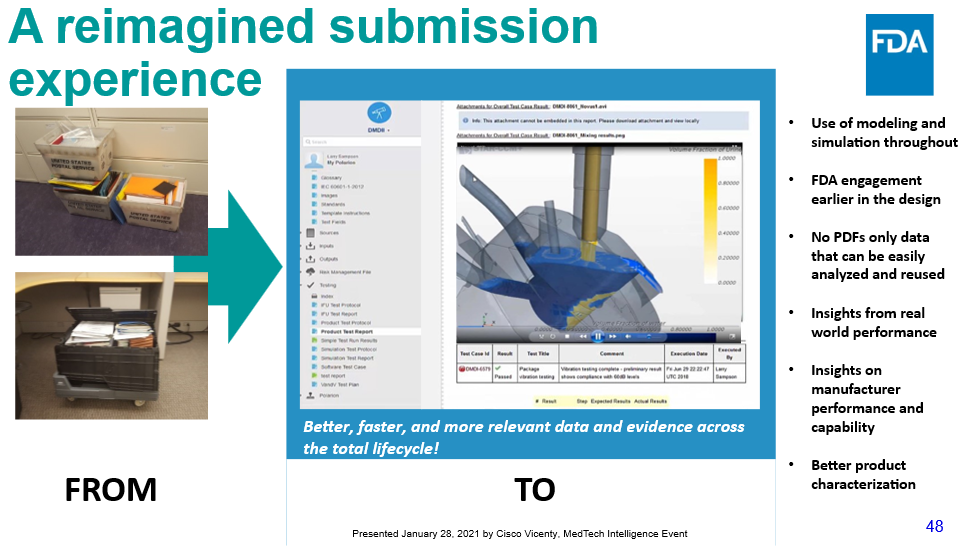
Integrated design control improves execution because connected information is easier to review, reuse, and carry forward across the lifecycle. One practical consequence is that downstream regulatory activities also become easier to support. When requirements, risk, verification, validation, and related evidence remain connected during development, teams do not need to reconstruct those relationships later for submission preparation.
A maturity path many medtech teams will recognize
Most organizations do not move from fragmented execution to integrated design control in one step. They tend to progress through recognizable stages.
1. Disconnected execution
At this stage, teams rely on spreadsheets, documents, shared drives, presentations, and point tools. Requirements may be written formally, but risk, verification, design outputs, and usability evidence are often managed separately. Traceability is largely manual, and change assessment depends heavily on individual knowledge.
2. Structured but partially connected control
Here, the organization has introduced more discipline through templates, workflows, and clearer review or approval practices. But important gaps remain. Risk management may still sit outside the requirements flow, verification and validation records may require manual reconciliation, and change effects are not always visible across related artifacts.
3. Integrated design control
In a more connected model, requirements, risk, design outputs, verification, validation, reviews, and related evidence are maintained in a common environment. Relationships are current, easier to navigate, and more usable during reviews, changes, and documentation preparation.
It’s important to emphasize the synergy between tools, processes and people. The popular aphorism “a fool with a tool is still a fool” comes to mind. Process improvements, tool implementation and training go hand in hand. Real and measurable gains can be obtained without paralyzing project risk or a massive investment in time, effort and cost.
Making traceability usable, not just available
Connected data becomes far more valuable when teams can see and navigate the relationships behind it.
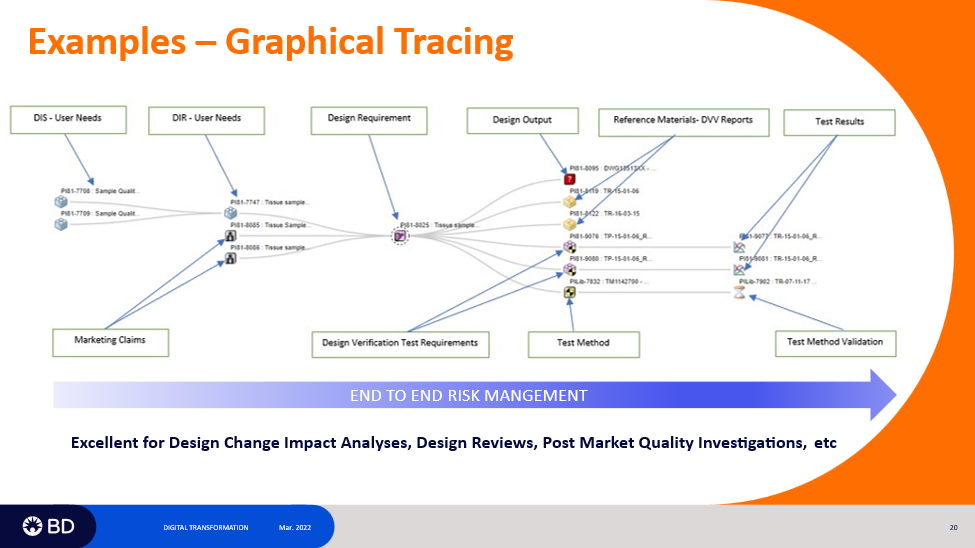
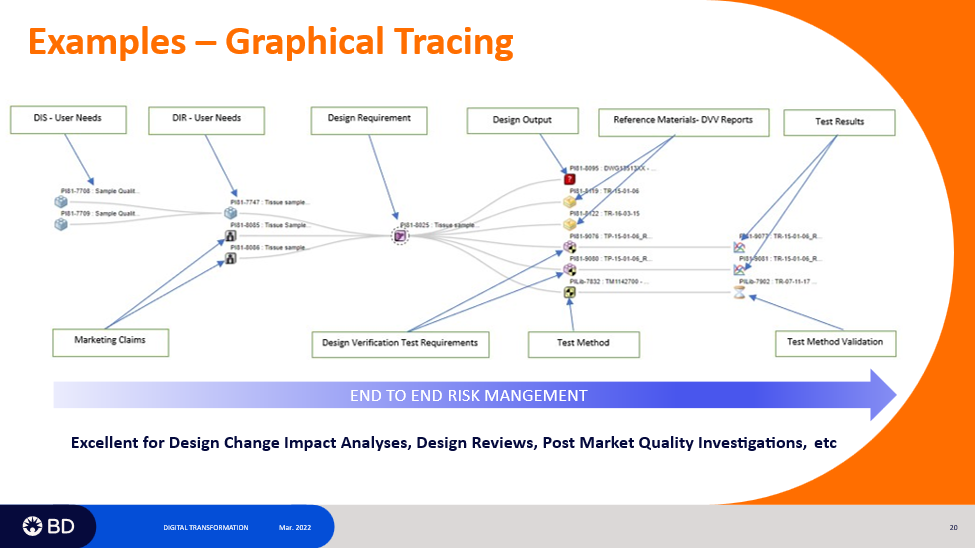
That is where graphical traceability matters. Instead of links being hidden inside records or visible only in static matrices, teams can navigate across user needs, requirements, design outputs, verification artifacts, test methods, and results in a connected visual context.
When relationships are visible, teams can answer practical questions more quickly:
- If this requirement changes, what tests and outputs are affected?
- How can we effectively analyze post market surveillance data and its impacts to our prior risk management strategy and controls?
- Which verification evidence supports this product characteristic or claim?
- What else should be reviewed if a test fails or a field issue is reported?
- Are all relevant downstream artifacts connected before a change is approved?
That visibility is especially valuable in three common situations:
- change impact analysis, where teams need to understand downstream consequences before approving updates
- design reviews, where stakeholders need to move across connected evidence without losing context
- post-market investigations, where teams need to trace quickly across requirements, tests, outputs, and risk controls to assess scope and investigate with precision
How Polarion X for Medical Devices supports this model
Polarion X for Medical Devices is Siemens’ preconfigured solution for helping medical device teams implement integrated design control more quickly and consistently. Built on Polarion, it connects requirements, risk, design outputs, verification, validation, reviews, and related documentation activities in a shared environment.
Accelerating the path to integrated design control
Building integrated design control from scratch takes time. Polarion X for Medical Devices helps organizations get there faster in two ways.
First, pre-built design control templates provide a foundation tailored for medical device development, including workflows, traceability, risk integration, reviews, change management, and design history documentation. It is designed to be ready to use without being rigid, so teams can align it to their own processes without starting over.
Second, SaaS delivery reduces deployment overhead, so teams can spend less time on infrastructure and more time operationalizing design control.
Polarion X for Medical Devices reflects lessons learned from implementing integrated design control in large medical device organizations. The goal is to help organizations achieve rapid gains while minimizing implementation risk.
Connecting requirements and risk
Design inputs can be linked directly to hazards, hazardous situations, harms, risk controls, and related analysis artifacts. This helps teams show how requirements and controls were established in response, supporting risk management activities aligned with ISO 14971.
Linking verification and validation to intent
Verification and validation activities can be traced back to the requirements, user needs, and risk controls they are intended to support. This makes it easier to demonstrate coverage, review evidence in context, and understand what may be affected when changes occur.
Managing software and usability evidence in context
As software becomes more connected and updates more frequent, design control must align with planning and development activities. This is not just about linking software artifacts. It is about keeping software and usability evidence connected to the design control relationships that give them meaning.
Managing change with context
Because related artifacts are connected, change assessments can extend beyond the item being edited. Teams can evaluate likely downstream impact across requirements, outputs, tests, risks, and approvals before authorizing the change.
Supporting structured reviews and documentation readiness
Because artifacts remain connected as work progresses, teams can support structured reviews with better context and reduce the effort required to assemble formal design history documentation. Instead of reconstructing traceability late in the process, they can maintain a more current and review-ready development record.
Why it matters across engineering, quality, and regulatory
Integrated design control improves how engineering, quality, and regulatory teams work together because it reduces the need to reconstruct context across disconnected systems. Engineering gains better visibility into downstream effects. Quality gains stronger support for reviews and change assessment. Regulatory teams gain a more current evidence base for submissions, inspections, and documentation activities.
The broader business outcomes are straightforward:
- less manual effort to maintain traceability
- faster and more reliable change impact assessment
- better visibility across the design control process
- less friction in reviews and investigations
- stronger audit and documentation readiness
- a more scalable foundation across products, teams, and programs
A more practical path forward
Medical device organizations do not need more disconnected compliance activity. They need development systems that make control easier to maintain while work is happening. Quality becomes a byproduct of execution rather than a scramble at the end.
The opportunity is not just to digitize design control, but to make it easier to execute. The more effectively user needs, requirements, risk, verification, validation, and change activity are connected, the easier it becomes to maintain control without slowing execution.
That is the value of integrated design control: better visibility, stronger traceability, faster impact assessment, and a more reliable foundation for documentation readiness.
For organizations still managing design control across disconnected systems, this may be the right time to evaluate what a more integrated approach could deliver.
Frequently Asked Questions
What is integrated design control?
Integrated design control connects requirements, risk, design outputs, verification, validation, reviews, and change records in a shared environment rather than across disconnected tools and documents. This helps maintain relationships as part of everyday execution, making traceability more useful for impact analysis, reviews, investigations, and documentation readiness.
Why does this matter for medical device teams?
Medical device teams need to maintain clear relationships across design inputs, risk controls, verification, validation, and design outputs while responding to change efficiently. A connected approach reduces manual effort, improves review quality, and supports stronger inspection and documentation readiness.
How does Polarion X for Medical Devices help?
Polarion X for Medical Devices helps organizations implement integrated design control more quickly with a preconfigured solution built on Polarion. It supports connected requirements, risk, verification, validation, reviews, and documentation activities in a shared environment.
Does integrated design control replace design history documentation?
No. It improves how evidence is generated, connected, and maintained during development so that formal documentation is easier to assemble, update, and defend.
Is this approach only relevant for large organizations?
No. Organizations of many sizes benefit from reducing manual reconciliation across requirements, risk, testing, and reviews. Larger organizations may feel the impact more sharply, but smaller teams also benefit from better visibility and less process friction.