Executive digest: the business case for LAER maturity
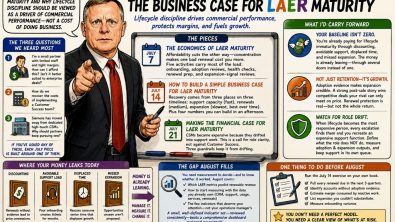
Three questions came up repeatedly this year, all from owners and principals, and none of them were about whether lifecycle management is a good idea.
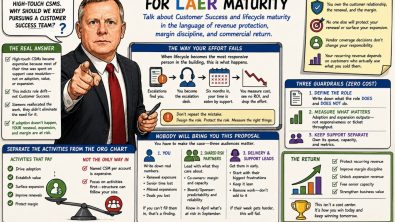
The first: I’m a small partner with limited staff and tight margins, how can I afford this, and isn’t it better suited to enterprise deals? The second: how do we recover the costs of implementing a Customer Success team? The third, and the one I found hardest, came from a principal who pointed out that Siemens has moved away from dedicated high-touch CSMs and asked why partners should continue to pursue one.
These questions are addressed one-by-one in each of my last three blogs.
The pieces
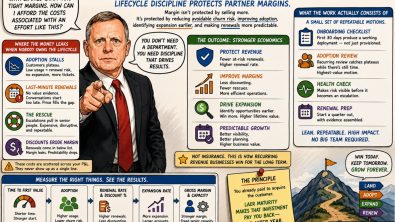
The Economics of LAER Maturity takes the affordability objection and shows it cuts the other way, since concentrated revenue means one bad renewal costs you proportionally more than it costs a larger firm. The more useful half of the article isn’t defensive. Five activities carry most of the load: an onboarding checklist, a recurring adoption review, a standard health check, renewal preparation starting a quarter out, and an expansion-signal review. Those are what let you reach a renewal without a discount conversation, turn a proven deployment into your highest-margin revenue, and answer the question every buyer of recurring software now asks: whether anyone will still be there after the implementation.
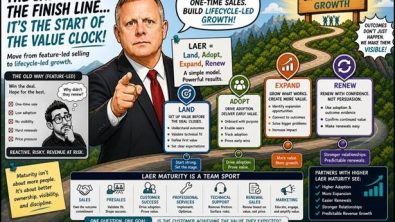
How to Build a Simple Business Case for LAER Maturity answers the cost-recovery question and pushes back on the premise inside it. Recovery arrives from three places on three different timelines, each traceable to a specific activity: support capacity from onboarding discipline, within a quarter or two; renewal outcomes from adoption reviews and health checks, lagging a full renewal cycle; expansion from signal review, slowest to start and best over time. Promise yourself a payback inside two quarters on the strength of renewals and you’ll miss. The article then lays out four numbers you can assemble in an afternoon.
Making the Financial Case for LAER Maturity starts with the CSM coverage question, and the reason behind it turns out to be the useful part. Those CSMs spent most of their time driving support case resolution with the SaaS platform team rather than driving adoption, establishing value, or having expansion conversations. From a leadership seat, that’s an expensive support function, and the conclusion follows. What it indicates isn’t Customer Success. It’s a role that drifted into a different job than the one on its title. Two clarifications the article makes plainly: those responsibilities were reallocated to other Siemens roles rather than eliminated, and it is not an opening for partners, since Customer Success delivery on Siemens-owned accounts isn’t being handed to the channel. The rest of the piece covers what most Customer Success advice gets wrong for owners: that nobody is going to bring you this proposal.
What I’d carry forward
The most useful thing to notice is that your baseline isn’t zero. Every affordability conversation assumes the current state is free. It isn’t. You’re already paying for lifecycle immaturity through discounting, avoidable support load, your own displaced time, and expansion nobody proposed. The money is already leaving, through several doors instead of one, which is why it never shows up as a line item you manage.
The second is that these activities aren’t a retention program with a growth side effect. Closer to the reverse. Adoption evidence is what makes an expansion proposal credible, and being able to describe how you get customers productive in the first sixty days gives you an answer in competitive deals that a rival can only meet on price. Renewal protection is real. It just isn’t the whole return.
The third thing is the warning buried in that CSM story, and it applies to you more sharply than it did to Siemens. When your one lifecycle person is also the most responsive person in the building, every escalation finds them, and within a year, you have an expensive resource doing support work. Then you run the numbers and conclude Customer Success doesn’t pay. You’d be right about the cost and wrong about the cause. Write down what the role does not do, measure it on adoption and expansion outputs rather than responsiveness, and keep support in its own queue. This is what June’s piece on where support ends was actually for.
The gap August fills
Every piece this month pointed at the same missing thing. To decide on this, and then to know whether it worked, you need measurement. Most firms are running on renewal rates and ticket counts, both of which tell you what already happened.
August takes that up: which LAER metrics predict renewable revenue, how to start measuring with the CRM, support, usage, services, and renewal data you already own, and which handful of indicators deserve your attention rather than your operations manager’s. The argument will be that a small, well-defined set of indicators reviewed consistently beats a comprehensive dashboard reviewed only occasionally.
One thing to do before August
If you read nothing else from the blog series, run the exercise from the “How to build a simple business case for LAER maturity” piece against your own book.
Pull every renewal due in your next three quarters and ask, for each one, whether you could produce evidence today that the customer got what they paid for. Not whether you believe it. Whether you could show it. Sum the annual value of the accounts where the answer is no.
It takes an afternoon and the number is almost always larger than expected. More to the point, it tells you which of the five activities to start with, because the accounts in that pile will have something in common, and whatever that is will point at your gap. Then pick one activity and run it for a quarter before you decide anything about headcount.
Look at your renewal base through a financial lens before renewal season does it for you. Start with the quarter you just closed.
About the author
William McInnis is a Global Partner Development Executive at Siemens Digital Industries Software, where he focuses on global go-to-market programs, partner operations strategy, customer success, renewals, and Siemens’ XaaS transformation. With more than 25 years of experience across Accenture, Siemens, Autodesk, Microsoft, and Lockheed Martin, William has led global programs spanning customer success, cloud adoption, solution delivery, business integration, and enterprise transformation. He is especially focused on helping partners adopt LAER-based customer engagement practices that improve customer outcomes, renewal performance, and sustainable growth.