Making the Financial Case for LAER Maturity
The hardest question I’ve been asked this year came from a partner principal, and it wasn’t about money.
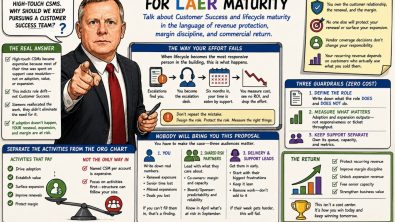
“Siemens has moved away from dedicated high-touch CSMs. Why should we keep pursuing a Customer Success team?”
Fair thing to ask, and it deserves a real answer rather than a deflection. The premise is also correct, and the reason behind it is more useful to you than the fact itself.
The high-touch CSM model became hard to justify because of what those CSMs ended up doing all day. Most of their time went to driving support case resolution. Coordinating escalations, chasing fixes, sitting between an unhappy customer and an engineering backlog. Comparatively little of it went to the work the role was created for, which was driving adoption, establishing value, and having expansion conversations. Look at that from a leadership seat and you are funding a very expensive support function. On that evidence, the conclusion isn’t unreasonable.
Notice what that actually indicts. Not Customer Success. A named role that had drifted into a different job than the one on its title.
So this is an argument for role clarity rather than against lifecycle work, and it’s worth reading next to June’s piece on where support ends and lifecycle ownership begins. That distinction wasn’t academic. This is what its absence costs at scale.
Two clarifications before I get to what it means for you. Siemens hasn’t stopped doing Customer Success work; those responsibilities have been reallocated to other Siemens roles. If adoption had stopped mattering, the work would have been eliminated rather than reassigned.
What it means on your own book
Strip the coverage question down and it’s a decision about accounts Siemens owns, sized against the economics of Siemens’ own book. Your question is about accounts you own, where you hold the customer relationship, the renewal, and the margin. Two different books, two different sets of economics. A decision about one carries very little information about the other.
Whoever carries the renewal risk carries the adoption responsibility. On your accounts, no Siemens role, reallocated or otherwise, is going to protect your renewal, surface your expansion, or explain to your customer why the deployment stalled. Nothing about anyone else’s coverage model changes the fact that your recurring revenue depends on customers who actually use what you sold them.
The way your own effort is most likely to fail
This is the part I’d take from it, and it’s worth more to you than the answer to the original objection.
The drift that made high-touch CSMs look expensive is not a large-organization problem. It’s the default outcome, and a small firm is more exposed to it, not less. When your one lifecycle person is also the most responsive person in the building, every escalation finds them. Six months in, they’re the escalation desk. Eighteen months in, you run the numbers, see an expensive resource doing support work, and reach exactly the conclusion Siemens reached. You’ll be right about the cost and wrong about the cause.
Three guardrails, and none of them cost anything. Write down what the role does not do, not only what it does. Measure it on adoption and expansion outputs rather than on responsiveness or ticket throughput, because whatever you measure it on is what it will become. And keep support as a distinct function with its own queue, so a case entering the system doesn’t automatically consume your lifecycle capacity.
One thing your objection gets right regardless of any of this: a dedicated named CSM for every account is an expensive structure and a poor entry point for a firm your size. Separate the activities from the org chart. The activities are what pay.
Nobody is going to bring you this proposal
Last week’s piece was about assembling the numbers. This one is about what happens next, and your situation isn’t the one most Customer Success advice assumes.
That advice is written for someone who has to sell the idea upward. You don’t. If you own the firm there’s no budget committee to persuade and no VP to win over, which sounds easier and is actually harder, because nothing forces you to articulate the case, and an initiative nobody had to defend tends to get half-started and quietly dropped when Q3 gets busy. So the discipline has to be self-imposed. Three audiences matter here, and only one is obvious.
The first audience is you
There’s a version of this you can talk yourself into that won’t survive contact with a busy quarter. It sounds like: we should be closer to our customers after the sale, we’re not staying in touch enough, we should really do something about customer success. Every clause is true. None of it commits you to anything, which is why it feels good and produces nothing.
The version that survives is specific and uncomfortable. You have this much recurring revenue renewing in the next nine months in accounts where you cannot demonstrate value. You spent this many senior hours last year stabilizing accounts that went quiet after implementation. You left these two expansions on the table because nobody was close enough to see them. You lost a competitive deal in March partly because you had no credible answer on how you get customers productive.
Write those four things down with actual figures. If you can’t fill them in, that’s the finding, and it’s a more useful one than any framework.
The reason to start with exposure rather than opportunity is that you’ll discount your own growth projections and you won’t discount your own history. But don’t stop at exposure either. A decision made purely on downside gets you a defensive commitment, and defensive commitments are the first thing you drop when something urgent lands. Once the exposure is written down, put the other half next to it: renewals that close without a discount conversation, expansion proposals that go out with evidence behind them, a post-sale story you can use in competitive deals. Same activities. The second half is what makes you actually do it.
The second audience is whoever shares the risk
Co-owners, a board, a private equity sponsor, a spouse who signed the same personal guarantee you did.
With co-owners and principals, the strongest ground is margin and senior capacity, because they feel rescue work the way you do. Be specific about whose calendar got consumed last year and what it displaced. With a board or sponsor, lead with predictability rather than growth. A recurring revenue business is valued on the reliability of its revenue base, so knowing in April which September renewals are exposed has value quite apart from whether you save them.
The third audience is the one most owners skip
Your delivery and support leads.
These are the people whose week changes if this gets adopted. If they experience it as new process layered on a full workload, it will be performed for two months and abandoned, and you will conclude that Customer Success doesn’t work for firms your size. That’s the most common failure mode I see, and it isn’t a capability problem.
What tends to work is starting from something that already frustrates them, which is usually the same three accounts generating avoidable tickets. Frame the adoption review as how that stops rather than as a new reporting obligation. Give the motion a named owner and a trigger, and then hold the review yourself for the first two months so it’s visibly your priority and not an errand you assigned.
You’ll hear two objections from this group, and both deserve straight answers. Someone will ask whether this is just what support already does. The precise answer is that support is reactive and resolution-oriented while adoption work is proactive and outcome-oriented, and a customer can receive excellent support for twelve months and still reach renewal with nothing realized. Someone else will say customers would tell us if there were a problem. Some would. The dangerous accounts are the quiet ones, and you hear from them exactly once.
Don’t make this a hiring decision
The fastest way to kill this is to convert it into a single question about a salary. If the decision becomes “do we hire a Customer Success Manager,” you’ve made lifecycle maturity contingent on a yes to the most expensive version of it, and if the answer is no this year, nothing happens.
Name who owns each stage, put the monthly review on the calendar, run it a quarter or two, then let the headcount question come out of what you observe. You’ll be deciding with data about which motions consume capacity and where the constraint sits.
One thing not to promise yourself
It’s tempting to attach a retention improvement to this. Cleanest metric, easiest number to say out loud.
Resist a specific figure. Renewal outcomes have many inputs, several of which have nothing to do with you, and if you commit to a percentage you’ll spend a year defending something you invented before you had data. Commit to leading indicators instead: coverage of adoption evidence across your renewal base, time to a working deployment, the share of at-risk accounts you identified before the final quarter of the term. Those are inside your control, they move faster than renewal rates, and they’re what you’d want on your dashboard anyway.
Post-sale work stops reading as overhead the moment it’s connected to revenue you can name, on both sides of the ledger. Most of what makes this decision hard is that the connection is real and nobody in your firm has written it down yet.
Use revenue, risk, margin, and return language to position LAER maturity investment. Lead with what is already exposed, and start with the cheapest activity that addresses it.
About the author
William McInnis is a Global Partner Development Executive at Siemens Digital Industries Software, where he focuses on global go-to-market programs, partner operations strategy, customer success, renewals, and Siemens’ XaaS transformation. With more than 25 years of experience across Accenture, Siemens, Autodesk, Microsoft, and Lockheed Martin, William has led global programs spanning customer success, cloud adoption, solution delivery, business integration, and enterprise transformation. He is especially focused on helping partners adopt LAER-based customer engagement practices that improve customer outcomes, renewal performance, and sustainable growth.