How sellers are using NotebookLM to build sharper account plans in less time

The account plan that never gets finished
Most account plans start with good intentions. A blank template, a few tabs open, a calendar reminder to finish it before the QBR. Then the week happens. By the time the meeting arrives, the plan is either half-done or a copy of last quarter’s with updated dates.
This is not a discipline problem. It is a time problem. Building a genuinely useful account plan, one that reflects the customer’s actual priorities, the competitive landscape, recent news and the internal stakeholder map, takes hours of research most sellers simply do not have.
And in enterprise sales, that gap shows. Not in the first five minutes of a meeting, but the moment an executive asks a question you did not anticipate. The moment a competitor walks in better prepared. The moment you realize the customer has shifted their priorities and your plan did not capture it.
Something has shifted, though. A small number of sellers are closing that gap using a tool most people still associate with note-taking. And the difference in their preparation quality is hard to ignore.
Account planning has always had a research problem. The information exists. Annual reports, earnings calls, press releases, industry analyst summaries, previous meeting notes, internal CRM history. The problem is never access. The problem is synthesis. By the time a seller has read enough to form a coherent point of view, the window for preparation has closed.
The typical workaround looks like this:
- Skim the customer’s website for a mission statement
- Pull last year’s account plan and update the numbers
- Search for recent news the night before the meeting
- Rely on memory and relationship history to fill the gaps
It is fast. It is also shallow. And in enterprise sales, shallow account plan preparation is visible the moment a conversation moves off script.
What NotebookLM actually is
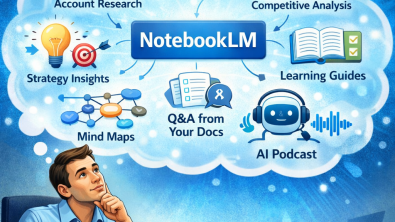
NotebookLM is a research and reasoning tool from Google. It is not a chatbot in the traditional sense. You do not ask it general questions and hope for useful answers. Instead, you upload your own source documents: earnings transcripts, analyst reports, account notes, product briefs, competitive summaries. It reasons exclusively from that material.
That distinction matters. When you ask NotebookLM a question, the answer comes from what you fed it, not from the open internet. It cites the sources it draws from. It stays grounded. And it works across a wide range of inputs:
- Customer annual reports and investor presentations
- Previous call notes and CRM records
- Industry analyst reports
- Internal battlecards and product positioning documents
- News articles and press releases saved as PDFs
Think of it as a private analyst that has read everything you have given it and is ready to answer questions, surface patterns and draft content based only on that material.
Why this matters for sellers
The best sellers do not just know their product. They know their customer’s business as well as the customer does, sometimes better. That level of account planning is what earns access to executive conversations, shortens sales cycles and differentiates a vendor from a trusted advisor.
The problem is that standard is difficult to sustain across a full account portfolio. NotebookLM does not replace the seller’s judgment or the relationship. What it does is compress the time it takes to reach a credible, informed starting point. That means more accounts prepared to a higher standard, with less time spent on raw research. For enterprise sellers managing complex, multi-stakeholder accounts, that is a meaningful shift in capacity.
Practical ways sales teams can use it
Executive meeting preparation. Upload the customer’s latest earnings call transcript, their annual report and any recent press coverage. Ask NotebookLM to summarise the top strategic priorities leadership has signalled publicly. Use that as the foundation for your meeting agenda and opening questions.
Whitespace and expansion planning. Feed in your current contract scope, the customer’s organisational structure and any product usage data you have. Ask NotebookLM to identify where there are gaps between what the customer is using and what their stated priorities require. It will not invent opportunities, but it will surface connections you might have missed.
Competitive positioning. Load your internal battlecards alongside publicly available information about the competitor: their product announcements, case studies and customer reviews. Ask NotebookLM to map where your solution has clear differentiation and where the customer might push back. Use it to rehearse objection handling before the meeting.
Stakeholder briefing documents. If you are bringing in a senior executive or specialist for a customer meeting, use NotebookLM to generate a concise briefing from your account notes and recent customer activity. It saves the internal prep call and gets everyone aligned faster.
A feature worth calling out
NotebookLM includes an Audio Overview function that converts your source material into a conversational podcast-style summary. For sellers who are time-pressed and process information better by listening, this is a practical way to absorb account context during a commute or between meetings. It is not a replacement for reading, but it is a genuinely useful way to ingest large amounts of material quickly without sitting at a desk.
A simple way to get started
The fastest way to see the value is to pick one account and run a focused experiment before your next meeting.
- Gather three to five documents: the customer’s most recent annual report, your last two meeting summaries and one relevant industry report
- Create a new notebook in NotebookLM and upload all of them
- Ask: “What are the top priorities this customer has signalled in the last twelve months?”
- Ask: “Where do the customer’s stated challenges align with what we offer?”
- Use the output to draft your meeting agenda and your opening questions
The whole process takes thirty to forty-five minutes. Compare what you produce to your last account plan and the gap will be clear.
The broader shift
The sellers who will be hardest to compete with over the next few years are not necessarily the ones with the largest networks or the most product knowledge. They will be the ones who show up to every conversation with a level of preparation that feels almost unfair. Who ask questions that make the customer feel genuinely understood, who anticipate objections before they surface and who connect their solution to what the customer actually cares about.
That standard used to require either a dedicated research team or an unusual amount of personal discipline. Tools like NotebookLM make it accessible to any seller willing to change how they spend their preparation time.
The question is not whether AI will change how account planning gets done. It already is. The question is whether you are using it yet. Listen to this podcast to learn more about how NotebookLM can change the way you plan and prepare for your most important accounts.
About the author
Benedict Russell is a Global Partner Development Executive responsible for scaling global GTM programs across all motions. He helps shape Siemens’ digital selling and AI strategy, embedding best practices that accelerate SaaS adoption and recurring revenue. Previously, he drove partner coverage and expansion, adding 300+ partners to the Siemens ecosystem. Read Benedict’s most recent blog here.