Navigating the Complexity of Enterprise BOM Management

A digital transformation approach for a future-ready organization
Craig Armenti – Director of Electronics Solutions@Siemens Digital Industries Software | Electronics | Digital Twins | PLM | NPI | Supply Chain | Sustainability and Compliance
In today’s fast-paced, digitally driven business environment, managing the Bill of Materials (BOM) requires a strategic shift, one that enables a more innovative, more connected approach. By evolving beyond fragmented systems and static processes, organizations can unlock greater efficiency, enhance cross-functional collaboration, reduce costs, and accelerate innovation.
Why BOM management? Despite significant advances in technology, many electronics manufacturers remain constrained by the realities of legacy infrastructure and long-standing organizational silos. Fragmented and distributed BOM data, manual processes, and disconnected disciplines continue to slow innovation and hinder production efficiency. These limitations aren’t just technical, they’re structural and show up daily in missed deadlines, rework, and lost opportunities.
Overcoming these challenges requires more than just new tools, it calls for integrated systems, cross-functional alignment, and strong governance that supports smarter, faster, and more scalable operations.
Let’s take a closer look at the requirements for a robust enterprise BOM strategy.
Key challenges in BOM management
- Fragmented and distributed BOM data: The lack of integration and connectivity between domains and disciplines results in fragmented BOMs, poor traceability, slow process cycle times, manual errors, and difficulty managing variants. This fragmentation hampers the overall efficiency and accuracy of BOM management.
- Manual BOM management: Without a unified definition and management of change and configuration across the product lifecycle, organizations struggle with disconnected processes and manual data reconciliation efforts. This leads to departmental disconnects, inconsistencies, and delays in the creation and release of downstream BOMs, ultimately impacting time to market.
- Legacy or multiple BOM solutions: Heavy reliance on legacy tools and custom macros to manage different versions and types of product BOMs creates challenges in alignment, data quality, and validation. These outdated solutions often fail to meet the demands of modern, complex product development environments.
- BOM management gaps: Implementing a comprehensive governance model for BOMs over the complete lifecycle can be challenging. Managing multiple stakeholders, communication issues, and compliance requirements can lead to delays in the time to market and hinder the overall effectiveness of your BOM management.
It’s time to move forward with a framework-driven approach to multi-domain and multi-disciplinary BOM Management…
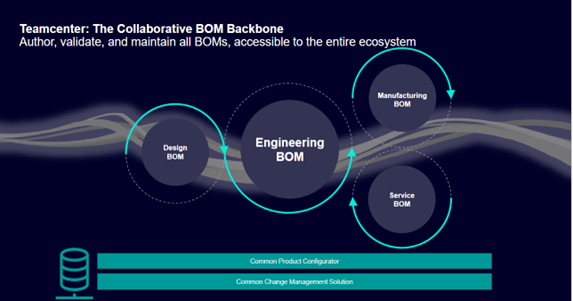
An effective enterprise BOM strategy should successfully address all of these challenges and align with the business strategy. It should cover the functional architecture of the BOM landscape, the supported BOM use cases, and best practices. And it must be accessible to the entire product development ecosystem.
Here are some key considerations:
- Functional architecture: Design the BOM system according to the organization’s requirements, ensuring it supports key business processes.
- BOM use cases: Integrate use cases that enhance product and process efficiency, relevance, resilience, quality, and traceability.
- Best practices: Adopt best practices that address the latest market, business function, and technology trends.
Digital transformation plays a critical role
In the face of paradigm shifts driven by digital transformation and globalization, enterprises should reassess and optimize their BOM strategies. Digital transformation is not just a buzzword; it’s a necessity for companies who intend to stay competitive in today’s complex market. By modernizing and digitalizing BOM management, companies can:
- Streamline processes and reduce manual errors through automation and integration.
- Foster better communication and coordination across departments and with external partners.
- Reduce operational costs by eliminating inefficiencies and leveraging advanced technologies, leading to substantial financial benefits.
- Enable faster and more flexible product development cycles, which will allow quicker adaptation to market changes and foster a culture of innovation.
The current approach to BOM management is unsustainable
Rising product complexity and shrinking delivery windows demand faster, more agile processes that can adapt to evolving customer needs, shifting markets, and accelerating technology.
Modernizing the BOM is a strategic move that aligns with the increasing demands of today’s business landscape, offering numerous benefits for efficiency, collaboration, cost savings, and innovation. Companies can ensure future competitiveness and success by building a resilient and efficient enterprise BOM architecture. Embracing digital transformation in BOM management is essential for navigating the complexities of the modern market and achieving long-term growth.
Digital transformation is a journey, not a destination
By embracing it step by step, companies can evolve into more competitive, agile operations—empowering collaboration and innovation to thrive in today’s fast-paced, ever-changing global marketplace. Reach out today to learn how we can help transform your business.
Want to dive deeper? Download our white paper “A framework driven approach for multi-domain and multi-disciplinary bill of materials management” to explore proven strategies for speeding up product delivery while reducing risk.
For more information, visit: www.sw.siemens.com/en-US/solutions/bom-management/