Proactive BOM analysis for supply chain resilience
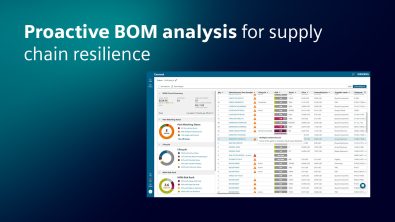
BOM risk has become a critical design constraint, where a single part shortage can trigger weeks of redesign churn and manufacturing volatility. For growing companies, these problems are often magnified by the “panic-buying” of large reserve stocks just to avoid simple procurement delays. Proactive BOM analysis breaks this cycle by reducing late-stage issues, protecting release schedules, and ensuring that supply resilience is treated as an engineering decision, not a procurement exception.
Supply chain volatility has shifted what “good design” looks like. It’s no longer enough to meet electrical and mechanical requirements on paper. Designs also need to remain buildable as availability, lifecycle status, and lead times change in real time. Teams that consistently hit dates treat the bill of materials (BOM) as a living risk model, not a static spreadsheet exported at the end.
This is where proactive BOM analysis can act as a competitive differentiator. It integrates supply intelligence throughout the design process, enables cross-functional alignment in real time and ties intent to design implementation. Xpedition technology integrates digital component definitions with real-world supply chain intelligence so your team can build resilience into the design workflow instead of bolting it on during late-stage manufacturing crisis.
The “late discovery tax” of BOM risk
Most organizations recognize supply risk. The common point of failure is when it’s discovered.
Late BOM surprises typically show up as:
- A key IC goes into allocation after placement is finalized.
- A passive is “available,” but only in a package your footprint can’t accept.
- A lifecycle change (NRND/EOL) appears mid-design.
- An alternate exists, but it’s not approved, verified or Form-Fit-Function (FFF) compatible.
- Engineering and procurement are working from different BOM versions.
Each of these events triggers the late discovery tax: substitution requests, layout edits, re-verification, ECO cycles and schedule compression.
What proactive BOM analysis means
Proactive BOM analysis is not a single report. It is a continuous loop that starts at component selection and continues through release.
A practical definition has three parts:
- Continuous intelligence: Supply risk signals are visible while you design, not after.
- Collaborative decisioning: Engineering, sourcing, and procurement align early on acceptable parts and FFF alternates.
- Traceable execution: Decisions and changes stay connected to the design implementation through release with lifecycle insights.
A simple way to operationalize it is: Detect risk early. Decide alternates fast. Deliver a release-ready BOM.
PartQuest Portal: bring supply intelligence into the earliest decisions
The most leverage you have in any design occurs before choices are locked into schematics and footprints. Once a part is routed during layout, the cost of changing triples. That’s why proactive BOM analysis starts with component discovery and evaluation.
PartQuest Portal moves supply chain resilience to this “point of zero cost” by surfacing market intelligence directly during component discovery. Instead of just finding a part that meets a spec, design can now validate buildability during the design process.
What this enables in practice:
- Pre-layout risk visibility. Designers can see potential exposure before it becomes redesign work.
- Smarter alternate planning. You can evaluate options while requirements and constraints are still flexible.
- Fewer last-minute substitutions. You reduce the probability of swapping components under time pressure.
PartQuest Portal ensures that by the time you reach layout, your BOM is just a list of parts – it’s a validated plan for production.
BOM Intelligence with Siemens Connect: align stakeholders on one shared BOM reality
Even when supply intelligence exists, many teams still lose time because collaboration happens in disconnected tools: emailed spreadsheets, forwarded links, and screenshots in chat threads. The design intent is separated from implementation, so decisions are made but not consistently captured. Approvals are implied, but not traceable. Versions drift out of sync.
BOM intelligence becomes far more powerful when it is shared through a collaboration layer that keeps stakeholders aligned with the same data and the same decisions. Siemens Connect supports cloud-enabled collaboration so teams can review, discuss, and converge on BOM choices without relying on manual handoffs.
This matters because BOM decisions are never purely technical. They are cross-functional by nature:
- Engineering cares about requirements, performance margins, physical constraints, and validation impact.
- Procurement cares about lead times, supply risk, and sourcing options.
- Manufacturing cares about approved vendor lists, substitutions, and production readiness.
When these perspectives converge early, the design process enables digital iteration to optimize design decisions for all stakeholders.
A common scenario illustrates the difference:
- Procurement flags a high-risk MCU.
- Engineering reviews pre-qualified alternates.
- The team confirms footprint and key parameters before layout is committed.
- The BOM decision is captured, visible, and reusable for the next design.
One shared view beats ten forwarded spreadsheets.
Xpedition Standard: execute with fewer surprises downstream
Proactive BOM analysis only pays off when insights and decisions flow into execution: schematic capture, layout, and the outputs that drive manufacturing. That’s where Xpedition Standard connects intent to implementation.
Xpedition Standard is a scalable PCB design solution for growing teams needing advanced capabilities. It balances cost-efficiency with powerful features, and it supports the workflows teams rely on as complexity increases. When end-to-end design intelligence and collaboration reduce churn, the design environment becomes a place to implement confidently rather than repeatedly rework.
The integrated workflow: from part selection to release confidence
A resilient workflow is consistent and traceable.
Here is a practical, repeatable flow that connects PartQuest Portal, Siemens Connect, and Xpedition Standard:
- Part discovery and evaluation (PartQuest Portal): Shortlist components with supply and lifecycle context in view.
- Early BOM build: Assemble the initial BOM with risk signals attached to critical lines.
- Collaborative BOM review (Siemens Connect and Xpedition Standard): Align engineering, procurement, and manufacturing on:
- critical parts and constraints
- acceptable alternates
- exceptions that require program sign-off
- Design implementation (Xpedition Standard): Implement chosen parts and alternates early, reducing layout churn later.
- Milestone-based refresh: Re-check risk at the moments that matter:
- pre-layout
- placement freeze
- routing freeze
- pre-release
This closes the loop. You’re not reacting to supply risk after the design is “done.” You’re continuously and proactively verifying buildability as you design.
Design resilience is a workflow, not a fire drill
If your current process discovers BOM risk at the finish line, you’re paying the late discovery tax. Consistency creates resilience. Continuous BOM intelligence protects schedules and margins. Cross-functional alignment reduces redesign churn.
With PartQuest Portal, built-in BOM intelligence, and execution in Xpedition Standard, teams can stay ahead of the curve building products that are correct-by-construction.