Siemens Capital software how to YouTube series: How to capture and apply harness design changes
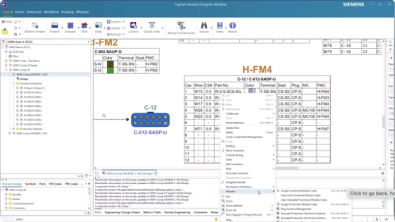
Check out Siemens Capital software how to series to find practical, workflow-driven demonstrations that show how to execute critical harness engineering tasks, including this feature on How to capture and apply harness design changes!
In today’s electrical systems landscape, change is inevitable. New feature requests, late-stage requirement updates or new functional refinements must be integrated into existing projects. Harness design engineers working across OEM and Tier 1 environments must ensure changes don’t disrupt anything downstream.
In this blog, we demonstrate how Siemens Capital solutions enable engineers to capture, propagate, validate and apply harness design changes automatically, preserving design intent while reducing risk across the value chain.
The challenge to apply harness design changes
A new electrical function needs to be introduced and assigned to an existing component on your harness design. In a modern, variant-rich E/E architecture, even a single functional change can have an impact to other components – modules, wires, connectors and related child designs.
There is no room for ambiguity when introducing a new electrical function, so you must create the new functional module with its relationships to existing modules clearly defined and correctly assigned to the appropriate wire. The connector containing that wire must reflect the updated module assignment, and the entire change must remain consistent with architectural rules and variant logic.
Once fully captured, the change is transferred to the Tier 1 supplier and applied to the target design. Any misinterpretation or inconsistent implementation at this stage can lead to rework, schedule delays or even manufacturing errors, making precision and traceability essential throughout the process.
How to capture, transfer and apply changes automatically
In Capital, OEM engineers begin by formally initiating a change order within the source design. Instead of relying on disconnected documentation, they create the new electrical functional module directly within the model and define relationships immediately, including setting exclusivity rules against existing modules.
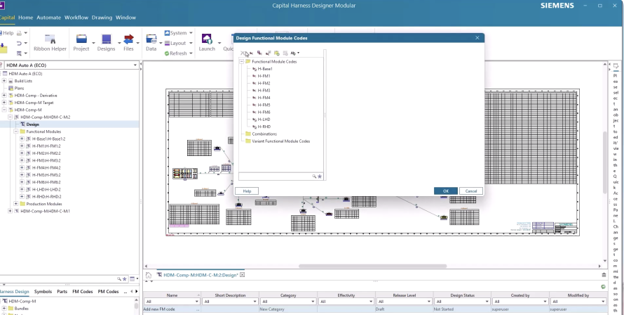
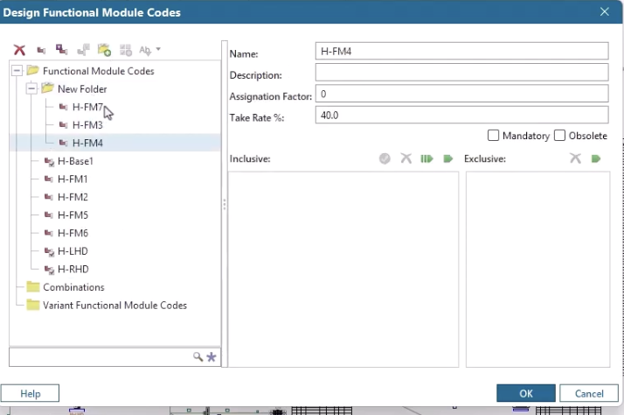
Next, the module is consumed and assigned to the appropriate wire, and the connector module assignment updates accordingly.
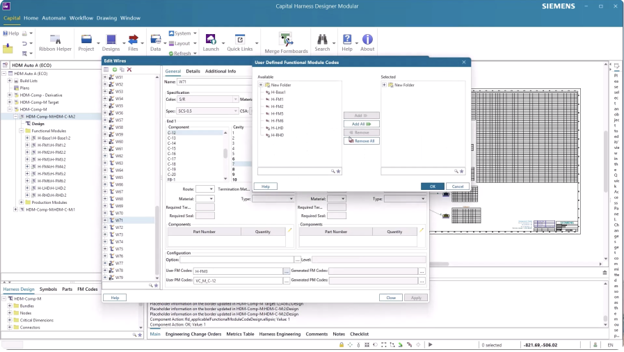

Now the engineer creates the corresponding module design to fully represent the new function.
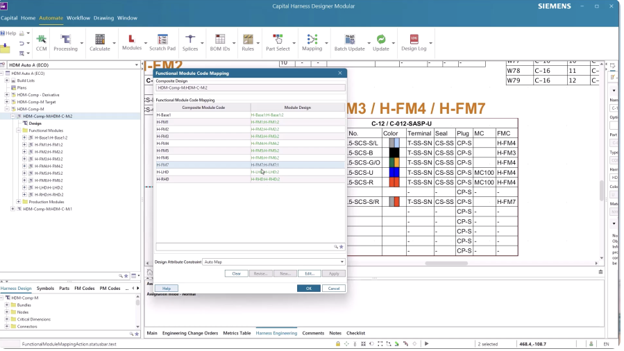
The change is now fully modeled and ready for transfer.
At the Tier 1 supplier, harness designers receive the change order. Instead of manually interpreting instructions and replicating edits, they use Capital’s Change Manager to automatically apply the modification to the target design.
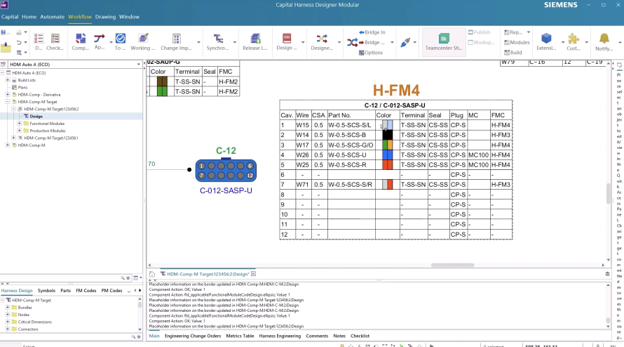
All related child designs are visible within the Map Modules interface, making dependencies clear.
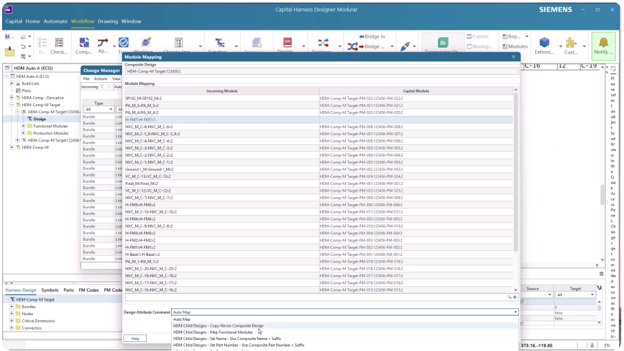
The required constraints are applied, a new reference is assigned, and the system confirms successful implementation.
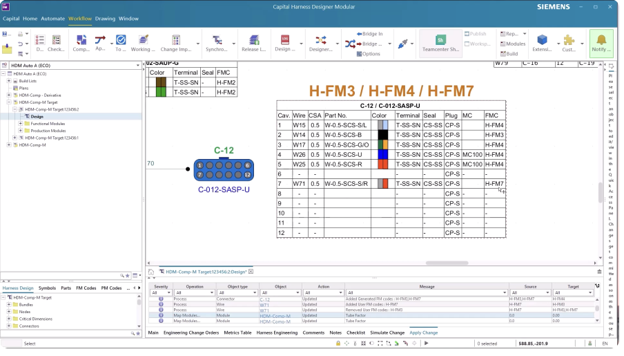
The updated wire is correctly assigned to the new functional module, without guesswork or manual cross-checking.
Capital benefits
With Siemens Capital solutions, engineers capture changes once at the source and they are propagated automatically to the target design. In this way, design intent travels with the update, preserving relationships, constraints and variant rules and surfacing any potential downstream impacts.
This structured, model-based approach:
- Reduces the risk of manual error
- Shortens iteration cycles
- Strengthens collaboration between OEMs and suppliers
- Enables engineers to make changes with confidence
As electrical complexity increases and development cycles compress, the ability to manage change systematically becomes a competitive advantage. Capital ensures that when a designers apply harness design changes, they are implemented correctly and consistently.
Read the full blog series to learn more ways Siemens Capital simplifies and streamlines harness design.
Capital X is the SaaS (Software-as-a-Service) version of the Capital portfolio that has been the leading solution for comprehensive E/E systems development for over two decades. Capital X, operated by Siemens, offering a comprehensive digital twin and seamless collaboration to optimize the design, engineering and validation of complex products. Click here to learn more about Capital X.