How to optimize your spray drying process with digital twins
Why spray drying still matters
Did you know that up to 15% of the energy used in dairy plants is used for spray drying? It is frequently referred to as the “hidden giant” of food manufacturing for this reason.
The spray drying process quietly powers much of what ends up in your pantry. Powdered milk, infant formula, instant soups, sauces, coffee, and nutritional supplements all depend on it. By turning liquids into powders, spray drying makes it possible to ship products farther, store them longer, and deliver consistency batch after batch.
The catch is that spray drying is expensive and difficult to optimize. Many plants run dryers conservatively to avoid off-spec product. That feels safe, but it often leads to wasted energy, lower throughput, and hidden losses that can run into hundreds of thousands of dollars per dryer each year.
With energy prices climbing and sustainability goals becoming more urgent, those losses are no longer justifiable. The good news is that new digital approaches are changing the way this process is managed.
What is spray drying in the food and beverage industry?
At its core, spray drying in food industry operations follow three steps. First, liquid feed is atomized into droplets through high-pressure nozzles or rotary atomizers. Next, those droplets are dried almost instantly in a chamber of heated air. Finally, the resulting powder is collected using cyclones, bag filters, or drums.
There are two main process types worth noting.
- Single-effect drying: heat is introduced from one source at the top of the chamber.
- Multiple-effect drying: adds a static bed at the bottom of the chamber, improving drying efficiency and controlling particle size.
This process is a cornerstone of food production because it delivers powders that are stable, portable, and easy to rehydrate. Without it, products like milk powder, coffee, or nutritional supplements would be much harder to produce at scale.
Spray dryer applications across food and beverage
The reason spray drying is so widely used is simple: it supports an incredible range of products. Common spray dryer applications include dairy powders, infant formula, instant coffee, malt beverages, soups, sauces, and flavorings. It is also used to produce nutritional powders and functional ingredients.
Beyond food, spray drying has a growing role in pharmaceuticals, nutraceuticals, ceramics, and specialty chemicals. Its ability to create precise particle sizes and extend shelf life makes it valuable across industries.
The challenges of spray drying in the food industry
Of course, with that versatility comes complexity. Spray drying in food industry operations faces four main hurdles:
- Energy intensity – running dryers conservatively consumes excessive power and heat.
- Moisture variability – environmental changes and feed variation make consistency difficult.
- Fouling and downtime – powder deposits inside chambers force unplanned shutdowns.
- Slow product changeovers – scaling new recipes requires trial runs that take time and waste product.
These problems ripple across the business. Operators struggle with constant adjustments. Managers see rising costs and reduced output. And executives face pressure to meet sustainability targets while keeping margins intact.
Spray drying optimization with digital twin technology
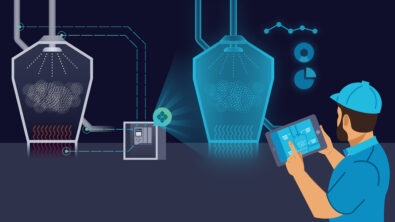
This is where spray drying optimization with digital twin technology changes the equation. A digital twin is a virtual model of the dryer that behaves just like the real one. It allows teams to simulate, predict, and optimize dryer performance in real time.
With a digital twin, manufacturers can:
- Control moisture content more precisely.
- Reduce over-drying to save energy.
- Adapt automatically to seasonal or feed variation.
- Run in open-loop (operator guidance) or closed-loop (automated control).
Watch Clip: Seamless Integration — Connecting the Digital Ecosystem for Process Optimization
Instead of operating with trial and error, teams can run dryers with confidence, backed by science and data.
Spray drying optimization for efficiency, productivity and sustainability
Even modest changes in the spray drying process deliver outsized gains. For example:
- Smarter setpoints speed up new product introductions.
- Cutting unnecessary over-drying saves thousands in energy costs.
- Running closer to safe moisture limits increases throughput.
- Reducing fouling extends uptime and reduces maintenance costs.
Watch Clip: Unlocking Productivity and Energy Efficiency in Drying Processes
When viewed together, these gains mean higher margins, lower environmental impact, and a faster path to market. It’s why digital optimization has moved from “nice-to-have” to “must-have” for food and beverage manufacturers.
Real-world case study: Digital twin spray drying in action
The value of digital twin spray drying is proven in practice. One global FMCG manufacturer used Siemens’ Spray Dryer Optimizer and saw:
- Higher product moisture without quality issues.
- Lower energy use across runs.
- Increased throughput with the same equipment.
- ROI achieved in about 12 months.
The plant was later recognized by the World Economic Forum as a Lighthouse Factory for digital transformation.
Watch Clip: Enhancing FMCG Powder Production with Digital Twin Technology
This case shows that optimization is not only technically possible, but also financially rewarding and industry-recognized.
A smarter way to operate: Dashboard and control integration
The impact extends to the control room. Siemens’ Spray Dryer Optimizer connects seamlessly with existing DCS, SCADA, or PLC systems, giving teams a single dashboard with:
- Real-time KPIs for moisture, energy, and throughput.
- Predictive recommendations for setpoints.
- Open- and closed-loop modes for flexible operations.
- Historical data for long-term analysis.
Watch Clip: Integrated Spray Dryer Optimization System Overview
For operators, this means fewer blind spots. For managers, it means visibility into a process that historically hid inefficiencies until it was too late.
Why digital twin spray drying is different from traditional methods
Advanced process control (APC) has been used for years, but its benefits are limited. Over time, APC performance drifts. It adapts slowly to new products. And it relies heavily on historical data.
Digital twin spray drying is built differently:
- Physics-based modeling makes it more accurate.
- Real-time insights provide faster feedback than lab testing.
- Flexibility makes it compatible with both new and legacy dryers.
- Performance remains consistent over years, not just months.
For manufacturers, this is more than an incremental upgrade. It’s a long-term foundation for efficiency, sustainability, and competitiveness.
Watch the full webinar recording
The spray drying process in the food industry is essential, but traditional approaches leave too much value untapped. With digital twin spray drying, companies can cut waste, improve product quality, and increase throughput without expensive equipment replacements.
Watch the Full Recording: Spray Drying Optimization with Siemens
Frequently asked questions about spray drying
Q1: What is the spray drying process used for?
It is used to make stable powders from liquids, such as milk, coffee, soups, sauces, infant formula, and nutritional products.
Q2: What are common spray dryer applications in the food industry?
Spray dryers are applied in dairy, malt beverages, soups, sauces, flavorings, infant formula, and nutritional powders.
Q3: How does spray drying optimization reduce costs?
By improving moisture control, reducing downtime, and increasing throughput, manufacturers save energy and get more from the same equipment.
Q4: How is digital twin spray drying different from traditional optimization methods?
It models drying behavior using first-principle physics, making it more accurate, adaptable, and sustainable than traditional methods.
Q5: What industries outside food use spray drying?
Spray drying is also applied in pharmaceuticals, nutraceuticals, ceramics and specialty chemicals.
Q6: What is spray drying temperature?
Spray drying typically operates with inlet temperatures between 150°C and 300°C depending on the product, with outlet temperatures adjusted to protect product quality.
Q7: What are the main types of spray dryers?
The two most common are rotary atomizer dryers and nozzle atomizer dryers. Rotary atomizers are often used for high-capacity systems, while nozzle systems provide finer control for sensitive products.