Innovative simulation and test solutions for trustworthy data-centric AI
This blogpost reports on our research mission to achieve innovative simulation and test solutions for trustworthy data-centric AI. This research is performed with KU Leuven in the frame of our research project SATISFY.AI, with support from the Flanders Innovation & Entrepreneurship Agency (VLAIO).
1. Challenge: Trustworthy AI starts with trustworthy data
Data analytics with big data is already used successfully in sectors such as banking/finance, pharma & healthcare and retail. In contrast, in engineering sector the adoption is still lower, likely due to the difficulty to handle data scarcity, data complexity, and the lack of data trustworthiness. These difficulties must be overcome, in order to increase the quality of AI/ML (Artificial Intelligence / Machine Learning) models based on engineering data. Indeed, Trustworthy AI starts with Trustworthy Data1.
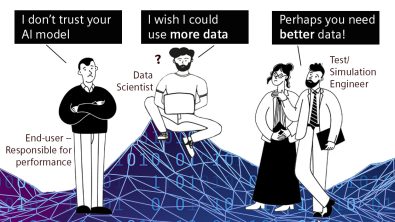
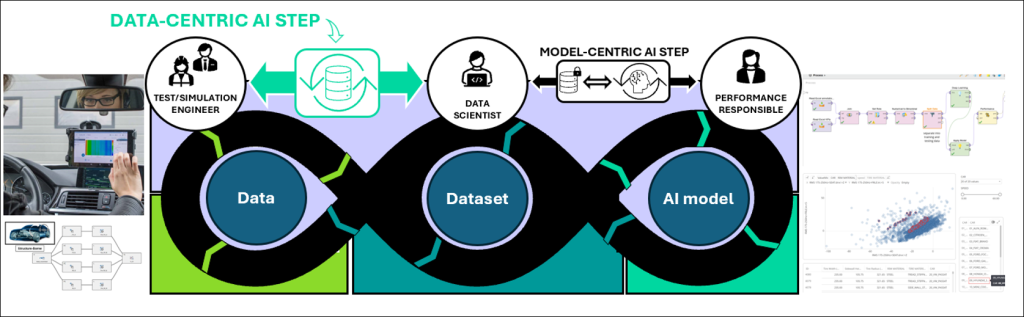
Often, engineering companies that start with AI are focused on producing the best AI model for a given dataset, i.e. they adopt the ‘Model-Centric AI’ approach. However, the main hurdle that they face is that data sets are often not well annotated and/or lack information. Studies reveal that data scientists may spend 80% of their time on AI projects on cleaning and curating data2. This happens because the traditional model-centric AI assumes and requires clean data sets, which is unrealistic in industry. We see a need, also promoted by leaders in the AI field3, for a paradigm shift towards ‘Data-Centric AI’,with the goal to systematically produce the best dataset to feed a given ML model, as shown in Figure 1.
2. SATISFY.AI: Research project enabling trustworthy data-centric AI
With the aim of overcoming the data challenges in engineering sector, we’ve embarked on a new research project SATISFY.AI, pursuing the paradigm shift to data-centric AI, and targeting trustworthy data-centric AI solutions for engineering applications (as shown in Figure 2), in order to foster collaboration among data scientists, simulation and test engineers and performance responsible personnel in industrial engineering.
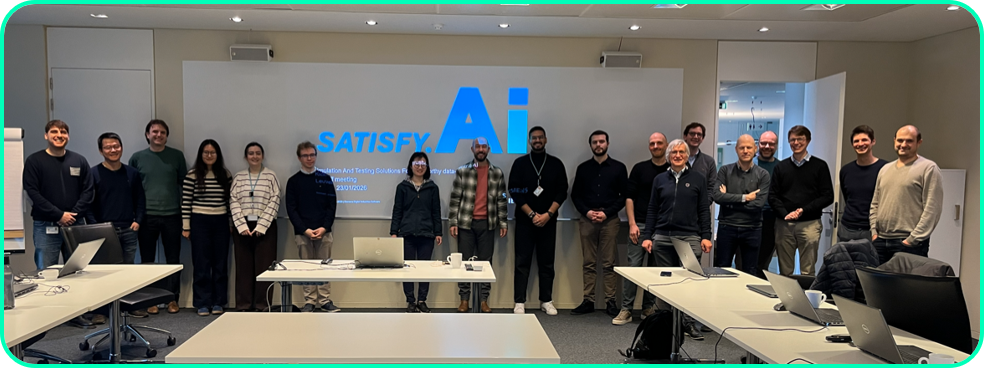
Siemens is carrying out the SATISFY.AI research project together with our long-term R&D partner KU Leuven. KU Leuven is represented by the LMSD – Mecha(tro)nic System Dynamics division of the KU Leuven Mechanical Engineering Department via Prof. Frank Naets and Prof. Konstantinos Gryllias and by the DTAI – Declarative Languages and Artificial Intelligence division of the KU Leuven Computer Science Department via Prof. Mathias Verbeke and Prof. Peter Karsmakers. The SATISFY.AI research project thus unites Siemens’ domain experts with KU Leuven’s AI and mechatronic top researchers, together performing the necessary research to achieve trustworthy AI solutions for the engineering sector, addressing complex data challenges for engineering product design.
Siemens has had a close partnership with KU Leuven for decades, which has seen academic researchers and students work alongside Siemens engineers on multiple important research projects4. In 2024, Siemens donated a Chair for Digital Twins for Smart and Sustainable Products5 to further support research and innovation at KU Leuven in this domain. The chair promotes methodological research, stimulates innovations in industrial applications, disseminates results, and supports education in the field of Digital Twin technology6.
3. Research outlook
In our SATISFY.AI research project, we’ll address the complex data challenges for product design and bring in place trustworthy AI workflows capable of handling and delivering AI-ready data.
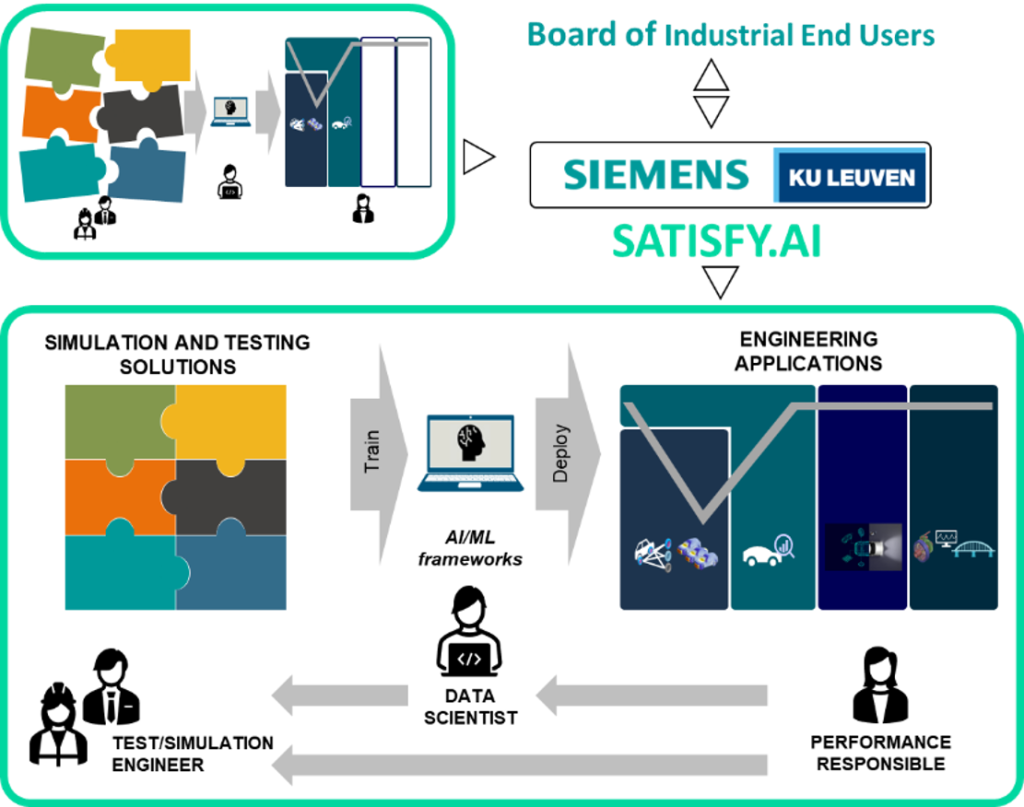
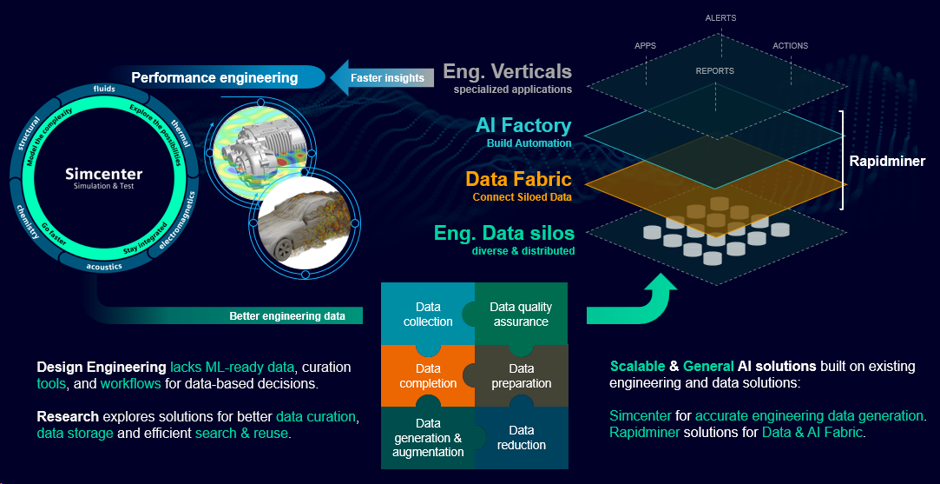
The project involves research into new methodologies for high-quality data acquisition and generation, managing complex mechatronics data, ensuring explainability and uncertainty quantification of AI results. Thanks to innovative simulation and test solutions for this purpose, the aim is to produce high-quality datasets for ML models, thus making AI reliable and efficient for engineering applications. As such, we will leverage and combine the Simcenter portfolio7 of simulation and test solutions with the Rapidminer solutions for Data and AI fabric8. As visualized in Figure 3, this will enable us to shift to higher gears in the domain of data-based engineering. By providing trustworthy AI workflows capable of handling and delivering AI-ready data, we will provide future-proof solutions to both data scientists and engineers, enabling them to simulate, optimize and verify critical performance aspects of complex industrial products.
The SATISFY.AI project addresses cases ranging from early-stage design, testing and verification, monitoring and prognostics, as shown in Figure 4. The use cases span over the entire product design, development and operational trajectory. This is visualized as an “extended V-cycle” (starting with the traditional “V-cycle” that is extended with a horizontal continuation into the operational phase). Towards industrial validation of our research, we’ll involve our Board of Industrial End Users: Novali, SAFRAN and Toyota Motor Europe have already confirmed interest in the SATISFY.AI research. These and other OEMs will interact with SATISFY.AI and contribute to industrial validation on representative use cases.

Furthermore, Siemens is already reaching out to its Simcenter customers who have expressed interest in adopting AI into their testing workflows to help them stay ahead of the competition. In this context, Siemens hosted its first AI Master Class in Leuven, Belgium on May 19-21. Check out this blog post9 for a recap of the highlights, key learnings and audience takeaways from this three-day Master class.
Acknowledgements
This research is supported by VLAIO (Flanders Innovation & Entrepreneurship Agency) in the frame of the research project SATISFY.AI (“Simulation And TestIng Solutions For trustworthY data-centric AI”, with reference number HBC.2025.0492). We furthermore thank our Board of Industrial End Users – Novali, SAFRAN, Toyota Motor Europe and other OEMs – for supporting the research. Finally, we gratefully acknowledge the SATISFY.AI research team at KU Leuven and Siemens.
References
- Peter Koerte, The return of the simple: Transforming industry through AI, Siemens Research and Innovation Ecosystem (RIE) Aachen Arc Annual Conference, Aachen (DE), October 25, 2024. ↩︎
- Big Data Quarterly, Reversing the 80/20 rule in Data Analytics, May 21, 2021. ↩︎
- MIT, MIT DCAI Lecture 1: Data-Centric AI vs. Model-Centric AI, Lecture, January 16, 2024. ↩︎
- Adrien Scheuer, Onur Atak, Stijn Donders, ML for Industrial CAE – “Just scale it”, Siemens The Art of the Possible Blogpost, April 7, 2026. ↩︎
- Siemens Digital Industries Software, Siemens and KU Leuven collaborate to research Digital Twin for Smart and Sustainable Products, Press Release, June 11, 2024. ↩︎
- KU Leuven, Siemens Chair Digital Twin for Smart and Sustainable Products, KU Leuven website, Retrieved 2026. ↩︎
- Siemens Digital Industries Software, Simcenter, Retrieved 2026. ↩︎
- Siemens Digital Industries Software, Rapidminer, Retrieved 2026. ↩︎
- Amin Hassani, AI master class 2026: takeaways on turning physical test data into competitive advantage, Simcenter blog, June 22, 2026. ↩︎