Transfer Learning accelerating the shift to new battery materials and chemistries
1. Challenges in new battery design
Enabling the renewable energy transition through innovative battery design methodologies
As the global transition to renewable energy accelerates, the pressure to develop safer, cheaper, and more efficient batteries has never been higher. However, moving from established chemistries such as Lithium Cobalt Oxide (LCO) to newer alternatives like Lithium Iron Phosphate (LFP) often feels like starting all over again because we cannot easily leverage on the experimental data and numerical models that we have collected over decades. By applying Machine Learning-based Reduced Order Models (ML-ROM)1 and Transfer Learning (TL), we will be able to transfer knowledge from data-rich environments to data-scarce ones, effectively speeding up the innovation in the battery industry.
The challenge of accelerating battery innovation isn’t new, and the scientific community has been actively exploring various avenues. For instance, traditional machine learning models have shown promise in predicting battery performance and lifespan for specific chemistries like LCO and even LFP, leveraging large datasets. However, these models often require retraining from scratch when moving to a new material or chemistry, making the process time-consuming and data-intensive. Our focus with ML-ROM and Transfer Learning aims to directly address this ‘cold start’ problem, building on existing knowledge rather than always starting anew.
The data dilemma: We can’t wait for decades of testing
In the world of battery research, data is most valuable. For decades, LCO has been one of the most common chemistries for Lithium-Ion Batteries, resulting in decades worth of experimental and numerical data regarding its thermal behavior, degradation patterns, and electrochemical performance. In contrast, LFP has very recently come to the fore, mainly due to its safety and cost-effectiveness. However, as it only surged recently, our library of LFP-related data is significantly smaller than other materials and chemistries.
Indeed, traditionally, developing a new battery chemistry requires thousands of hours of physical cycling and dedicated tests. For this, we cannot rely solely on physical testing, as the time-to-market for new LFP-based innovations could take years2. This is where physics-based simulation comes in. High-fidelity models can simulate battery behavior3, capturing all the underlying physics. However, they are computationally expensive, often taking hours or days to simulate only a short time interval.
2. Solution: Accelerating battery innovation through Simulation
Siemens Industry Software NV (SISW), based in Leuven, Belgium, is a key partner in the research project FULL-MAP, an innovative initiative funded by the European Commission aimed at revolutionizing the discovery and development of battery materials and interfaces[2]. In this blog post, we report our advances and outlook in accelerating battery innovation through simulation, by combining the use of ROM with a Transfer Learning approach.
Reduced Order Models providing both accuracy and efficiency
To solve this, we need to use Reduced Order Models (ROM). A ROM is essentially a simplified model that keeps the high-fidelity physics but reduces the computational expense4. Within our current research framework in FULL-MAP, specifically in the activities led by Siemens Digital Industries Software (SISW) and supported by partners Ikerlan and Vrije Universiteit Brussel (VUB), we are using Machine Learning (ML) to build these ROMs. Nevertheless, there is a catch: the training stage for these ML models is highly data intensive. An important challenge remains: How do we train an ML-ROM to predict LFP battery behaviour accurately if we don’t have enough data for LFP to build an accurate ROM? This is where Transfer Learning comes in.
Transfer Learning: Teaching an old model new tricks
The answer lies in Transfer Learning (TL)5. You can think of Transfer Learning as follows; a student who through years of study has mastered Italian and is now trying to learn Spanish. Because, through their knowledge of Italian, they understand the underlying structure of Romance languages, they don’t need to start from scratch; they simply need to enrich their Romance language base with the specific differences in vocabulary and grammar that the Spanish language brings. In our analogy, the “Italian” is the wealth of data we have for LCO, and the “Spanish” is the emerging data for LFP.
Figure 1 overviews the envisaged two-step transfer learning process to bridge the data gap in battery innovation.
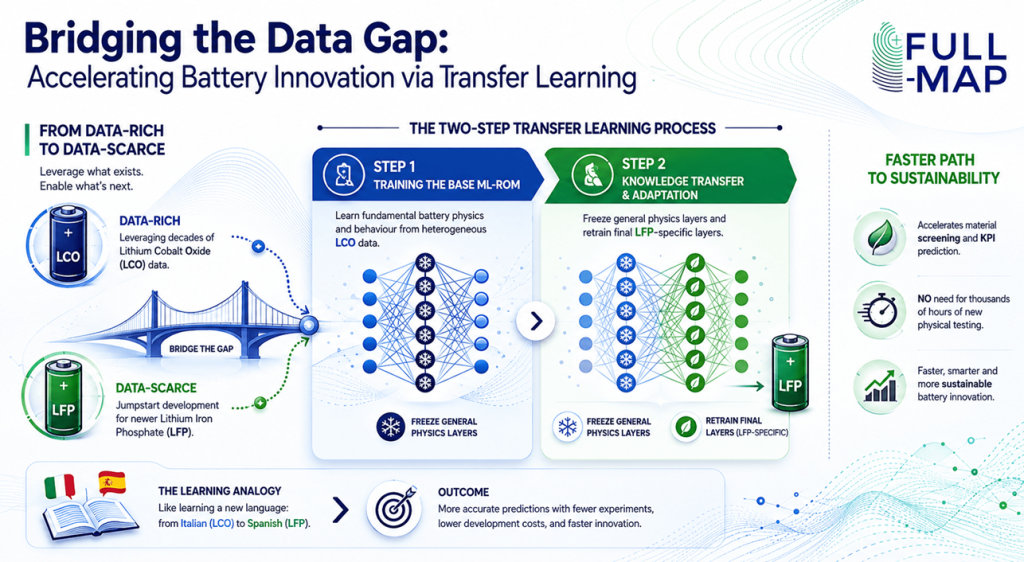
Indeed, the Transfer Learning process in battery design engineering breaks down into two key steps:
- Step 1: Learning from heterogeneous data
First, we develop a robust ML-ROM based on the available set of heterogeneous data, leveraging project inputs on data specification, collection, analysis and management. This data, which often has different origins includes data from laboratory experiments (originating from Advanced characterization and testing) , high-fidelity physics models, historical datasets, etc. By combining these data sets, the ML model learns the fundamental laws of physics describing battery behavior: how ions move, how heat is generated, how materials expand and contract, etc. At this stage, the model in our example might be heavily weighted toward LCO characteristics, but it will also have developed a deep understanding of battery physics.
- Step 2: Transferring knowledge
Once the base model is trained, we apply Transfer Learning to adapt it to the new material and/or chemistry, in our example LFP. Instead of training a new ML-ROM from zero, we freeze the layers of the neural network that understand the general physics and only retrain the final layers that are specific to the material/chemistry with the limited LFP data available.
3. Battery Innovation Results and Outlook
Approach: focus on two application use cases
Within the FULL-MAP project, we focus our Transfer Learning on two application cases:
- Accelerate materials screening: Using computational chemistry tools for active materials design we can test thousands of material variations in silico without ever stepping into a lab. Instead of requiring a massive, independent dataset for every new iteration, Transfer Learning allows us to leverage the general physics learned from data-rich chemistries (such as e.g. LCO) and enrich it with dedicated simulations on a new data-poor chemistry (e.g. LFP). This enables us to predict critical properties like ion diffusion and conductivity with far less effort, effectively reducing the time required to screen new materials by building upon established expertise.
- Predict battery cell KPIs: By transferring the Key Performance Indicators (KPIs) and the physics of battery ageing learned from decades of LCO data, we can accurately predict the behavior of newer LFP cells, leveraging the high-fidelity models of the battery cell performance and degradation like lithium plating and particle cracking, as already achieved in the FULL-MAP project.
It is expected that Transfer Learning can and will be deployed much more broadly in the future in cases where we are facing the cold start problem, having little-to-no data for emerging technologies.
From theory to integration: The FULL-MAP Orchestrator
A breakthrough in the lab is only useful if it can be used by industry. One of the most exciting aspects of our work is how we are ensuring these models are accessible to manufacturers, OEMs, and the wider scientific community through the FULL-MAP platform6.
We envision this platform as an agent orchestrator situated at the intersection of language models, reasoning systems, and foundation models. Rather than relying on isolated software silos, this orchestrator coordinates a library of pretrained, domain-specific models and integrates them directly into research and production workflows. By using a capable reasoning framework to select and adapt existing models to perform previously missing prediction steps within the workflow, we ensure compatibility across the entire battery value chain, from materials to manufacturing to application. This allows the knowledge transferred from LCO to LFP to flow freely, enabling users to adapt their strategies to new chemistries quickly.
Looking ahead: A faster path to sustainability
The work we are doing in Transfer Learning is about more than just saving time; it is about making the battery development process more resilient. By learning how to transfer knowledge between chemistries, we are taking important steps to bring new materials, such as solid-state electrolytes or sodium-ion batteries, much faster to the market.
The Transfer Learning activities have recently started at project partners SISW, Ikerlan and VUB. The insights we are gaining from these material screenings and virtual performance testing will help the industry move faster toward new chemistry options, providing a roadmap for how ML-ROMs can be exploited by the orchestrator.
In the FULL-MAP project we are refining these models and pushing the boundaries of what is possible in battery testing and simulation. As an outcome of the ongoing research, from SISW we will advance in accelerating battery innovation through simulation, which will strengthen our future Simcenter solutions related to battery simulation7,8 and battery cell design9. The transition to a sustainable, electrified future depends on our ability to innovate faster than ever before, and with Transfer Learning, we are doing exactly that.
4. Acknowledgements
The European Commission is gratefully acknowledged for funding the project FULL-MAP (Fully Integrated, Autonomous & Chemistry Agnostic Materials Acceleration Platform for Sustainable Batteries), under the Horizon Europe research and innovation program, with grant agreement No. 101192848, and the involvement in the Battery2030+ Initiative (Battery 2030 CSA3, GA No. 101104022).
This blog post reports on the research activity in Task 2.5 of FULL-MAP, which focuses on Transfer Learning (TL). The current article is also available on the FULL-MAP website (here). We gratefully acknowledge the other Task 2.5 partners VUB (Bert Verbruggen), Ikerlan (Kevin Villalobos, Josu Ircio Fernández, Itziar Altuna Ruiz de Eguino, Llorenç Capó Torres) for their support. We furthermore thank the broader FULL-MAP consortium partners, for their research activities in connection to this Task.
References
- Adrien Scheuer, Onur Atak, Stijn Donders, ML for Industrial CAE – “Just scale it”, Art of the Possible Blog, April 7, 2026. ↩︎
- Stijn Jonckheere, Laszlo Farkas, Accelerating battery innovation through simulation, Art of the Possible Blog, February 3, 2026. ↩︎
- Gaetan Damblanc, Re-think Lithium-ion battery cell design now – with 3D high fidelity simulation, Simcenter Blog, Sept. 11, 2024. ↩︎
- Gabriel Amine-Eddine, What’s new in Simcenter Reduced Order Modeling?, Simcenter Blog, April 29, 2024. ↩︎
- Jie Lu, Vahid Behbood, Peng Hao, Hua Zuo, Shan Xue, Guangquan Zhang, Transfer learning using computational intelligence: A survey. Knowledge-Based Systems, 80, 14-23, 2015. ↩︎
- FULL-MAP consortium, Scientific Vision, Retrieved 2026. ↩︎
- Siemens Digital Industries Software, Simcenter Culgi, Retrieved 2026. ↩︎
- Siemens Digital Industries Software, Simcenter, Retrieved 2026. ↩︎
- Siemens Digital Industries Software,Battery Cell Design, Retrieved 2026. ↩︎