Accelerating next-generation battery design through simulation
1. The promise of next-generation batteries
Imagine an electric vehicle that charges faster, drives further, and is inherently safer. This is not a distant vision; it is the promise of next-generation battery technologies such as Solid-State Batteries (SSBs). At Siemens, we are leveraging advanced simulation tools to help turn this promise into reality.
The urgent need for sustainable and accessible mobility, combined with the pressure of finite global resources, is driving a major transformation in transportation. Electric vehicles (EVs) play a central role in this transition, offering a pathway to reduce emissions and improve energy efficiency. This shift toward electrified mobility is strongly supported by Europe’s strategy for clean transportation, as reflected in initiatives such as Battery 2030+1.
Technological progress is making this shift possible. Advances in renewable energy, battery materials, smart grids, and electric powertrains are supporting the widespread adoption of electric mobility. Within this evolving landscape, digital engineering tools are becoming essential. They enable a deeper understanding of complex battery behavior, helping to reduce development time and optimize performance early in the design process2. In my PhD research, I use these digital capabilities to accelerate the development of next-generation batteries, with a particular focus on solid-state technologies.
2. Challenges in solid-state batteries
To understand how simulation can support the development of solid-state batteries, it is important to look at the challenges limiting the widespread adoption of this technology.
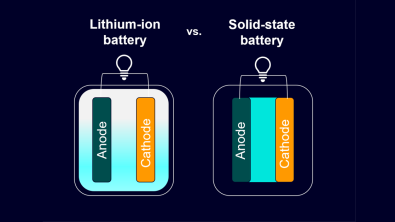
While lithium-ion batteries have enabled the current generation of electric vehicles, their performance is approaching fundamental limits, particularly in energy density, safety and fast-charging3. Solid-state batteries offer a promising alternative. By replacing the flammable liquid electrolyte with a solid-state alternative, they have the potential to improve safety while enabling higher energy densities. Solid electrolytes can support the integration of lithium metal anodes, which allow an increase in energy density by up to 70%.
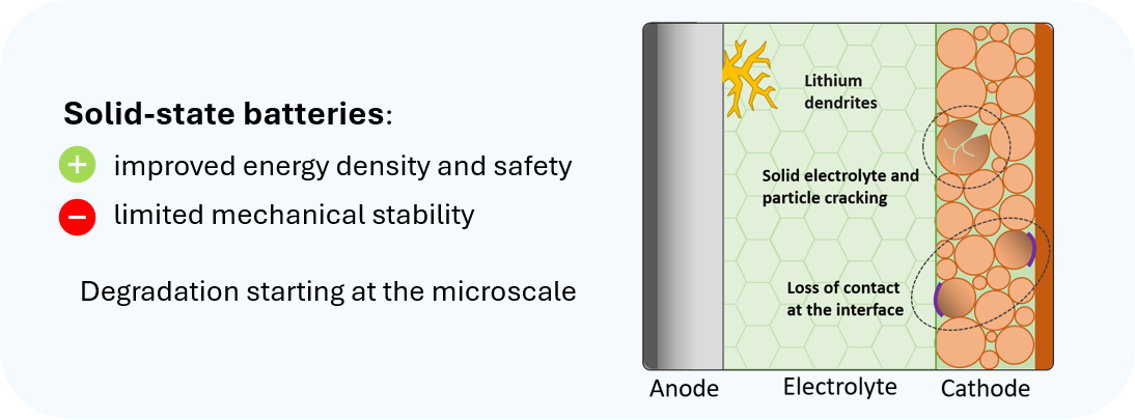
However, these advantages come with new engineering challenges. Solid electrolytes, whether ceramic-based, polymer-based, or a combination of both, offer different benefits and limitations. As a result, designing a reliable solid-state battery requires balancing multiple factors at the same time.
Some of the main challenges include:
- Mechanical degradation: stresses generated during operation can lead to cracking, loss of contact between components, and reduced performance;
- Ionic transport: many solid electrolytes do not conduct ions as efficiently as conventional liquid electrolytes, especially at room temperature;
- Interfacial performance: maintaining good contact between electrodes and the electrolyte is critical for efficient ion transport and long-term durability;
- Manufacturing: scaling laboratory concepts into reliable, cost-effective products remains a significant hurdle.
At the heart of these challenges lies the complex interaction between material microstructure, electrochemistry, and mechanics (Figure 1). Understanding these interactions is essential for unlocking the full potential of solid-state batteries, and this is where advanced simulation can provide valuable insight.
3. AMUSE: Accelerating battery design with a multi-physics simulation workflow
To address these challenges, researchers are increasingly turning to simulation-driven approaches to better understand battery behavior and guide design decisions. Within the AMUSE Baekeland research project (see Acknowledgements for further details), advanced modelling techniques are being used to investigate the complex interactions that govern solid-state battery performance and durability.
The performance and lifetime of solid-state batteries are strongly influenced by aging mechanisms that originate at the microscale. Capturing this behavior requires accounting for the complex interplay between electrochemical processes and mechanical degradation. To address this, I worked with my research colleagues and supervisors to research and develop a multi-physics, multi-scale modeling workflow that directly links the battery microstructure to its degradation and overall performance (Figure 2).
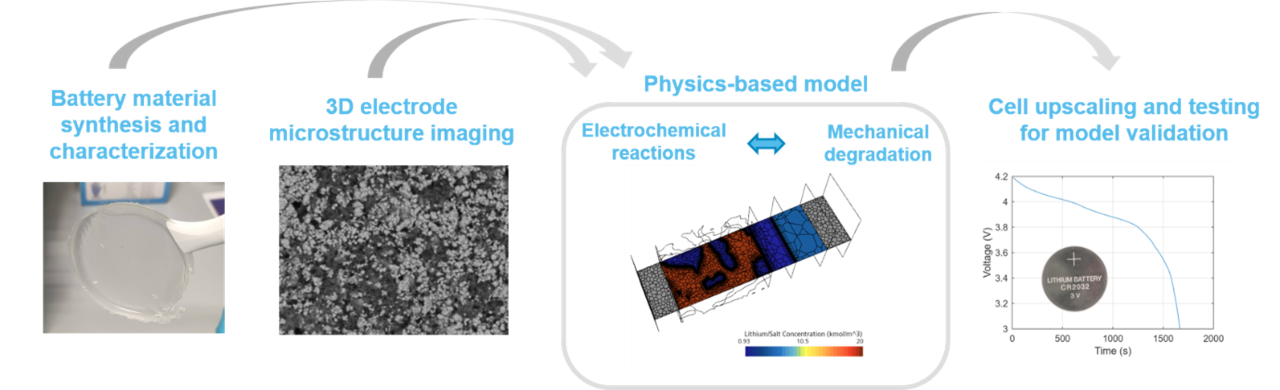
The workflow realized within the AMUSE project establishes a direct connection between material design, microstructure, degradation mechanisms, and overall battery performance. It combines experimental development and testing of solid-state battery cells with advanced imaging techniques that provide detailed insight into the internal electrode architecture5. These data form the foundation for a multi-physics modeling framework that captures the complex interaction between electrochemical processes and mechanical stress, both of which play a critical role in battery aging.
By linking observations at the microscale to behavior at the cell level, the workflow provides a comprehensive understanding of how material properties and microstructural features influence performance and durability. The resulting models are validated against experimental measurements to ensure their predictive capability. Once validated, the approach enables the systematic exploration of design parameters and operating conditions, helping to identify battery configurations that reduce degradation, extend lifetime, and improve overall performance. This simulation-driven methodology significantly accelerates the development and optimization of next-generation solid-state batteries.
4. Insights from solid-state battery performance and modeling
The combined experimental and modeling work has so far provided valuable insights into the factors that influence the performance and durability of solid-state batteries. Initial investigations have highlighted the importance of electrolyte design and interface engineering, pointing towards semi-solid battery configurations, which combine the safety and stability benefits of solid electrolytes with the enhanced interfacial contact of liquid components, as a promising direction for further exploration. Building on these findings, future R&D work will focus on gaining a deeper understanding of the electrochemical and mechanical behavior of such hybrid systems and their potential for improved performance and lifetime.
From a modeling and simulation perspective, the research has demonstrated the value of microstructure-resolved simulations for studying battery degradation mechanisms. By explicitly accounting for the heterogeneous nature of battery materials, these models can reveal localized stress concentrations and other critical features that are difficult to capture with more simplified approaches. Such insights are essential for identifying potential failure-prone regions and for guiding the design of more robust battery architectures.
5. Enabling the next-generation of batteries
As the demand for higher-performing and more sustainable energy storage solutions continues to grow, advanced simulation is becoming an increasingly important part of the battery development process. By providing insight into battery behavior across multiple physical domains and length scales, simulation enables researchers to explore complex phenomena that are often difficult to access through experiments alone.
Within the AMUSE project, simulation is used to connect material properties, electrochemical processes, and mechanical behavior within a unified modeling framework. Combined with testing, these approaches support a deeper understanding of the mechanisms that influence battery performance and durability, helping researchers make more informed design decisions throughout the development cycle.
While significant challenges remain before solid-state batteries can achieve widespread adoption, the combination of simulation and experiments offers a promising path forward. The research presented here contributes to the continued advancement of battery simulation capabilities and supports the evolution of future Simcenter solutions in areas such as battery mechanical simulation6, electro-chemical simulation7,8, as well as battery cell design9.
By enabling virtual exploration of battery designs and reducing reliance on costly trial-and-error approaches, digital engineering tools can accelerate battery innovation and help bring safer, more efficient, and more sustainable energy storage systems to market.
Acknowledgements
The research presented in this publication was performed by Anna De Gol within the framework of the AMUSE project (“A material-focused multi-physics simulation approach for ageing prediction of solid-state batteries”). This project is part of a Baekeland mandate, a program that enables researchers to pursue a PhD in close collaboration with industry, supported by VLAIO (Flanders Innovation & Entrepreneurship), the Flemish government agency for innovation.
The work was conducted at Siemens Industry Software NV (SISW) and the Vrije Universiteit Brussel (VUB), within the Electromobility Research Centre (MOBI), under the supervision of Professor Maitane Berecibar from the Battery Innovation Center (BIC).
Reference
- Battery2030+, Family of EU projects implementing the Battery2030+ Road Map (Battery 2030 CSA3, GA No. 101104022), Retrieved 2026. ↩︎
- Stijn Jonckheere, Laszlo Farkas, Accelerating battery innovation through simulation, Art of the Possible Blog, February 3, 2026. ↩︎
- A. Barré, B. Deguilhem, S. Grolleau, M. Gérard, F. Suard, and D. Riu, A review on lithium-ion battery ageing mechanisms and estimations for automotive applications” J. Power Sources, vol. 241, pp. 680-689, 2013. ↩︎
- De Gol, A., Dermenci, K. B., Farkas, L., & Berecibar, M. (2024). Electro‐Chemo‐Mechanical Degradation in Solid‐State Batteries: A Review of Microscale and Multiphysics Modeling. Advanced Energy Materials, 14(47), 2403255. ↩︎
- Oxana Shishkina, Stijn Donders, VirtualCT: realistic composite material modeling using micro-CT-based voxel approach, Simcenter Blog, May 9, 2019 ↩︎
- Siemens Digital Industries Software, Simcenter 3D, Retrieved 2026. ↩︎
- Siemens Digital Industries Software, Simcenter Culgi, Retrieved 2026. ↩︎
- Siemens Digital Industries Software, Simcenter STAR-CCM+, Retrieved 2026. ↩︎
- Siemens Digital Industries Software,Battery Cell Design, Retrieved 2026. ↩︎