Unlocking Efficiency: A Deep Dive into Tessent™ ATPG for Digital IC Testing

Ever wondered how we ensure the quality and reliability of the complex digital integrated circuits (ICs) that power our innovations? A cornerstone of this process is Automatic Test Pattern Generation (ATPG). It’s a powerful methodology that creates test patterns to detect manufacturing defects in silicon. Let’s take a journey through the core and advanced aspects of ATPG!
The Foundation: TessentATPG Core Topics
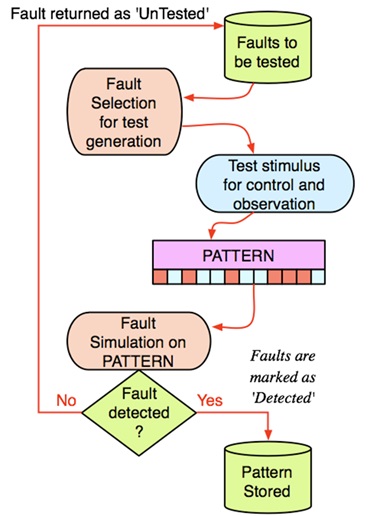
At its heart, ATPG is about making sure every part of our chip works as intended. ATPG is about generating test patterns (test vectors) that are applied to the chip during manufacturing test to determine if the chip is defect free. The goal is to detect manufacturing defects and ensure that the circuit operates as intended by comparing the expected fault-free output with the actual output measured during testing.
How is this achieved? It’s the clever design of scan architecture that makes this all possible. Scan transforms the chip’s complex internal workings into something easily controlled and observed, allowing Tessent ATPG to generate highly effective tests that ensure the quality and reliability of every chip.
The Magic of Scan: Unlocking ATPG’s Potential
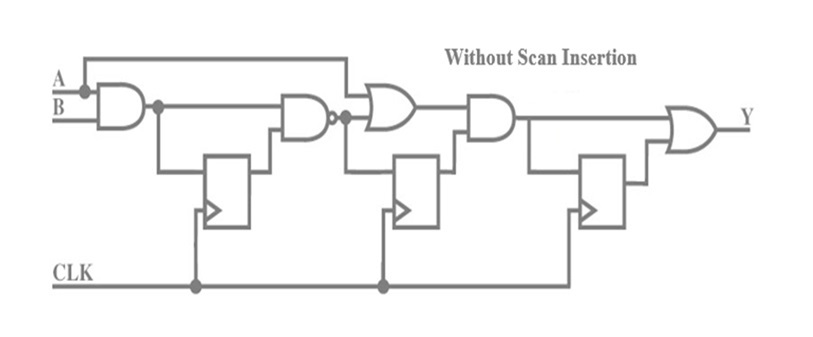
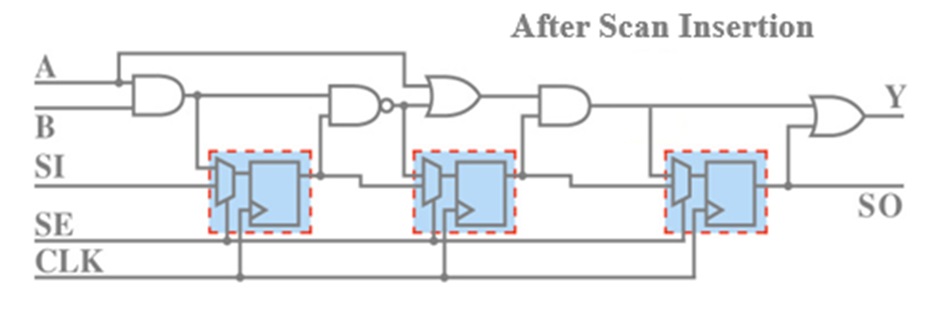
Scan design is the key enabler for efficient ATPG. By replacing all memory elements with their scannable equivalents and connecting them into scan chains, scan design allows for direct control and observation of internal states. This transformation makes the sequential circuit behave like a combinational circuit during test mode, greatly simplifying test generation and fault simulation. Without scan logic, testing complex chips would be extremely difficult due to the inability to easily control and observe internal storage elements.
Here’s how this “Scan magic” directly empowers Tessent ATPG:
Simplifying Sequential Logic for ATPG: Scan design converts complex sequential circuits into a form that Tessent ATPG can handle as if they were combinational, making test generation much simpler.
Precise Control and Observation for Fault Detection: By connecting scannable elements into scan chains, scan design allows Tessent ATPG to precisely set and monitor the values of all storage elements, improving fault detection.
Efficient Pattern Generation and High Fault Coverage: With scan chains in place, Tessent ATPG can quickly generate effective test patterns that thoroughly exercise the design, resulting in higher fault coverage.
Maximizing Testability and Chip Quality: The improved controllability and observability provided by scan design ensure that chips can be tested more thoroughly, leading to higher product quality and reliability.
Tessent ATPG utilizes a variety of fault models to abstract complex manufacturing defects as logical faults within the design. It efficiently generates test patterns for stuck-at faults, where a node is assumed to be permanently fixed at logic ‘0’ (stuck-at-0) or logic ‘1’ (stuck-at-1), enabling detection of common static defects such as opens and shorts. For modern high-speed designs, Tessent ATPG also excels at generating at-speed (transition) fault patterns, which verify that signals can transition reliably between ‘0’ and ‘1’ within the required clock cycle. This ensures both the performance and correctness of the chip by targeting defects like partially conducting transistors and resistive bridges that may only manifest at operational speeds.
Before Tessent ATPG can even begin, the design must adhere to specific Design Rule Checks (DRCs) for testability. Tessent offers robust DFT (Design-for-Test) capabilities, including automated insertion and verification, to ensure that the design is test-ready. These rules ensure that the scan chain is properly constructed and that the design is amenable to testing.
Failing design rule checks (DRCs) can result in untestable faults and inefficient test generation. Tessent ATPG generates various types of patterns to achieve the highest possible fault coverage while optimizing test time and cost.
Tessent ATPG Advanced Topics: Pushing the Boundaries of Test
As integrated circuits grow in complexity, advanced testing techniques become critical. Tessent ATPG addresses these challenges with a comprehensive suite of capabilities:
Support for advanced fault models: In addition to stuck-at and transition faults, Tessent ATPG generates IDDQ patterns to detect abnormal static current, toggle patterns to ensure every node can switch states, and user-defined fault models (UDFM) to target unique or emerging defect mechanisms. Cell-aware fault models: Tessent ATPG analyzes the internal structure of standard cells, enabling detection of cell-internal defects that are especially relevant at advanced process nodes. Automotive and safety-critical support: For applications such as automotive electronics, Tessent ATPG provides specialized fault models and methodologies to meet stringent standards like ISO 26262, including robust fault injection and high coverage targets. Powerful debug and analysis tools: The tool offers advanced features for debugging simulation mismatches, analyzing low coverage, and identifying undetectable faults, redundant logic, or DFT limitations. These capabilities empower engineers to achieve thorough defect detection and ensure high product reliability, even in the most demanding applications. In conclusion, ATPG ensures the reliable operation of integrated circuits by generating and applying test patterns during manufacturing, enabling the detection of defects by comparing expected and actual outputs.
Enroll today to unlock the full capabilities of the TessentTM ATPG Core Topics and TessentTM ATPG Advanced Topics courses on Siemens Xcelerator Academy. Gain expertise in generating and analyzing test patterns, detecting manufacturing defects, and ensuring reliable integrated circuit operation using advanced fault modelling and debugging techniques.
Additionally, you can now earn a digital badge/level 1 certificate for the Tessent ATPG Core Topics and Tessent ATPG Advanced Topics Courses by taking our Badging and Certification Exams. If you successfully pass the Level 1 Certification Exam, you can earn a digital badge and display it on LinkedIn or your email signature.
For additional questions or assistance with our training courses, contact a Siemens representative at xceleratoracademy_eda.disw@siemens.com.
Author: Ushaben Pratap Odedra, Customer Training Engineer, Siemens EDA Learning Services