The ten-year plan: fully autonomous industrial robots
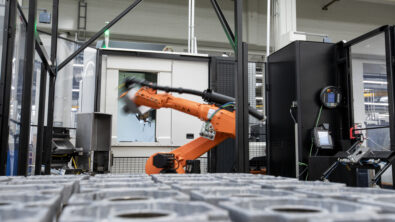
As industrial manufacturers strive to cut costs, enhance production lines, and make operations more sustainable they have begun to embark on digital transformation journeys. Leveraging technologies such as the digital twin and AI, factories can improve the automation capabilities of their equipment, addressing ongoing challenges such as labor shortages and high costs. Some factories have already successfully actualized the advantages of advanced robotics and have been rewarded with considerable and continued benefits.
Even still, there are still many steps manufacturers can take to reach peak automation, or to put it more plainly: robots building robots. Over the next decade, we forecast that industrial robots will no longer need explicit programming to perform tasks due to advancements in simulation and AI technologies. These capabilities will be the foundation for robots to eventually learn to build other robots practically autonomously.
During an episode about advancements in robotics on our Digital Transformation podcast series, Siemens experts Rahul Garg, Vice President for industrial machinery vertical software strategy at Siemens Digital Industries software, and Alex Greenberg, director in the digital industries software digital manufacturing division, discussed Siemens’ ten-year outlook on automation on the shop floor., highlighting the exciting possibilities empowered by generative AI and the digital twin.
Near future expectations
AI and the digital have helped manufacturers make massive strides in factory automation. Using the digital twin, companies can create an accurate, real time virtual representation of their factory that is both comprehensible and accessible for workers across teams and disciplines. Knowing where potential modifications fit in help engineers and designers test how certain processes will work before integrating new machines and processes into a production line; especially when considering human safety.
In conjunction with the digital twin, factories can implement AI to further automation goals. Utilizing AI, it is possible to improve the industrial robots’ sensing capabilities and decision-making processes, further enhancing functionality. Solutions such as Siemens SIMATIC Robot Pick AI take advantage of virtual training through the digital twin and computer vision prepare robots to handle unpredictable tasks with over 98 percent accuracy.
Keeping these current capabilities in mind, over the next 10-15, Siemens forecasts that manufacturers will see:
- Fully automated, intelligent robotic systems on shop floors
- Robots that can derive assembly instructions directly from AI-assisted 3D product designs
- Closed-loop ecosystems where design and manufacturing are AI-driven
Our penultimate goal is that these functionalities will be available without explicit programming. Leveraging the digital twin, manufacturers will be able to train shop floor robots and validate scenarios
to handle any situations and complete even customized designs. And with generative AI, engineers will be able to teach robots thousands of different configurations just based on a short description or verbal commands.
Into the virtual future
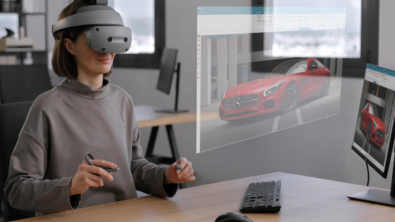
Creating robust automation systems through the digital twin and AI inevitably leads to creating the industrial metaverse, a digital space that enhances collaboration and maximizes production efficiency. In the industrial metaverse, manufacturers can gather synthetic data from virtual sensors and use it to deploy high-fidelity simulations for training and validating robots. Photorealistic environments within the industrial metaverse will also help reduce organizations’ reliance on physical prototypes by perfecting virtual testing, enabling faster time-to-market and cost-savings.
Laying the foundations for the industrial metaverse starts with automation. The very basis of the metaverse is the digital twin which already helps with prototyping both products and systems and can accurately simulate industrial environments. AI builds on this base by making robots smarter with Pick AI and more autonomous with generative AI. To learn how your organization can begin its journey towards a more collaborative, intelligent factory, listen to our podcast.
Siemens Digital Industries Software helps organizations of all sizes digitally transform using software, hardware and services from the Siemens Xcelerator business platform. Siemens’ software and the comprehensive digital twin enable companies to optimize their design, engineering and manufacturing processes to turn today’s ideas into the sustainable products of the future. From chips to entire systems, from product to process, across all industries. Siemens Digital Industries Software – Accelerating transformation.