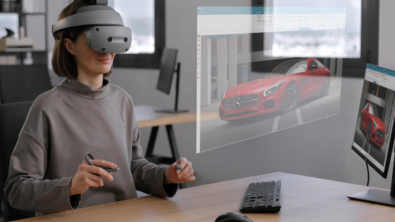
The intersection of AI, simulation, and design

Simulation stands as a pillar of the design process, allowing engineers to understand how a part will behave without ever having to build it and, in some cases, to understand it in ways a physical prototype couldn’t elucidate. While the value of simulation is clear and cannot be overstated, the cost of running them is equally high and, in many cases, can even be a bottleneck when it comes to developing new, innovative products.
Compared with traditional simulation, AI is orders of magnitude faster, generating results in seconds instead of hours or days but sacrificing true-to-life accuracy and perfect fidelity to achieve this. While neither of these technologies can be a replacement for the other, an intelligent combination of both can help achieve better results than either could alone.
In a recent podcast, experts Justin Hodges, Senior AI/ML Technical Specialist and Todd Tuthill, Vice President of Aerospace, Defense, and Marine Industries from Siemens and Fatma Kocer-Poyraz, Vice President of Engineering Data Science from Altair came together to discuss just what it means to bring AI and simulation together in industry.
Keep reading for some of the highlights of that conversation or click here to listen to the full episode.
The synergy between AI and simulation
AI is fast and simulation is accurate, together they can achieve the best of both worlds. A key technology developed in recent years are AI-powered reduced order models, or ROMs, which can be trained on simulation data to accurately infer how a given system will behave under various conditions. These ROMs are fast, but still require large amounts of traditional simulation data to train and have trouble extending beyond their training data. However, by using them to augment simulation and design processes, they become a powerful tool for maximizing the value of more expensive traditional simulations.
Using a ROM, trained during early stages of the design process, helps guide the design process, letting designers and automated design space exploration tools understand weather a particular area of the design space is worth investigating further. If it is, a full simulation can be run and the results can be used to further refine the model; if not, the simulation resources can be allocated elsewhere.
Fatma describes AI and simulation as being synergistic, two kits in an engineer’s toolset the complement each other, each providing value in a different way. Synergistic is the best term to describe the relationship between the two, with AI guiding simulation while the simulations themselves serve to further enrich the AI models.
The value of AI enhanced simulations
While it is clear that AI can help accelerate simulation, this has value in more ways than one when it comes to making critical decisions. A large company might use AI to help them run more simulations in the same time for the same compute costs, however Fatma also highlights that, due to various constraints, a company may be forced to use just a single data point – that is a single high-fidelity simulation to make important design decisions.
In a situation like this, AI becomes an incredibly valuable tool to help provide more data points, filling in areas that a single simulation wouldn’t be able to cover and, when the time comes to actually run a high-fidelity simulation, that it is in the place where it will have the greatest impact. While this is an extreme case, Justin extends this example to show how AI can help design processes be more adaptive, allowing teams to quickly test one idea by more economically sampling the design space, after all inferencing with a ROM is basically free.
The combination of AI and simulation fundamentally allows for greater creativity from designers. With AI powered ROMs at their disposal, designers are able to quickly check ideas while more thoroughly exploring a design space at the same time, all with less waiting and less manual input.
The idea that generative AI can simply be taught math and physics then generate results may be appealing to some but it remains steadfastly science fiction rather than science fact. For the foreseeable future, simulation will remain a valuable and indispensable source of data for AI training. Even as AI continues to benefit from simulation data, it will also start to give back as well, bridging the gaps between high-fidelity simulations and helping guide the efforts of designers. Just as in the past simulation combined with physical prototypes to advance what was possible, so too will AI allow design to take the next step forward.
To find out more, listen to the full podcast here.
Siemens Digital Industries Software helps organizations of all sizes digitally transform using software, hardware and services from the Siemens Xcelerator business platform. Siemens’ software and the comprehensive digital twin enable companies to optimize their design, engineering and manufacturing processes to turn today’s ideas into the sustainable products of the future. From chips to entire systems, from product to process, across all industries. Siemens Digital Industries Software – Accelerating transformation.