Simulation Is No Longer The Bottleneck — But Something Else Might Be

For a long time, simulation was clearly a bottleneck.
Runs took hours or days, compute capacity was limited, and design loops were constrained by what could realistically be evaluated.
That has changed. Today, we can predict physics behavior in seconds, run high-fidelity simulations on GPUs in minutes, and explore design spaces that were previously out of reach. In many cases, the technical limitations of simulation have been reduced significantly.
And yet, engineering cycles are still slower than they could be.
Which suggests that simulation itself is no longer the limiting factor. Increasingly, it is the way simulation is embedded into engineering processes that determines the overall speed.
Simulation is no longer the bottleneck — your organization might be.
From Running Simulations To Industrializing Them
Simulation is still often treated as a specialized activity. It happens in dedicated teams, at specific stages, and usually under time pressure.
That works — but it doesn’t scale.
Looking at the current landscape, three developments are reshaping how simulation can be used:
- Faster generation and evaluation of design ideas
- A significant increase in solving speed
- Better integration of workflows across disciplines
Individually, these are strong improvements. Combined, they change the role of simulation entirely.
The shift is subtle but important: from running individual simulations towards embedding simulation into continuous decision-making.
1. Accelerating Ideas: Seeing The Physics Earlier
Traditional CAE workflows follow a familiar loop: design, mesh, solve, post-process, modify.
This works well, but it postpones insight. Engineers only see physics behavior after a full setup and solve, which limits the number of design variants that can realistically be explored.
AI-based approaches such as geometric deep learning change that dynamic. They allow engineers to predict structural behavior directly from geometry, without meshing and without running a full solve, often within minutes or seconds.
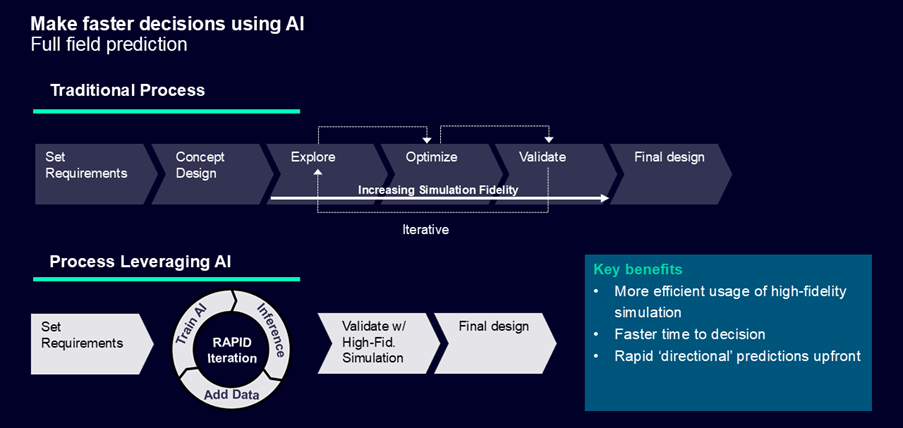
The impact is less about raw speed and more about when insight becomes available.
Engineers can explore significantly more variants early on and get quantitative feedback during concept development. Instead of evaluating a small number of designs, teams can explore broader regions of the design space and only validate the promising concepts with detailed simulation.
That makes design exploration more structured and less dependent on time constraints.
2. Accelerating Solving: Reducing Turnaround Time
Faster idea generation needs faster validation.
This is where the shift from CPU to GPU becomes relevant. In practical CFD applications, GPU-based simulation reduces turnaround time while also improving cost and energy efficiency.

- Multiple iterations per day instead of a few per week
- Large-scale simulations completed within hours
- Continuous generation of data for further analysis and optimization
On top of that, AI-based prediction methods add another layer.
Physics-based AI models can reduce evaluation times from hours to seconds in certain scenarios.
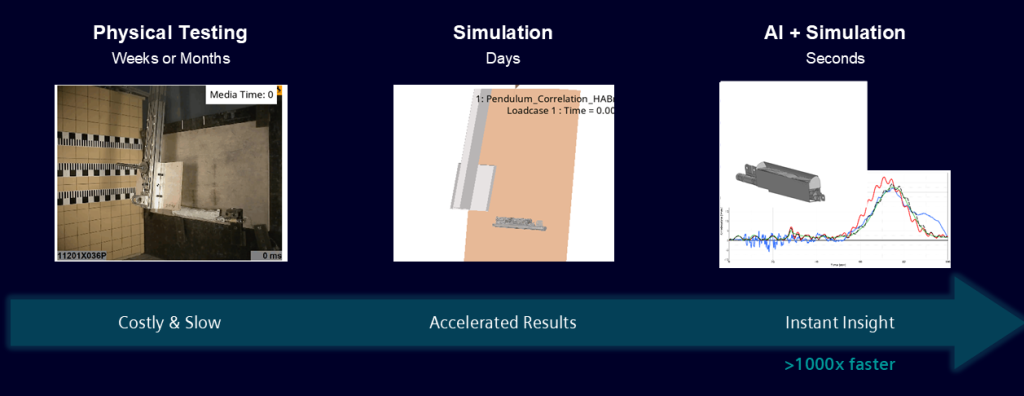
The key point is not substitution, but combination.
AI supports rapid exploration and guidance, while simulation ensures accuracy and validation. Together, they form a feedback loop: predict, simulate, learn, refine.
This loop is where the real acceleration happens.
3. Accelerating Workflows: The Part That Matters Most
Even with faster idea generation and faster solving, the overall impact is often smaller than expected.
The reason is rarely the technology itself. More often, it is how simulation is integrated into the broader engineering process.
Fragmentation still slows things down
In many environments, simulation is still affected by:
- Disconnected tools
- Fragmented data
- Manual handovers between teams
- Limited traceability between requirements, models and results
Even strong individual tools can create friction if they are not connected properly.
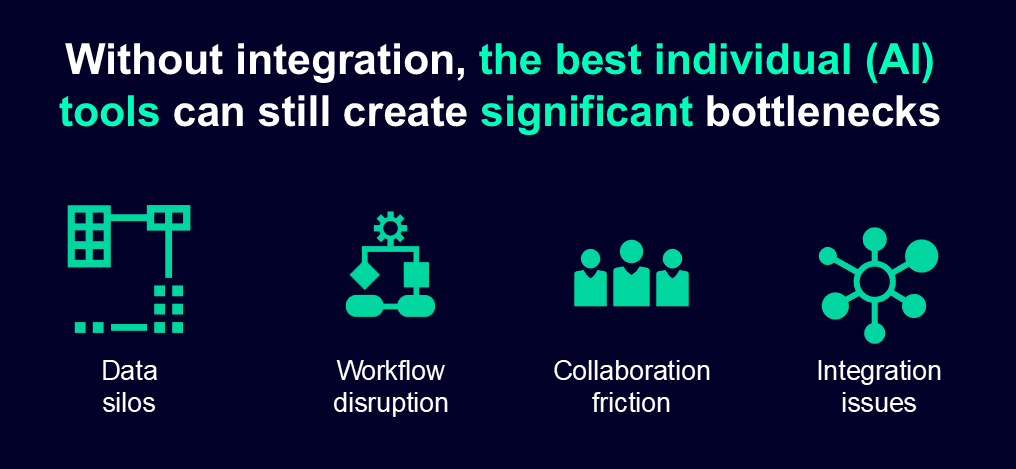
Simulation results without context are difficult to reuse. Data without structure is difficult to scale. And without integration, iteration speed at system level remains limited, regardless of how fast individual simulations run.
Industrializing Simulation Means Connecting The System
What makes the difference is not a single tool, but the way everything works together.
Industrializing simulation requires:
- A connected data backbone across the digital thread
- Consistent management of simulation and test data
- Automated and repeatable workflows
- Traceability from requirements to results
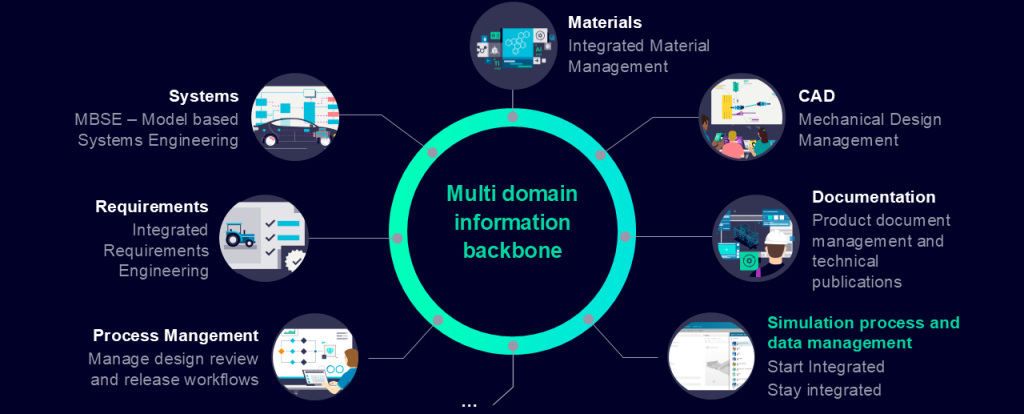
Once these pieces are in place, simulation becomes part of the system, not a standalone activity.
That enables reuse, consistency, and scalability. It also makes AI practical, because models can rely on structured, traceable data instead of isolated datasets.
At that point, simulation starts to scale beyond individual projects.
What Needs To Change
From a leadership perspective, this is less about introducing new tools and more about adjusting how simulation is applied.
Three changes tend to have the biggest impact:
1. Focus on the overall engineering system
Optimizing individual simulations is no longer enough. The flow of data, decisions, and iterations across teams becomes more important than the performance of a single solver.
2. Extend simulation across the lifecycle
Simulation creates value when it supports decisions early and remains connected to validation later. That requires integrating it more deeply into both design and verification processes.
3. Treat simulation data as a long-term asset
Reusable, structured data is the basis for scaling both simulation and AI. Without it, improvements remain local and temporary.
What Is Already Possible Today
Most of the required capabilities are already available:
- Designers can receive performance feedback within seconds
- Engineers can run high-fidelity simulations within hours
- Workflows can be connected across the engineering lifecycle
The challenge is not availability, but alignment.
Real impact comes from combining these capabilities in a coherent way.
Final Thought
Simulation used to be the limiting factor in engineering speed. Today, that limitation has largely shifted.
The question is no longer how to make simulation faster.
It is how to make simulation part of everyday decision-making.
In many cases, the remaining bottleneck is not the technology itself, but how well it is integrated into the engineering system.
Or, put differently: simulation is no longer the bottleneck — but depending on how it is used, the surrounding process still can be.
Read More
Many of the capabilities described here rely on foundational technologies around data, compute, and AI integration. We’re exploring these aspects in more detail in a dedicated blog series. Find it here: https://blogs.sw.siemens.com/art-of-the-possible/