Why Industrial Metaverse Supports a Holistic Digital Future
In a recent episode of the Industry Forward Podcast, Siemens experts Dale Tutt and Stuart McCutcheon finished a series exploring the multifaceted world of the Industrial Metaverse. The final part of the conversation explores why the Industrial Metaverse is more than a virtual reality application, its usefulness across businesses of all sizes, and the strategic considerations for its successful adoption.
You can listen to the episode through the player below or keep reading for a summary of the discussion.
Why the Industrial Metaverse Extends Beyond VR
Dale and Stuart begin by discussing a common misconception that the Industrial Metaverse is synonymous with virtual reality (VR). Both Dale and Stuart shared their early experiences with VR, recalling the cumbersome and often nauseating headsets of the early 2000s. Stuart recounted his first walkthrough in 2001, highlighting the significant advancements in technology, such as 4K headsets that offer a much more immersive and comfortable experience.
Stuart emphasized that VR represents only one aspect of the Industrial Metaverse. In one project, Stuart noted that only 5% of the data was 3D, while 95% comprised other forms of data. Clearly, VR has its uses– such as designing products in an immersive environment, preventive maintenance, or step-by-step operational guides– but it is not the entirety of the Industrial Metaverse. Rather, the core value lies in providing context for information, emphasizing that the Industrial Metaverse is not solely about the 3D experience.
Dale echoed this sentiment, drawing parallels to the comprehensive Digital Twin. He explained that a truly comprehensive Digital Twin encompasses all information required to design, define, build, and maintain a product, extending far beyond just 3D models and simulations.
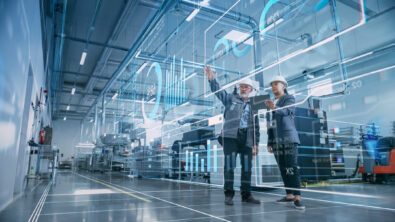
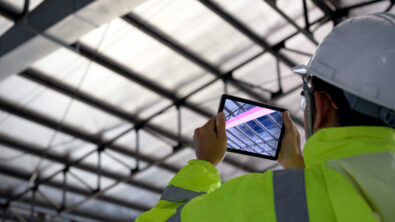
The conversation also touched upon augmented reality (AR) as a significant game-changer. Both speakers agreed that AR, which overlays digital information onto the real world, is gaining traction, particularly in manufacturing and service areas. Dale envisioned a future work environment within the Industrial Metaverse that moves beyond traditional keyboards and mice, embracing voice recognition and other intuitive interfaces.
Industrial Metaverse for All: Large Enterprises vs. Startups
The conversation then pivoted to address the accessibility of the Industrial Metaverse for small and medium firms. Stuart provided a nuanced answer, observing a “mixed bag” in current adoption trends.
Startups are unburdened by legacy. For example, Stuart described how a new company in Vietnam, with Siemens’ assistance, virtually designed, optimized, and commissioned a car plant in just 21 months. This startup, VinFast, along with others like JetZero, are embracing cloud-based Industrial Metaverse technologies, paying for what they use, and benefiting from the inherent scalability of the cloud. This allows them to move with incredible speed and gain a competitive edge.
For large companies, the challenge lies in their existing legacy systems, established processes, and inherent inertia. Changing to a new way of working can be difficult and slow for these companies. Legacy automotive companies, for instance, tend to be slower and less agile than startup automakers due to their significantly larger scale.
Yet, these large enterprises are not being left behind. Stuart mentioned working with large pharmaceutical companies that have adopted the Industrial Metaverse as their “North Star,” actively defining projects and processes to achieve an integrated, adaptive environment. The need for even traditional companies to evolve is paramount, as the days of static, 50-year-old plants are fading. Modern demands necessitate flexibility, adaptability, and the ability to respond quickly to customer needs. For these established companies, the journey begins with understanding their current baseline and then strategically implementing changes without disrupting production.
Dale reinforced this idea, emphasizing the importance of a holistic approach to digital transformation. The Industrial Metaverse, he argued, is just one element of this broader transformation, which must also consider people, tools, and processes. Simply introducing Industrial Metaverse technologies without re-evaluating existing processes or empowering employees will not yield optimal results.
The conversation also touched upon the critical role of Artificial Intelligence (AI) in the Industrial Metaverse. Stuart highlighted AI’s application in data orchestration, particularly in creating ontology models and connecting disparate pieces of information within the Digital Twin fabric. AI can help manage and update these connections, especially when they break, enabling greater scale and robustness.
Digitalization and Industrial Metaverse Demand Long Term View
As the conversation came to an end, both Stuart and Dale reiterated their belief that the Industrial Metaverse is here to stay. Stuart emphasized that the Industrial Metaverse should be considered as a journey and a long term strategy, rather than a single implementation. Companies should start today with solutions that deliver immediate value, gradually integrating digital threads into an Industrial Metaverse experience. As technology continues to evolve, become more affordable, and automate further, the adoption and impact of the Industrial Metaverse will only accelerate.
Dale agreed, asserting that digital transformation is essential for businesses as they seek performance, efficiency and flexibility in the future. The Industrial Metaverse provides companies with enhanced capabilities and the means to adopt digital solutions that generate tangible business value. Ultimately, Dale and Stuart both concluded that the realization of the Industrial Metaverse will demand a long term perspective, continuous investment and a commitment to embracing change.
Siemens Digital Industries Software helps organizations of all sizes digitally transform using software, hardware and services from the Siemens Xcelerator business platform. Siemens’ software and the comprehensive digital twin enable companies to optimize their design, engineering and manufacturing processes to turn today’s ideas into the sustainable products of the future. From chips to entire systems, from product to process, across all industries. Siemens Digital Industries Software – Accelerating transformation.