The Industrial Metaverse: Connected Data, AI and Digital Twin Drive Transformation
To many observers the concept of a metaverse has centered around consumer or gaming applications, providing a digital space for users to interact or play games in an immersive environment. Applications of this concept to business settings also tended to focus on how technology could be used to improve the experience of remote collaboration with colleagues. For industrial companies, however, a greater opportunity evolved out of this concept: the Industrial Metaverse.
In a recent podcast discussion, Stuart McCutcheon, Dale Tutt and I explored what this means for manufacturers and how it is shaping the future of engineering and operations. You can listen to the podcast through the player below or continue reading for a summary of our conversation.
What Is the Industrial Metaverse?
Unlike the consumer metaverse, which focuses on immersive entertainment, the Industrial Metaverse is a robust and precise environment designed for engineers, decision-makers and operators. It enables users to interact with and experience the comprehensive Digital Twin, software-defined automation and artificial intelligence systems within a collaborative space.
The environment collects and orchestrates data, with respect to context and time, from across a modern organization, allowing stakeholders to examine past states, current conditions, and future scenarios. As McCutcheon explained, “It’s all about making engineering decisions based on robust, precise data and leveraging that Digital Twin to bring the virtual and physical worlds together.”
The Industrial Metaverse is not a sudden revolution but rather an evolution of technologies such as the Digital Twin, Digital Threads, and IT/OT integration. For decades, engineers have designed and simulated products in 3D, but often in isolated systems. Today, the challenge is aggregating these disparate data sources into a single, unified view—a “single pane of glass”—that accelerates decision-making.
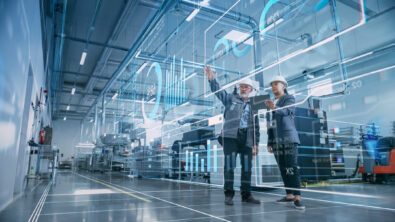
Imagine an engineer on the shop floor who currently logs into multiple systems to gather data, accessing various tools to run simulations and further steps to analyze insights before making a decision. The Industrial Metaverse aims to eliminate this friction by presenting all relevant information in an intuitive interface complete with robust modeling and simulation capabilities and even high fidelity visualizations of full 3D environments. This shift-left approach—bringing insights earlier in the lifecycle—can significantly improve efficiency and reduce errors.
Delivering Business Value Through Use Cases
For many new technologies, early efforts often focus on novelty rather than scale and value creation. Mandy early applications of Digital Twin technology, for instance, struggled to deliver clear return on the investment in their creation, especially as these early models were completely isolated.
Industrial Metaverse applications today are vulnerable to the same pitfalls of early technology adoption. Stuart explained how companies are working to avoid these challenges by focusing on specific use cases that can deliver measurable business benefits.
For example:
- Product Lifecycle Management: Visualizing the entire lifecycle of a vehicle—from design to manufacturing to service.
- Factory Optimization: Managing the lifecycle of the plant itself, including layout, equipment, and workflows.
- Cross-System Integration: Connecting ERP, MES, IoT, and PLM systems to provide a holistic view of operations.
Stuart explained how creating this integrated environment requires several technological pillars. Data from multiple systems must be connected in a systemic fashion that avoids slow and costly data replication. These data connections also must be understood from a network perspective through a Digital Twin fabric where connections between data are represented in addition to the data itself.
Large scale global scene creation is another key development thread, focused on the integration of the Digital Twin fabric into massive and realistic global scenes. Finally, all of the connected and contextualized data streams, models, global scenes and AI systems must be made accessible through a single-pane-of-glass user experience.
McCutcheon emphasized that these components are being developed incrementally, with each step delivering value through targeted use cases.
Despite progress, significant challenges remain. Orchestrating data across diverse systems—PLM, ERP, MES, IoT—requires advanced integration strategies. Technologies like graph databases and partnerships with hyperscalers (AWS, Microsoft, Snowflake) are critical to achieving scalability. And then there’s AI. While not yet fully realized, AI will play a pivotal role in enabling the Industrial Metaverse to scale, automate data relationships, and deliver predictive insights.
Continuing the Evolution of Digital Twin Technology
The Industrial Metaverse represents a major step forward in digital transformation. By connecting data, processes, AI and people in a unified virtual environment, companies can accelerate innovation, optimize operations, and improve collaboration across the product and production lifecycles.
As McCutcheon notes, “We’re still on the journey, but we’re building the blocks in a way that delivers value as we go.” For organizations looking to stay competitive, now is the time to explore how the Industrial Metaverse can transform their business.
Siemens Digital Industries Software helps organizations of all sizes digitally transform using software, hardware and services from the Siemens Xcelerator business platform. Siemens’ software and the comprehensive digital twin enable companies to optimize their design, engineering and manufacturing processes to turn today’s ideas into the sustainable products of the future. From chips to entire systems, from product to process, across all industries. Siemens Digital Industries Software – Accelerating transformation.