Industrial machinery and AI – episode 3 transcript
Chris Pennington: Hi everyone, and welcome back to the Siemens Digital Transformation Podcast series. I’m your host, Chris Pennington, Global Industry Marketing Leader for Industrial Machinery at Siemens Digital Industries Software. This is the first episode of our Digital Transformation podcast covering industrial machinery.
Now, as usual, I’m joined by my colleague Rahul Garg, Vice President for Industrial Machinery, Vertical Software. And for today’s sessions, we’re also joined by Ralph Wagner, Senior Vice President of data-driven Manufacturing. thanks for joining us today, Ralph. And could you maybe just start with a brief introduction to your role at Siemens?
Ralf Wagner: Yeah, absolutely. Thanks, Chris. And thanks for having me. Yes, my name is Ralph Wagner. I’m heading the business line data-driven manufacturing in Siemens. Actually, I’ve been with Siemens more than 25 years now and in most of the time I was in the industrial software space very closely related to the shop floor in manufacturing and production. For 1-1/2 years now I’ve been responsible for everything which actually provides value and actionable insights coming out of data from the shop floor, the shop floor equipment, and the OT systems to help our customers to get the next level of digital value.
Chris Pennington: That’s great. Now what I’d like to do is, is just talk a little bit about one of the products you look after. Could you maybe tell us a little bit more about Insights Hub?
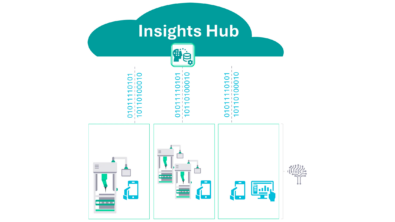
Ralf Wagner: Absolutely, Chris. Insights Hub is the Siemens offering when it comes to data-driven manufacturing solutions out-of-the-box. Insights Hub basically addresses the end-to-end technology stack for a solution to collect data from industrial equipment on the shop floor from the IT and OT systems which are required and data that is already there. If sensors are needed, we can integrate additional sensors, but in most of the cases that is not required as well to then have a consistent kind of data lake and time series store for that data with consistent and stable APIs which actually serve then the out-of-the-box solutions actually to help to our customers to get to value fast.
You don’t need to develop any own applications; you connect your existing equipment with the OT protocols that are available there. You have that data available in Insights Hub and then you have out-of-the-box applications for creating transparency, what’s happening on the shop floor, and you would be surprised how many customers don’t have that transparency, what’s happening on the shop floor with their equipment.
And then with that transparency, you can actually then go deeper because then you see what’s happening there and get actually actionable insights out of the data. But the good thing is we’re not doing this as a kind of a silo. We’re connecting this to the MES data to the SCADA data. Everything which is already there is being utilized and we embed this approach into what almost all manufacturing customers have.
They have a continuous improvement program in place. Basically, they meet every morning, they will do a stand up on the shop floor and they look back on how the last shift was doing, the last that week was doing, they look at their main KPIs which they have defined that might be quality, that might be first past yield, that might be additional buffer stocks that might be availability of critical equipment. And we help them to actually get this kind of measured in a very transparent and harmonized way in order then to identify deviations from the targets that have been setting for those KPIs very quickly
Then if you identify deviation then IoT data, which is the bread and butter of Insights Hub coming from the systems mentioned before, is actually there. And with AI tools and transparency tools and other mechanisms, we help to get to the root cause of any deviation very, very quickly, in many cases with a few mouse clicks only this is really changing those daily stand-ups, the continuous improvement programs of our customers significantly to what we call data-driven manufacturing at the end of the day.
You don’t need the days and weeks to get down to a root cause to identify what actually happened and why it happened and how you can avoid it on the shop floor in the next shift. You can get down to this root causes in a few minutes or hours to actually react way faster and quicker to get back your production KPIs where they belong. This is how Insights Hub is helping our customers. It’s an end-to-end cloud technology stack from the connectivity to this out-of-the-box applications with optionality that customers can develop their own dashboards, their own applications with Mendix and low code as they like. it’s a fully-fledged solution for data-driven manufacturing.
Rahul Garg: That’s that sounds quite impressive there Ralph. I love the concept where you identified when they have these stand-up daily stand ups, and they look at problems and it may take them weeks and days to find the problem and solve the answers.
But they cannot get to the issues right away and solve it right away so that you can actually take some corrective action even on that same day shift or the next day shift. But to kind of get the maximum value, is this something that can be used by the shop floor operator, or do you need some specialist to be using these capabilities? How does it work? Because you probably need some different kinds of people and in in your environment as well in your business to make this work better.
Ralf Wagner: Absolutely. And Rahul, that’s a very important point because indeed there are different maturity levels in the in the shop floor when it comes to digitalization and IoT and data and therefore our solutions actually target different personas. We have solutions like the out-of-the-box asset condition monitoring and predictive maintenance, which is very easy and simple to use for the operator themselves to get the transparency what is happening with their assets, what’s happening with their main KPIs, where they’re measured against.
But then we also have solutions which actually help our customers with AI in the background to predict quality during the production process is still going on with using all the data that this needs to be configured. We have tailored just towards the manufacturing engineering person. They know their process, they know how the machine is programmed, they know how the tools are being changed and wear and tear. So, with that experience and know how about the process itself, they can configure the AI in a kind of wizard like approach. But you need to be a production engineer.
And last but not least, we have tools where you can create your own AI models for data scientists, just for the large enterprise customers who actually have these kinds of resources. But the majority of manufacturing customers today still don’t have this kind of expertise. So, the main target group.
And users are the operators of the machine, the equipment in the line as well as the manufacturing engineers to configure these kinds of solutions.
Rahul Garg: You know while we this is that’s very good to hear Ralph. While we have got the operators being the target audience who are primarily, I guess the biggest users of these kinds of capabilities based on some of the experiences you have had with our customers, can you provide some insights into what kind of use and value some of our customers have seen by using this?
Ralf Wagner: Absolutely, yes. What we typically talk to our customers is when we start the process of adopting insights up and data-driven manufacturing approaches on top of their continuous improvement process. We see increase of availability of critical assets which are being monitored and then maybe even in some cases equipped with predictive maintenance approaches of 30% and more availability of those assets. Avoiding unplanned downtime is pure money at the bottom line as we know.
Then we have the customers who actually reduce their nonconformance cost in the quality validation process up to 50-60% with AI driven solutions for quality prediction because they know during the production process which might take them 30 minutes. Already after 10 minutes they know we have a quality problem here, so they can actually do countermeasures and not only find that out at the end of the production line that this is scrap and has to be thrown away. Then we have fewer defects also in the quality range from up to 30% with the customers reporting.
Sometimes it’s the transparency that it’s being created which helps them to link back root causes for quality problems, which they only find out at the end of the line to link it to certain process parameters, to link it to certain material types to certain suppliers and find it out way more quickly. Which helps them overall then to increase their performance because identifying bottlenecks which customers who use the IoT data and the insights of data and feed it into for example the plant simulation model. They actually before they then implement improvement measures on the shop floor, they use the plant simulation model to try this out, which is then getting them to 20% and more performance points on top of the current situation.
And last but not least, a very popular one here as well is energy consumption. We know that many customers specifically in Europe, they have energy and sustainability targets set for themselves, which they might even report out quarterly. In Europe, there are even tax credits being provided if you can actually prove with the ISO 50,001 compliant reporting that you reduce your energy consumption inside surpass applications that actually provide these kinds of reports. You have not only the sustainability targets fulfilled, but also get some nice effects on the on the tax credits and cost side and we have customers who were able to lower their energy consumption in certain part of their production of up to 30%.
There’s a really tangible kind of value to this. And Rahul and Chris, this is why we’re doing this for our customers. Yeah, there was the IoT hype 4-5 years ago where it was all about technology. But that train has moved. It’s all about the value. It’s the technology is an enabler to get to the value I just described because this is making the difference and technology is there to help customers to get there.
Rahul Garg: You know some of these details you just shared Ralph are very, very insightful, and very helpful to understand the value that customers can get. But as you were talking about some of the challenges customers are facing and the value that they’re getting, one of the things that came to my mind is are these capable is this insights up as a solution and some of the values that you identified, is this primarily targeted towards or is this something that can be achieved more with the with larger enterprise companies or mid-sized companies can also see the value of this?
Ralf Wagner: The nice thing about a cloud SaaS based software as a service solution, Rahul, which is really end-to-end integrated, is that it can be used by SMB, small business, medium businesses as well as by enterprise customers and it’s adopted by exactly both I would say even in a kind of similar fashion, while large enterprises always talk then very briefly about roll out.
We have customers who rolled out inside sub solutions to 80 plans in 20 countries because it’s a SaaS solution and it’s very easy to configure with not a lot of system integration being required. That was even done in less than eight months, so it sees that if you prepare yourself for rollout for large enterprises, it’s very well equipped. But on the other side, as there are no big servers’ installations being required on site, it’s also a nice solution for SMBs because they can get to this kind of value with SaaS based solutions.
Siemens Digital Industries Software helps organizations of all sizes digitally transform using software, hardware and services from the Siemens Xcelerator business platform. Siemens’ software and the comprehensive digital twin enable companies to optimize their design, engineering and manufacturing processes to turn today’s ideas into the sustainable products of the future. From chips to entire systems, from product to process, across all industries. Siemens Digital Industries Software – Accelerating transformation.