How Industrial AI is Transforming Manufacturing with Intelligent Solutions
The manufacturing sector stands at a critical crossroads. Companies worldwide grapple with skill shortages, unpredictable supply chain disruptions, and ever-increasing product complexity. To navigate these challenges, industry leaders are looking to the potential of artificial intelligence (AI). Of course, for industrial applications, consumer-facing chatbots that have dominated headlines are insufficient. Robust, reliable industrial AI systems, in contrast, must be designed to operate in environments where precision and safety are non-negotiable.
On the Future Ready podcast, Dr. Matthias Loskyll, Senior Director of AI and Robotics at Siemens Digital Industries shared insights into how Siemens is addressing these manufacturing challenges through practical, industrial AI applications. Keep reading for a summary of the discussion, or listen to the podcast through the player below.
Democratizing AI on the Factory Floor
Matthias described how Siemens has focused on making AI accessible to users without specialized AI expertise. This democratization strategy is important for manufacturing companies that generally lack AI specialists on staff.
Matthias also made the unique requirements for industrial AI systems clear. In industrial contexts, reliability, robustness, safety, precision and low latencies aren’t just nice to have but essential. Industrial AI systems interact with the physical world, potentially altering the behavior of machinery, logistics systems and more in the real world. When industrial AI succeeds in these conditions, it creates tangible, measurable value for manufacturers.
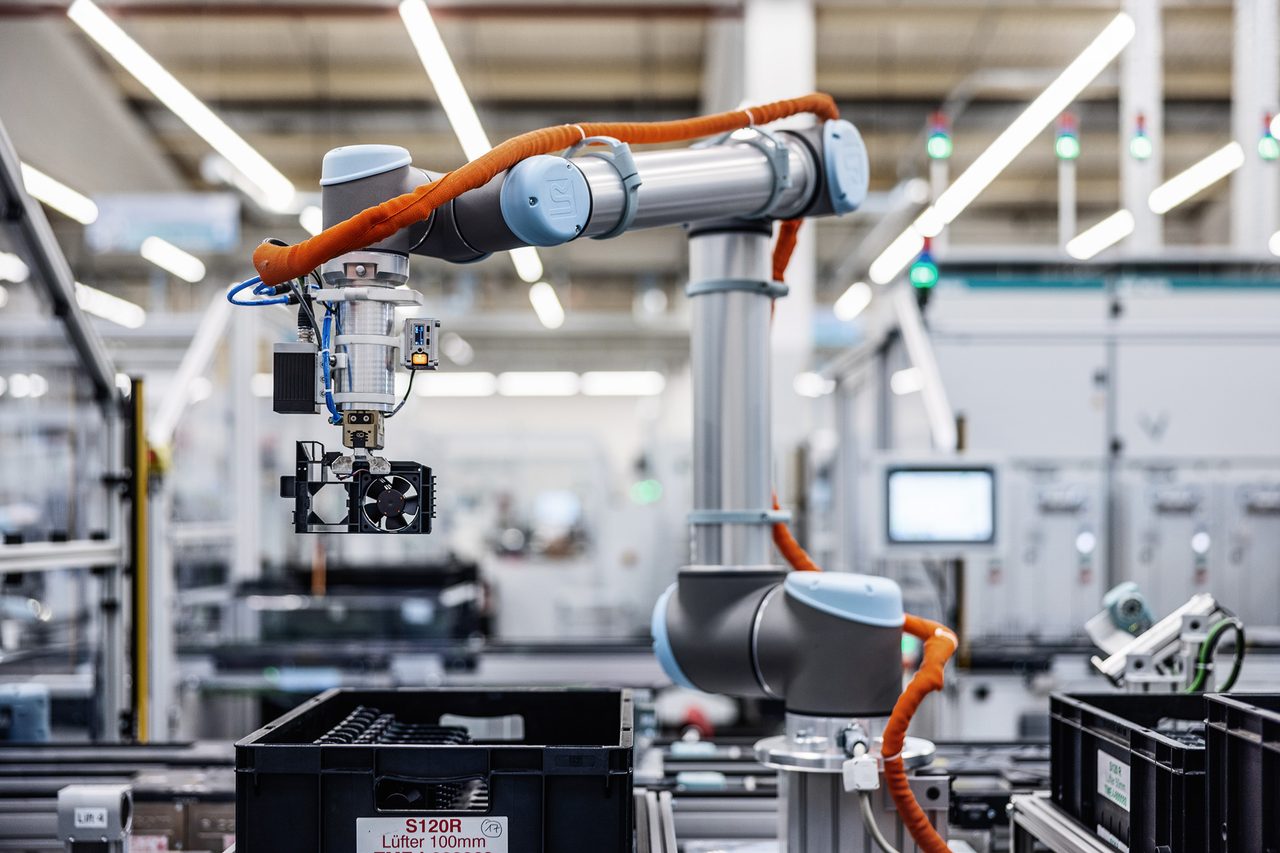
One standout example is Siemens Inspekto, an AI-based visual quality inspection system that allows anyone to automate complex quality checks using only a handful of acceptable product samples. What traditionally required days of setup can now be operational within hours, dramatically accelerating deployment timelines and making sophisticated inspection capabilities available to a broader range of manufacturers.
For high-throughput production environments, Siemens offers the Visual Inspection Cockpit (VIC), which combines machine vision with built-in AI models capable of handling diverse product types, capable even of inspecting naturally variable items like loaves of bread. Matthias also explained how direct integration of these visual inspection technologies with Siemens programmable logic controllers (PLCs) creates a closed-loop AI system where real-time machine control and AI-powered inspection work in tandem.
Scaling AI from Proof of Concept to Production
For many companies, the journey from proof-of-concept or pilot project to full-scale deployment is just beginning. Siemens supports companies through this journey, combining AI expertise with first-hand knowledge operating complex production facilities.
Matthias outline how Audi has leveraged this approach with their implementation for weld spatter detection in car body manufacturing. Using Siemens industrial PLCs equipped with NVIDIA GPUs and integrated into the Industrial AI Suite software stack, Audi achieved a remarkable 25-fold acceleration in AI inferencing directly on the shop floor where the actual welding operations occur. This proximity to the physical process enables rapid response times critical for quality control in high-speed manufacturing.
Audi’s success also highlights how industrial partnerships can leverage complementary strengths to deliver compelling results. Partners like NVIDIA can provide world-leading accelerated computing and GPU technology, while Siemens contributes deep domain knowledge in automation systems, engineering tools Digital Twin capabilities and the methods used to run modern factories.
Applying Industrial AI in Process Industries
Industrial AI applications extend beyond discrete manufacturing into process industries like chemical plants and oil and gas production. Matthias described how embedded industrial AI tools can help stabilize processes and optimize critical parameters that determine product quality in continuous production operations. In these cases, process control software and modeling solutions can work in a closed loop to model, test and optimize operations. Embedded industrial AI tools can help engineers or even tune process parameters autonomously, with human oversight.
AI-based soft sensing represents another innovative application, creating virtual instruments that infer key parameters without physical sensors. This proves valuable when physical sensors are too slow, too expensive, or simply cannot be installed in extreme environments like industrial boilers. Siemens’ C-Trans SSE IQ predicts emissions and quality-critical variables from existing process data, supporting applications in gas turbines, boilers, and heaters.
Industrial AI Supports Future of Faster Manufacturing
As manufacturing continues evolving, the integration of AI into industrial operations will only deepen. While many deployments remain in early stages, a strategic approach that focuses on accessible tools for experts and non-experts deployed in robust and reliable frameworks provides a blueprint for how industrial AI can move beyond hype to deliver concrete business value. The future of manufacturing lies not in replacing human expertise but in augmenting it with intelligent systems that make operations faster, more reliable, and more adaptive to change.
For more conversations on exciting industrial technologies featuring key experts, follow the Future Ready podcast.
Siemens Digital Industries Software helps organizations of all sizes digitally transform using software, hardware and services from the Siemens Xcelerator business platform. Siemens’ software and the comprehensive digital twin enable companies to optimize their design, engineering and manufacturing processes to turn today’s ideas into the sustainable products of the future. From chips to entire systems, from product to process, across all industries. Siemens Digital Industries Software – Accelerating transformation.