How green hydrogen can energize a better energy transition – Transcript

To learn more, read: Your guide to overcoming green hydrogen challenges.
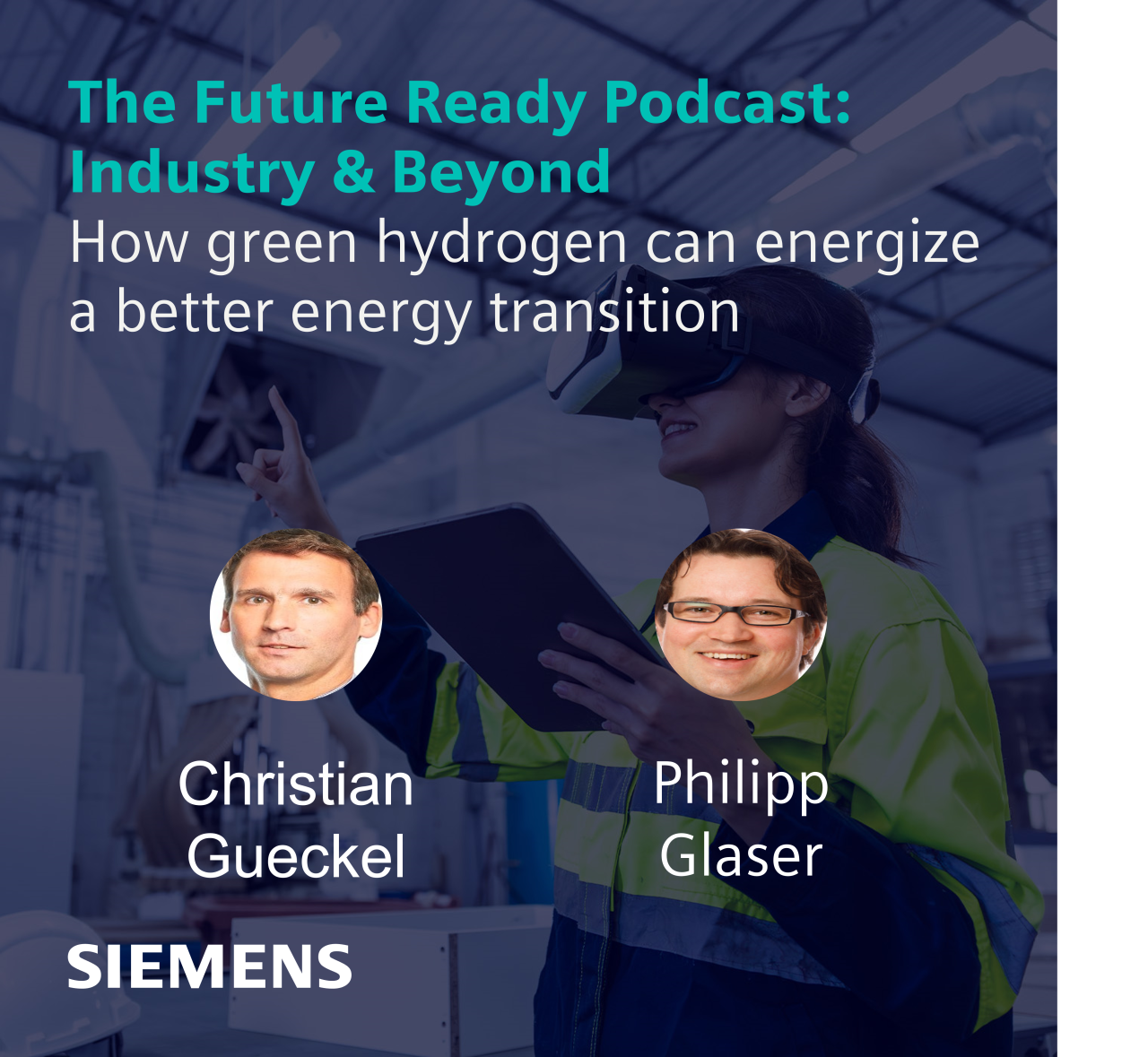
Shawn Wasserman: Hello and welcome to the Future Ready Podcast. My name is Shawn Wasserman, Process Industry Marketing Writer for Siemens Digital Industries Software. I will be curating this podcast experience for you.
Today we have a conversation between Christian Gueckel, Head of Verticals Chemicals and Energy at Siemens Digital Industries and Philipp Glaser Head of Hydrogen Business at Siemens Digital Industries.
Their topic of discussion: How green hydrogen can energize a better energy transition. With that out of the way, Christian will start us off.
Christian Gueckel: Welcome back to our energy podcast series. In our previous episodes, we had a discussion about:
- The big shifts in energy,
- The energy trilemma,
- The crucial role of open energy platforms in connecting the entire value chain, and
- The newly developing value chain.
Today, we are taking that conversation a step further. We are zeroing in on green hydrogen, not just as a concept or a buzzword, but as a critical component that must compete on [a] mass scale.
Green hydrogen plays a major role for many green molecules. We will explore how technologies, market forces and policy need to align to make this happen.
I’m Christian Gueckel, and I’m very happy to have my colleague Philipp Glaser with me.
Philipp Glaser: Thank you very much Christian for the introduction. I’m [really] looking forward to this episode.
Christian Gueckel: So, let’s pick up where we left on the last episode [where] we talked about the need for renewables to come together. Today, as I said, let’s specifically focus on green hydrogen.
What does it mean for this renewable system, [to include] green hydrogen and [for] its derivatives to come together? [How do they] compete [at] mass scale? And why is this integration so crucial for the energy transition?
And the second question I have for you is: how does Siemens with its open energy platform specifically facilitate this?
Philipp Glaser: Well, exactly.
These are the leading questions for today, right? So, you talked about sustainability, security and affordability. And for green hydrogen to achieve [all] three, it especially needs to be cost effective.
That means we need efficiency across the entire value chain from the wind turbine to the hydrogen molecule and then also to the derivatives. So, this is where the open energy platform becomes so vital.
Green hydrogen production is inherently linked to the volatile renewable electricity sources. And the platform is designed to [help] you root this energy, to decide if you use this energy to store electricity, to convert it to hydrogen or use it directly.
So, … the platform, is so to say, the digital brain that is ensuring that these elements come together from the solar farms, the wind parks, electrolyzers, storage facilities… So, these things do not only coexist. They have to be optimized together. They have to work together.
So, [at] Siemens, we are providing, so to say, the home base for green hydrogen with this platform.
Christian Gueckel: Interesting, interesting.
Philipp, you have been driving the green hydrogen business at Siemens for quite some time, a couple of years now. What [are], in your opinion, the major trends and challenges in this market?
Philipp Glaser: Well, before I come to the challenges itself, let me make one comment [about] where the green hydrogen industry stands at the moment.
So, the first thing is we are past the pure R&D (research and development) phase, but we are still not in the full commercialization stage. We are in the early commercialization stage.
So, there are many pilot projects. There are a lot of proof of concepts. But we have not yet really scaled to the gigawatt scale. So, [that’s] what the industry, what the market is still waiting for.
So, … for the status of the industry itself. If we look at the challenges, I see mainly four of these:
- First of all, there are a lot of innovative technologies that are not yet proven in use.
- Second, the levelized cost of hydrogen [is] still too expensive.
- Thirdly, there is a lack of the market itself, and the lack of market maturity comes also from the lack of logistics. You know, hydrogen is not easy to transport. So, market and logistics.
- And number four [are] the regulations that we have around hydrogen.
Christian Gueckel: Okay, quite some hurdles to overcome. So, let’s dig a bit deeper into these challenges.
Tell us more about your view on the technology trends and challenges in hydrogen.
Philipp Glaser: Well, as I already said, there are a lot of innovative technologies which are not yet [proven].
So, [it’s interesting], right? Because I’ve been [for] so many years in the chemical industry already. Now comes a new segment where you have so many innovations. So, a very exciting thing; which I really love to be part of that development.
So, when you look, for example, at the electrolyzer OEMs. A lot of these electrolyzer OEMs come from various backgrounds and are [new] on the market [and] new in the chemical industry. And many of them have very interesting innovations, but many of these are also untested.
So, you do not find a lot of electrolyzers where there are decades of experience which are really proven in use over decades. So, what they have to do, or what needs to be done, they need to use data to learn, to supervise, to optimize. And [to also] develop their next generation of electrolyzers.
So, we are enabling them to use their data, if they want, on [their] own servers, for example, to do fleet management, to manage, to maintain, to operate, and to improve their technologies.
And all this is only possible, and that’s a very important aspect here as well. When data is secure, right? Because no one wants to share their intellectual property or share data on unsecure platforms.
Christian Gueckel: Yes, that’s true. This data security is certainly a very, very important point.
Philipp Glaser: You know, if you want to do these things: [using] data. The data must be secure, right?
These companies are developing these concepts, this intellectual property, just imagine [if] something would get lost.
Now that would be really threatening for these companies.
Christian Gueckel: So, let’s focus a little bit on the second topic you mentioned. The levelized costs of green hydrogen are still too high.
And therefore, obviously, [the] derivatives you derive from green hydrogen are too high.
So, what is your perception on a price development for [green hydrogen] in the mid-to-long term?
Philipp Glaser: That’s a very interesting one because that’s exactly where we have a major lever. Where we try to support the industry to [bring] down [the] cost.
But stepping one [step] back, green hydrogen was or still is around about four times as expensive [as] gray hydrogen. However, the current situation [globally] also shows that … fossil energy can be extremely volatile in price and in availability.
So, we also see that the discussion has, of course, [changed] from the green aspect. And where we have a very price sensitive green aspect [that also adds resiliency to the] energy supply.
But when we come back to the green pricing, to the price of the green hydrogen. Of course, all that relies on the volatility of these green energies. So, of wind and solar. And this volatility needs to be managed.
So, we even say that it’s in our DNA when we come back to the platform that we embrace the typical volatility of green energies by integrating the whole set of data from the weather conditions, the plant automation system, the operation strategies, the offtaker profile and to integrate all [this] data into one platform.
So, when you take for example Europe, there we have at the moment something around 4 to 8 euro per kilogram of green hydrogen. But we mainly see that these are produced in plants which have not yet scaled up.
So, there is not a plant at a gigawatt capacity yet. So, there is a lot of room to put down the levelized cost of hydrogen. So, we have, for example, [we] have done some simulation models already where we combine this scale up with this above-mentioned [scenario].
With this tech, with this technology that this can make around about half the price for the levelized cost of hydrogen. But there’s another important aspect when we think about the price for green hydrogen. Because [one] thing is the price and the cost that you have to produce the green hydrogen. On the other hand, [there] is the question, how do you create your business model?
Christian Gueckel: Well, let me step in there. I mean, the business model depends a lot on the market itself. And as you mentioned, it’s still under development.
A lot of these topics, a lot of these plants are still small pilot plants and so on. So, what is your perspective then on the business model, slash the market development for green hydrogen?
Philipp Glaser: And let’s start with the markets. So that’s because that’s a very exciting topic. When I speak to customers, [I] very often hear that they say the unmature markets are more challenging for them than the technical challenges. Because [of] the technical challenges, they see a lot of innovations; they see a lot of approaches that can used to solve and overcome [of] these challenges.
But this market, the unmature market, is even more challenging for them, very much. So, the problem is that if you want to step into the production of green hydrogen, you can today, [hardly] foresee what price you can get for the next 10 years. And on the other hand, the offtaker also can hardly calculate how much, [and] what price he has to pay in the next 10 years for green hydrogen.
And on top comes the logistic topic, because hydrogen is not easy to transport, right? You have to cool it down. You have to put it under pressure. And not every plant is close to a hydrogen pipeline.
Shawn Wasserman: Hello, Shawn here again. I’m here to let you know that’s all the time we have for today’s episode of the Future Ready podcast. Thank you, Christian and Philipp.
As they’ve discussed, the future of green hydrogen is about more than technology. Its success depends on innovation, cost competitiveness, market development, logistics and regulatory frameworks.
Despite these challenges, the direction is clear. The industry is moving from pilot projects towards commercialization and digitalization that scale the technology efficiently and securely.
What is also clear is that no single green technology element can succeed in isolation. Renewable generation, hydrogen production, storage, transportation and offtake must all work as a part of an integrated energy ecosystem. This is exactly why Siemens made its open and interoperable digital platform for the energy transition.
With that, I’d like to thank our listeners for joining us for this episode of the Future Ready Podcast. We hope you enjoyed the conversation and found it valuable. Stay innovative, and let’s continue shaping a sustainable energy future together.
To learn more, read: Your guide to overcoming green hydrogen challenges.
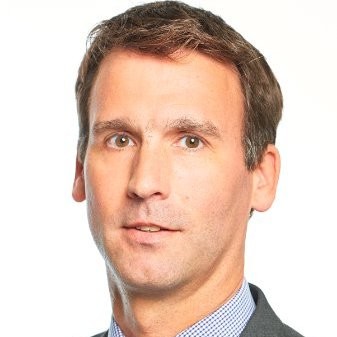
Christian Gueckel – Head of Verticals Chemicals and Energy at Siemens Digital Industries
Christian Gueckel is the Head of Vertical Chemicals and Energy at Siemens Digital Industries. In this role, he is responsible for sales operations within the vertical.
Prior to joining Siemens, Gueckel spent more than ten years at the specialty chemicals company Clariant in various management positions, including Head of Strategy and Marketing. He also earned his PhD in inorganic chemistry from the Ludwig Maximilian University of Munich.
Connect with Christian on LinkedIn

Philipp Glaser – Head of Hydrogen Business for Process Automation at Siemens Digital Industries
Philipp Glaser is the Head of Hydrogen Business for Process Automation at Siemens Digital Industries. In this role, he is responsible for the go-to-market strategy for SIMATIC PCS neo.
Glaser joined Siemens almost 20 years ago where he has spent his whole professional life in various positions associated within the process industry. While in these positions, generating individual value for various companies became his personal passion. He also gained experience in numerous sales, marketing and business positions. Philipp has an Industrial Engineering and Management degree from the Karlsruhe Institute of Technology (KIT).
Connect with Philipp on LinkedIn

Shawn Wasserman – Process Industry Marketing Writer
As a process Industry thought leadership writer at Siemens Digital Industries Software, Shawn produces podcasts and blogs to help leaders in the process industry streamline their operations via new tools, technologies and software. For over 10 years, he has informed, inspired and engaged the engineering and thought leadership communities through online content.