Exploring a new model of mass production

In the past, it wasn’t uncommon for a single person to own and operate one or two factories in which they produced goods for their regional market yet, in the modern era, that paradigm has all but disappeared to be replaced by large companies owning centralized factories shipping goods to a global market. While each approach has its up and down sides, with a modern digital backbone, the concept of a owner-operator in the digital era may reimagine what it means to operate production on a global scale.
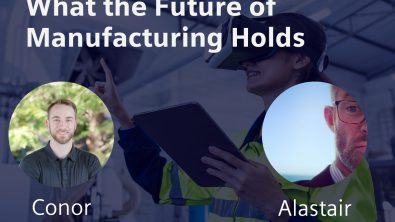
In a recent podcast, host Conor Peick was joined by Alastair Orchard, head of Digital Enterprise Thought Leadership for Siemens Digital Industries, to explore the model of the owner-operator in modern manufacturing and how smart contracting and agentic systems make that possible.
Check out the full podcast here or keep reading for some of the highlights of that conversation.
Smart contracts and a network of operators
In the past, a single factory, owned by a single person would generally produce a single type of good dictated by the owner. Now, Alastair explains how a modern version of that concept would look radically different. In this concept, rather than producing goods and supplying them to the local market, a factory would instead directly supply its products capacity.
As part of a larger network, a single factory would be able to produce certain types of goods within a certain region and companies looking to supply their products within that region could issue what Alastair describes as a smart contract to that factory to manufacture their product. This contract, issued through the blockchain would not only serve as a contract in the traditional sense but also a means to share proprietary information needed for manufacturing as well as a way to ensure the final product meets the companies quality standards.
This type of flexible, adaptive production process also requires a strong digital backbone. In a scenario where a factory could accept a contract to make energy drinks one day and t-shirts the next, the ability to virtually commission production lines and quickly reconfigure physical assets is a must. This is why, to achieve this modular factory model, robust digitalization technologies, like the digital twin, data fabrics and Industrial AI must be paired with cutting edge shop floor technology like AGVs, Physical AI and closed-loop manufacturing techniques.
By combining all these technologies and more together it’s possible to create a factory able to rapidly reconfigure itself to meet whatever the needs of the current product are, be that food and beverage, textile or machine parts. This method also allows companies to better take advantage of regional markets, utilizing local expertise and logistics without needing to maintain it full time in a market where it might not make sense to do so.
Factories connect to an agentic system
Taking things a step further, Alastair describes what he calls an agentic system for these smart contracts. In this vision of the future, companies could use AI to analyze demand pattern make predictions on what goods are best supplied to what markets by examining data on a scale humans cannot. From there, agents can issue smart contracts to the right factories in the right locations to capitalize on predicted demand.
Another key aspect where agents will show their value is in adapting product designs. Not only is it important to customize a product to meet local demand, often times a when manufacturing goods in a modular network, the availability of raw materials or manufacturing tools will vary from region to region. This means that to ensure constant quality no matter the region, a blueprint or recipe must be adapted to match the tools and materials available in a given region.
While this process can be done manually, in order to reach the promise of a flexible and agile manufacturing network, allowing agentic AI systems to handle it instead makes far more sense. These systems could quickly understand the required changes, make them, validate them and present them to a human for final review in a single streamlined process that starts at the same time the data is analyzed to deiced what region to manufacture a given product in, meaning that by the time a smart contract is issued, the modified design is already approved for use in that factory.
While the future of a network of factories run by owner-operators is probably a long way off and won’t ever fully replace centralized manufacturing it still offers a glimpse at a production methodology that may be a better fit for the products and consumers of tomorrow.
Siemens Digital Industries Software helps organizations of all sizes digitally transform using software, hardware and services from the Siemens Xcelerator business platform. Siemens’ software and the comprehensive digital twin enable companies to optimize their design, engineering and manufacturing processes to turn today’s ideas into the sustainable products of the future. From chips to entire systems, from product to process, across all industries. Siemens Digital Industries Software – Accelerating transformation.