How Digital Twin Innovations Drive Future Enterprises
Though well established in industry discourse, Digital Twin technology still has room to mature and grow, adding to its existing value as a powerful tool for engineering, simulation, virtual commissioning, lifecycle management and more. As it matures and synergizes with other key technologies, such as Industrial AI, the Digital Twin will expand into a connected, intelligent, and real-time representation of entire industrial enterprises.
Artificial Intelligence (AI), meanwhile, holds enormous potential for transforming industrial operations. The effectiveness of AI however is highly dependent on the quality, structure and accessibility of the data used for model training and operation. Most industrial companies possess vast quantities of data, yet that data is frequently siloed across disparate systems, inconsistently formatted and difficult to aggregate in a way that makes it immediately useful for AI applications.
The Digital Twin can ease the collection and organization of data to improve AI training. By establishing a virtual representation of physical assets and processes from the outset, companies can begin building a structured, coherent data environment.
In a recent podcast covering the topic, Dominik Zettler, Vice President of Simulation for Industrial Systems at Siemens, also highlighted the value of synthetic data generated by simulation models. Synthetic data can supplement real-world datasets, help identify anomalies and provide a benchmark against which actual operational data can be evaluated. As Dominik notes in the conversation, not all data is equally relevant, and the discipline of determining what data matters for a given use case is itself a critical capability that organizations must develop.
The Executable Digital Twin Embeds Real-Time Intelligence
For many companies, production machines and facilities represent vast resources of untapped or underutilized data that can be better leveraged through the Digital Twin. The executable Digital Twin (xDT) can help companies better access production data by embedding simulation intelligence directly into live production processes.
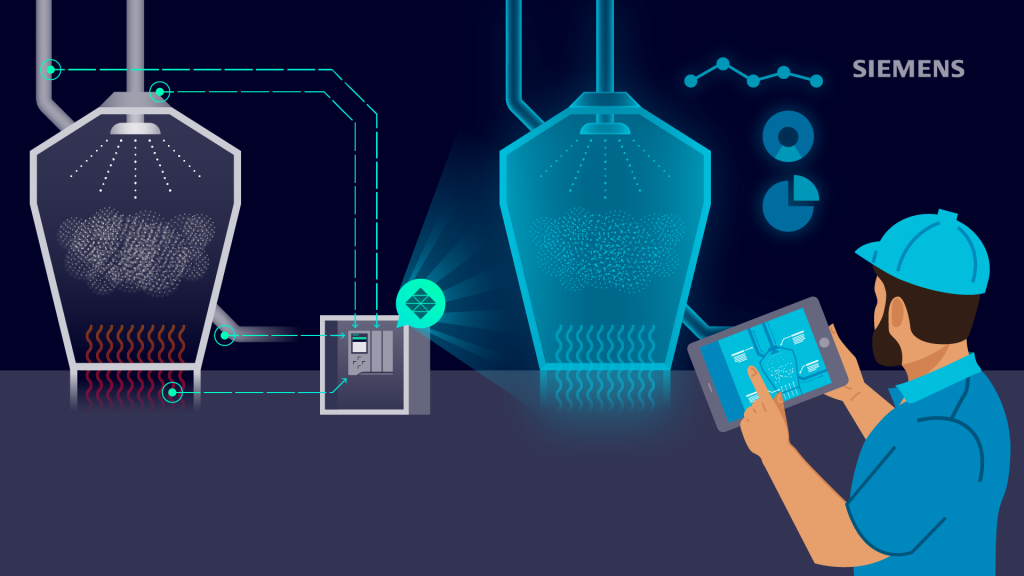
The xDT operates continuously at the edge and its outputs can be fed directly into control systems such as programmable logic controllers or supplied to dashboards or other operational systems to give engineers detailed and contemporaneous insights into production machines or processes.
For instance, Zettler shared the example of a spray drying process in which large quantities of energy are consumed to evaporate liquid content and achieve a desired powder consistency. If the properties of the wet powder vary, the process parameters must be adjusted accordingly to maintain quality and avoid energy waste. An xDT, continuously modeling the thermodynamic behavior of the process and responding to real-time input data, can make those adjustments seamlessly and automatically. The benefits are tangible: improved product quality, reduced energy consumption, and lower operational costs.
The xDT is also designed for adaptability. Models can be updated and redeployed without disrupting operations, allowing organizations to accommodate new materials, changing environmental conditions, or evolving process requirements without significant downtime or reconfiguration effort.
The Industrial Metaverse: A Long-Term Vision Taking Shape
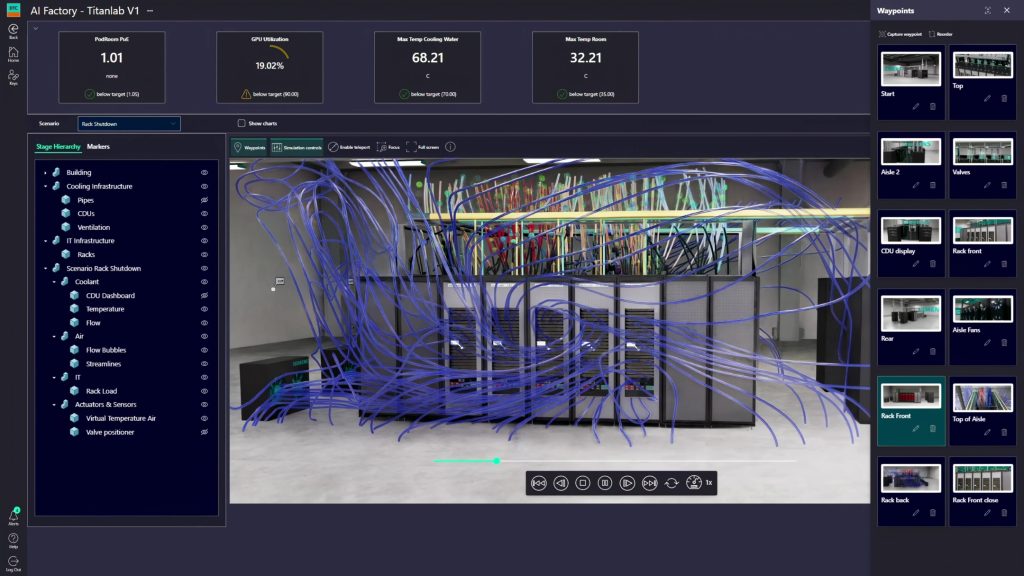
Looking further into the future, Zettler situates all of these developments — the Digital Twin, the recently announced Digital Twin Composer, xDT and Industrial AI — within the broader architectural vision of the Industrial Metaverse. This concept represents the convergence of Digital Twin capabilities across the full lifecycle of both products and production systems, integrated into a persistent, interconnected virtual environment that mirrors and informs the physical enterprise.
Zettler distinguishes the Industrial Metaverse from more consumer-oriented interpretations of the term. He does not envision a single, unified Industrial Metaverse shared across companies and industries. Instead, he anticipates the emergence of private Industrial Metaverses — owned and operated by individual enterprises to protect intellectual property, maintain control over sensitive technology and manage supplier relationships within a governed environment. Export control regulations, data sovereignty requirements and competitive considerations all reinforce this model.
In Zettler’s view, the building blocks for this vision are already in place. The comprehensive Digital Twin, the Digital Twin Composer and the xDT are not isolated products — they are the foundational ingredients of an Industrial Metaverse that will grow incrementally over the coming years. Large enterprises will lead the way, and as the technology matures and becomes more accessible, adoption will broaden across company sizes and industry sectors.
A Practical Takeaway for Industry Professionals
The foundational technologies for digital transformation are already in place. For many companies, the challenge is in making the prospect of the Digital Twin, Industria AI and beyond more approachable. The terminology alone can appear daunting, and organizations may be tempted to delay action until the landscape feels more settled or more comprehensible.
Zettler’s advice is to lean in rather than . The entry-level use cases are genuinely achievable, the tools are increasingly accessible and the value is demonstrable. In sum, think big, start small. For engineering and industry professionals navigating the complexity of digital transformation, adopting an ambitious vision while targeting initial investments provides the most reliable foundation on which to build.
Siemens Digital Industries Software helps organizations of all sizes digitally transform using software, hardware and services from the Siemens Xcelerator business platform. Siemens’ software and the comprehensive digital twin enable companies to optimize their design, engineering and manufacturing processes to turn today’s ideas into the sustainable products of the future. From chips to entire systems, from product to process, across all industries. Siemens Digital Industries Software – Accelerating transformation.