AI that onboards your humanoid
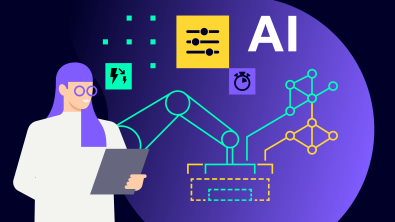
Once limited to eye‑catching technology demonstrations, humanoid robots are now approaching production readiness. As they move rapidly toward real-world deployment, success depends on effective onboarding, continuous learning and robust software management. The combination of AI and the Digital Twin enables faster, perpetual training.
In an episode of The Industry Forward Podcast, host Dale Tutt, Global Vice President of Industry Strategy at Siemens Digital Industries Software, spoke with Rahul Garg, Vice President of Industrial Machinery at Siemens Digital Industries Software to discuss how humanoid robots are trained, deployed and scaled, highlighting the critical roles of AI and the Digital Twin in making them feasible industrial solutions.
AI’s role in training
Much like human workers, humanoids must be trained to learn certain tasks. Because humanoid robots are designed to be adaptable to any type of process and dynamically respond to operations, it is imperative that organizations calibrate them for specific environments. Siemens estimates that this training process will take upwards of two weeks; without AI or the Digital Twin, humanoid training will extend much farther, if not be nearly impossible.
It is not feasible to prepare a humanoid for every single scenario they may encounter. Already, physical AI, which integrates vision and perception and sensor feedback to enable real-world interaction and enhance motion-planning, transforms humanoids into decision-making robots that can dynamically adapt in real time. Despite their intelligence, even simple tasks are subtly more complex for humanoids. This is where AI comes in and empowers humanoids to accommodate new scenarios through generalization. Using AI to train humanoids, businesses can ensure that their robots can handle varied loads or tasks without explicit reprogramming and continuously learn in unpredictable environments. And when used in tandem with the Digital Twin, together they both become essential training tools for humanoids.
Leveraging the Digital Twin’s simulation abilities and the analytical capabilities of AI, manufacturers can create immersive settings that perfectly imitate physical factories and production lines. In this virtual space, robots can practice tasks, address common challenges and develop problem-solving skills within a reasonable time frame. Unlike physical environments where engineers are limited by both time and unavoidable tangible constraints, simulated environments provide settings with no restrictions, enabling robots to learn to tackle even unanticipated problems. Additionally, since this is all digitally constructed, creating training scenarios is quicker and more cost effective than setting them up in the real world.
Compared to training traditional robots, AI and simulation turns what once took months and years into a few weeks. The Digital Twin can even run thousands of scenarios simultaneously, and this iterated on top of AI helps humanoids learn more robustly. And AI allows them to build upon what they learn so that they will not need explicit reprogramming.
Preparing to enter the workforce
Humanoid robots are not a one‑size‑fits‑all solution, but they represent a new category of flexible automation. The accelerating convergence of enabling technologies, supported by the Digital Twin and AI, is transforming humanoids from experimental concepts into practical production-ready assets. As shipments increase and scale becomes limited primarily by manufacturing capacity, organizations that invest early in digital foundations will be best positioned to harness the full potential of humanoid robots as they enter mainstream industrial use.
Their ability to learn and adapt to real-world environments makes them highly valuable, especially legacy and traditional settings where modernization is both expensive and unfeasible. To learn more about how your enterprise can prepare for humanoids and reap their benefits, consider tuning into the Industry Forward podcast and discovering how Siemens can help every step of the way.
Siemens Digital Industries Software helps organizations of all sizes digitally transform using software, hardware and services from the Siemens Xcelerator business platform. Siemens’ software and the comprehensive digital twin enable companies to optimize their design, engineering and manufacturing processes to turn today’s ideas into the sustainable products of the future. From chips to entire systems, from product to process, across all industries. Siemens Digital Industries Software – Accelerating transformation.