Advanced robotics and AI in industrial manufacturing- Episode 4 transcript
Chris Pennington: Etienne, thanks for supporting this discussion. It’s fascinating to get a glimpse into the future of industrial robotics.
We’ve already talked about leveraging multiple robots from multiple vendors, so now we’ll transition to talking about how they’re programmed to move. For this, I’d like to introduce a new guest. Hello and welcome to the show, Jens. Can you go into bit more depth about your role and experience to start things off?
Jens Meckel: Yeah. Thanks a lot, Chris. I have a quite a lot of experience in the engineering with TIA Portal, which is a huge engineering portal for the S7-PLCs and that may seem a bit awkward in robotics, but that’s a very good match. Also, when I look to our customers, as Mark said, the acceptance of robots has also something to do with that.
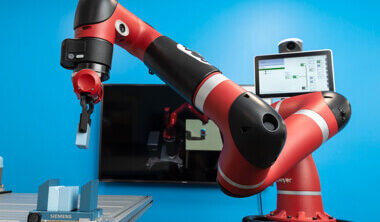
I really need that specialist on robotics, or it can be also done by the service people and by the people you have for the rest of your automation system and that’s why we introduced the Simatic robot library which is based on the so-called Standard Robot Command Interface, and that technology has been standardized by the PROFINET organization. It’s standardized by all the leading robot vendors. They came together and they created that standard robot command interface and that makes it possible to use your PLC engineering – TIA Portal – for programming the robot. That really lowers the barrier of using robots in your automation system, which is very important for the robots to help you in production and that you get your return on investments on the robots.
With that, it is possible to program the robot from within your automation engineering TIA Portal just by dragging libraries into your standard programming, and then you can move the robot. That is especially important if you think about your service personal, because your service personal in the automation world usually knows that kind of PLC engineering tooling very well. Now they can also service the robot within their PLC Engineering environment. Not only for one robot vendor, but different robot vendors. It’s very easy for them to incorporate the robots into their standard automation environment.
Rahul Garg: Jens, one of the things I hear you talk about is that you’re enabling the democratization of robots, right? Because you’re making it a lot easier for people who are not familiar, perhaps with the programming of robots, making it easier for them to leverage some of their existing skills with programming of automation and bringing that skill into the world of robots as well.
Jens Meckel: This is why I call the PLC engineering low code engineering. Why is its low code engineering? Because it’s like a circuit diagram. You can use that very same easy low code engineering method for programming the robot. It is really democratizing the robotics.
Rahul Garg: Yes, yes. One of the things you mentioned was in your responsibilities was around the Pick AI robot as well. Could you talk a little bit more about what’s so important about a pick robot and what are the things we have done with the Pick AI capabilities there?
Jens Meckel: Yes, Rahul. As I talked before about SRCI, that’s standardization of the robot programming and the robot programming can be done in the TIA Portal. That is one thing that the automation engineers now can easily move the robots, but it is also important for them to have an easy access to robot skills. Skills like the picking skill that makes the robot pick an object with only very few engineering effort.
Max mentioned that they’re using that in the factory. Picking objects and in the traditional robot programming is very hard and often even impossible to pick an unknown object. But that’s quite a common task, especially if you’re talking about end of line intralogistics, you don’t know the objects you have to pick. Pick AI uses a neural network which is pretrained. You do not need a special training for a different path and different objects. Just use the Pick AI algorithm and that can be programmed from your engineering in the TIA Portal. Then you get the pick points for your suction gripper. It’s very easy. No training basically needed.
Where we see the robotic going towards making it very easy for the user to implement those complex algorithms. But the complexity is completely hidden to the user. The user just has drag and drop capability of a of a library object, pick points provided and that’s about it. Then he gets it running.
Rahul Garg: This is quite fascinating. We as humans don’t think too much about the task of picking up something with our human dexterity. Trying to get a robot to do that has its own challenges but looks like we have got some of those challenges addressed now. Is this capability in production in any of Siemens facilities or anyplace else?
Jens Meckel: Yes, it is used in the factory. Max gave us some examples from Erlangen, and it’s also been used by a big intralogistics system integrator, so customers already using that, and we are very happy about that because this is the future of programming a robot.
Rahul Garg: In the context of the facility, I think Max also spoke about multiple robots. I guess they are using the SRCI library to help program all of their robots as well.
Jens Meckel: Yes, partly. Because not all robot vendors have already introduced SRCI. They are working on it. All the big ones working on it at the moment, but they have some robot vendors where they already have that interface implemented. That’s then also used in the Erlangen factory because if the automation engineer can now use that SRCI protocol, then you can really use your standard HMI you already have at the machine and also get the service information to do some reconfiguration off the robot from your standard HMI. This is very convenient for the automation engineer.
Also, Max said before that they have a lot of brownfields out there which have the need of automation because it would really bring a lot of benefits to them. Now imagine you do not need to completely rebuild the machine, but you can also use the existing HMI to also supporting your robot. That’s the big advantage for brownfields. From my perspective, that’s why they’re using it also at the Erlangen factory.
Rahul Garg: That can be quite fascinating because an HMI is typically a tool used more at an operator level. Using those capabilities even to manage the functions of a robot can be quite valuable on an ongoing basis.
Jens Meckel: Yes. You always have the same interface as well to the operator, so it’s not vendor a, vendor B, vendor C interface HMI. But you have the same look and feel also on the HMI for the for the operators.
Chris Pennington: Maybe we could move on just to discuss the solution process for programming a robot.
Jens Meckel: Yeah, Chris, this is the very same tooling, in the same environment as the automation engineer would do the rest of the programming of the of the machine. For example, at Siemens we have the TIA Portal where you do your automation engineering with, and you use the very same PLC engineering. Then you can just drag and drop your robot libraries in, and you can program your robot movement. It’s very convenient for the automation engineer, and that’s easy to do. It’s like a circuit diagram. Even an electrician has no problems reading that code.
Chris Pennington: And are you leveraging any simulation tools to deploy advanced robotics in the factory?
Jens Meckel: Yes, we have. We have a dedicated simulation tool which is very easy to use. It’s dedicated more towards the automation engineer, where you can simulate using the SRCI that standardized protocol can do that simulation task of the robot, and then of course you can also use the tool chain with Process Simulate. Then you can import your path from Process Simulate to the TIA Portal.
Although this is a proof of concept at the moment, we’re working on that, to make it a product soon. Then you download it to the PLC, and you have your connection to the robot, and you’re in full control of the robot via the TIA Portal, but also leveraging all the tools like process simulate for example for simulation.
Rahul Garg: For programming robots, one of the key functions that needs to be enabled is safety. Is there something we further provide for that as well?
Jens Meckel: Yeah, if you take a look to our SIMOVE system, we created an AGV system which is controlled by a PLC which also includes safety. You have your safety covered with a PLC, with a standard task for an automation engineer. If you now think about those AGVs being serviced and operated in the factory, those automation engineers know how that works. It’s really an advantage to have AGVs with that capability. Our customers having a huge benefit, because even after five years, those automation engineers still know how to maintain that, because it is all standardized. And you have your safety covered.
Rahul Garg: That’s good point. You know, and as we are talking about using TIA Portal and the PLC language as well a program capability for robots. Is there something that we have extended even for CNC programming and even using robots for CNC machining?
Jens Meckel: Good question, Rahul. We do have that. It’s called Run My Robot and this is leveraging our CNC controllers to drive a robot. They’re driving that with a very high precision because obviously they are for machine tool systems. Usually, high precision is needed, so using that controller you can control a robot with the highest precision for special tasks. But depends on what you need here.High precision is the key for that tooling.
Rahul Garg: Yeah, I would imagine we are going down to less than millimeter level accuracies right for that level of precision.
Jens Meckel: Yes, absolutely.
Chris Pennington: We know that many industrial robots are already using AI capabilities, but Siemens has integrated ways to use AI to train robots as well. How do you see AI training models influencing robot programming for yourself?
Jens Meckel: For us, it’s very important because our customers, we talking about more than 200,000 users of our automation system TIA Portal. Often they do not have a lot of knowledge about robot programming. Therefore, we have to make it easy for them. We have to lower the burden of robot programming. They shouldn’t have any fear of programming a robot. That’s where AI comes into the game.
Using AI, we can lower the burden because those highly complicated programming tasks are hidden in the neural network, and they have just to select that AI capability to get their tasks done. Therefore, I think it’s very important that we incorporate more of those AI based tooling into our offering.
Rahul Garg: I would imagine this whole area of using AI doing program robots is gonna become a very dominant way of how things get done in the future, right. Because think about it: the AI being used for regular IT programming is becoming a natural process and I would imagine the same capability coming into the OT process.
Jens Meckel: If we hear about industrial metaverse, there are all these AI based skills coming into the game and being simulated in that environment. Max said before they have the factory on a millimeter grade into a virtual environment to be able to do that simulation to be able to see what change that brings.
If they change certain parameters in the automation environment, that’s where robotics really plays into that game. If you have that complete [digital] twin of the machine in your virtual environment, you can do tests. You can run the AI skills within that environment, see whether they fit or they don’t fit. Make your adjustments before you actually apply it to the real environment and always have that that twin running in the background. You can do optimizations in the twin first to see the results and then download it to your real environment.
Rahul Garg: That’s a good point. We were talking earlier about the whole perception phase and the decision-making phase of a robot. What you’re highlighting is the industrial metaverse can be very valuable in the perception phase because it gives you the ability to create a lot of scenarios that are not always possible in the real world, but at least gives you the ability to evaluate all that and then make sure that from a decision-making phase you incorporate all those scenarios.
Jens Meckel: Absolutely. It’s quite cost efficient because if you crash a robot in the virtual environment, it doesn’t cost anything. You just have to change the parameters and do the next run compared to a real environment where it’s quite costly. Plus, you can see the benefits in the individual environment and your customers can really see that and get a view on how this will change the way of working and also lower the burden for that investment.
Rahul Garg: Sure. This can be very fascinating. This can be a very important requirement going forward as companies look to incorporate more robots into their manufacturing environments having a digital twin and industrial metaverse environment is going to make it easier for them to ramp up very quickly.
Jens Meckel: Yeah, absolutely. This will be the future from my perspective.
Chris Pennington: I just wanted to finish off with a thought on humanoid robots. We’ve seen a lot of excitement recently with Elon Musk and his humanoid robots. But if we think about that in an industrial setting, what do you think about having humanoid robots on the factory floor. Do you think it’s going to be more difficult to program them? Do you think there’s a there’s a future in that approach?
Jens Meckel: Yes, I do see them coming absolutely because if you think about brownfields, and Max stated it before, you have those 18 people working in an automation cell in that brownfield and now you want to automate it. One way of course is to use traditional robots. But then you have to rework the complete automation cell. Thinking about a humanoid, which has more or less the same height, the same dimensions as a human. It will be very easy to let them do the work.
But of course, this is not something you can program. Traditionally, this is really something where you need a lot of AI capabilities. From my perspective, it will be more like you tell them what task they should fulfill. Then they do the rest because they have the foundation models, they have the physical agents, and they will do the task you tell them to do. If you had to program the task it’s almost impossible from my perspective because it will be way too complex. It will take some years, but if I see the Chinese government, for example, investing a lot of money. But not only in China, but also if you take a look at the US and the West Coast, there’s a lot of investments in those start-ups in those companies doing humanoid robots.
There will be a big market and for us it’s important as an automation supplier, we have to integrate them. It’s all about integration from our side. Integrate them perfectly in the rest of the automation workflow.
Chris Pennington: Interesting. Great answer. Thanks for that. Now we’re approaching the end of our discussion and I’d like to thank Yens for some more interesting topics that you brought up there. Now what I’d like to do is we’re approaching the end of the session is just to return to all our experts to get the final thoughts and on things for the future. Rahul, you can kick things off.
Rahul Garg: Chris, to me, advanced robotics is here, and the growth of robotics is going to escalate at A at a much, much faster pace given all the challenges around.
The only way to do all that is by bringing in more automation. Bringing in more robotics and some of the technologies that are now available. We are going to make it very easy for companies to start using introducing robots and driving more adoption of robots in their factories. It’s going to be a very exciting future for all of us and I think it’s for all of us to watch and learn and enjoy.
Chris Pennington: Yeah, good summary. Etienne, any final points from you?
Etienne Ferre: Yes, I agree with you, Rahul. I think that advanced robotics in the future will be easy robotics and that everybody on in each industry can use a robot. It will be cheap. It will be easy to program. We can have a real robot everywhere for any type of task and that will be the future.
Jens Meckel: Thanks Chris. For me, it’s really all about integration into the automation system. Make it easy for the OT engineer, lower the burden and hide all the very complex AI tasks from the user and make it very easy for them.
Chris Pennington: Well, thanks for all of those summaries and it’s been a pleasure having you all as our guests today. Thanks for joining to discuss advancements in industrial robotics and the various technologies required to create factories of the future. I also like to thank our listeners for tuning in today and we hope you join us for future episodes where we’ll continue to explore the future of manufacturing. Thank you.