From Oranges to Engineered Skin: Rethinking Medical Device Testing
Anthrotek is creating hyper-realistic body models that give medical device developers and training providers a more accurate alternative to oranges, foam and other traditional stand-ins.
For years, developing injectable medical devices and training clinicians on medical procedures has involved some surprisingly simple substitutes for the human body. Autoinjectors, EpiPens and insulin pens, for example, have often been tested and demonstrated using oranges because their resistance can approximate the feel of human skin. Surgical training has faced similar limitations, with simulated organs sometimes made from materials such as polystyrene foam.
For an industry under increasing pressure to validate devices before they reach patients, those approximations leave plenty of room for improvement. It’s a challenge UK-based materials science company Anthrotek is working to address.
“We’ve seen all sorts of models that are not suited to testing a medical device,” says Dr. Raoul Peltier, Anthrotek’s co-founder and CEO. “To this day, people are still using oranges to train people to do injections, or polystyrene boxes to replicate organs.”
An Unusual Route Into Medical Simulation
Anthrotek’s origins don’t follow the typical medical technology startup story.
Peltier is a materials scientist who spent close to a decade in academia before moving into biotechnology. Outside work, however, he had also developed an interest in special effects, experimenting with materials and fabrication techniques in his home workshop. Two years ago, after meeting his co-founder, he saw an opportunity to bring those two worlds together. The result was Anthrotek.
Rather than immediately committing to one market, the company spent its first year exploring three areas simultaneously: special effects, medical robotics and medical simulation. “We took that year to explore all three, and the result was that medical is the way to go,” Peltier says.
The second year was about narrowing that focus. Special effects was gradually wound down, robotics was reduced to a single academic collaboration, and medical simulation became Anthrotek’s primary business. Today, it represents around 80 percent of the company’s work. Peltier credits patient angel investors with giving the team enough time to find the right direction without the pressure to generate rapid returns. “If a company is lucky enough to do this, I would highly recommend it,” he says.
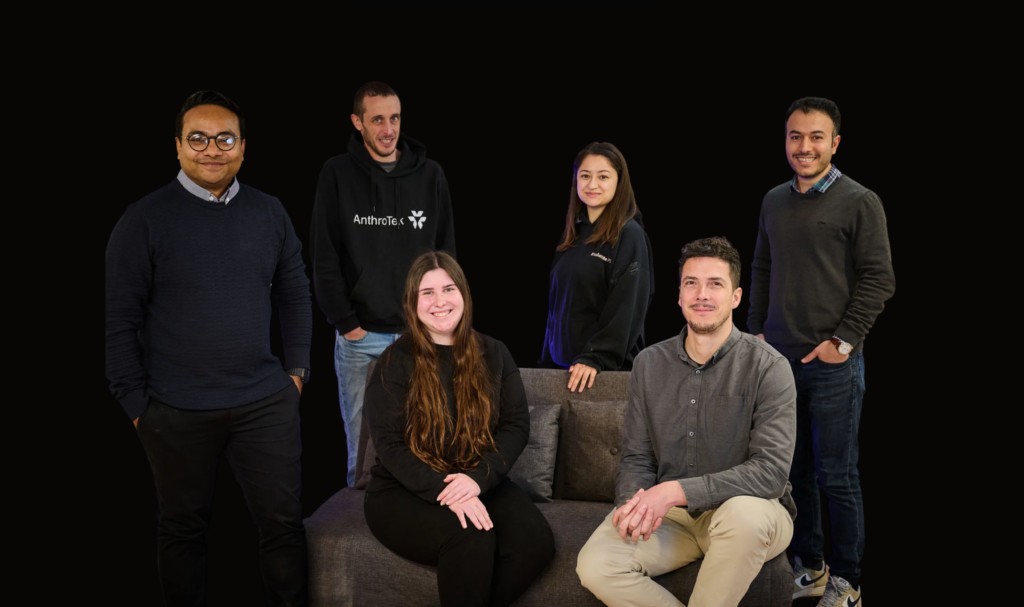
The Anthrotek team. L to R: Mr. Nazmus Tareque, Dr. Paul Stanley, Ms. Ana Canteiro, Ms. Helen Louka, Dr. Raoul Peltier and Dr. Pooyan Parnian. (Image: Anthrotek.)
Recreating the Mechanics of the Human Body
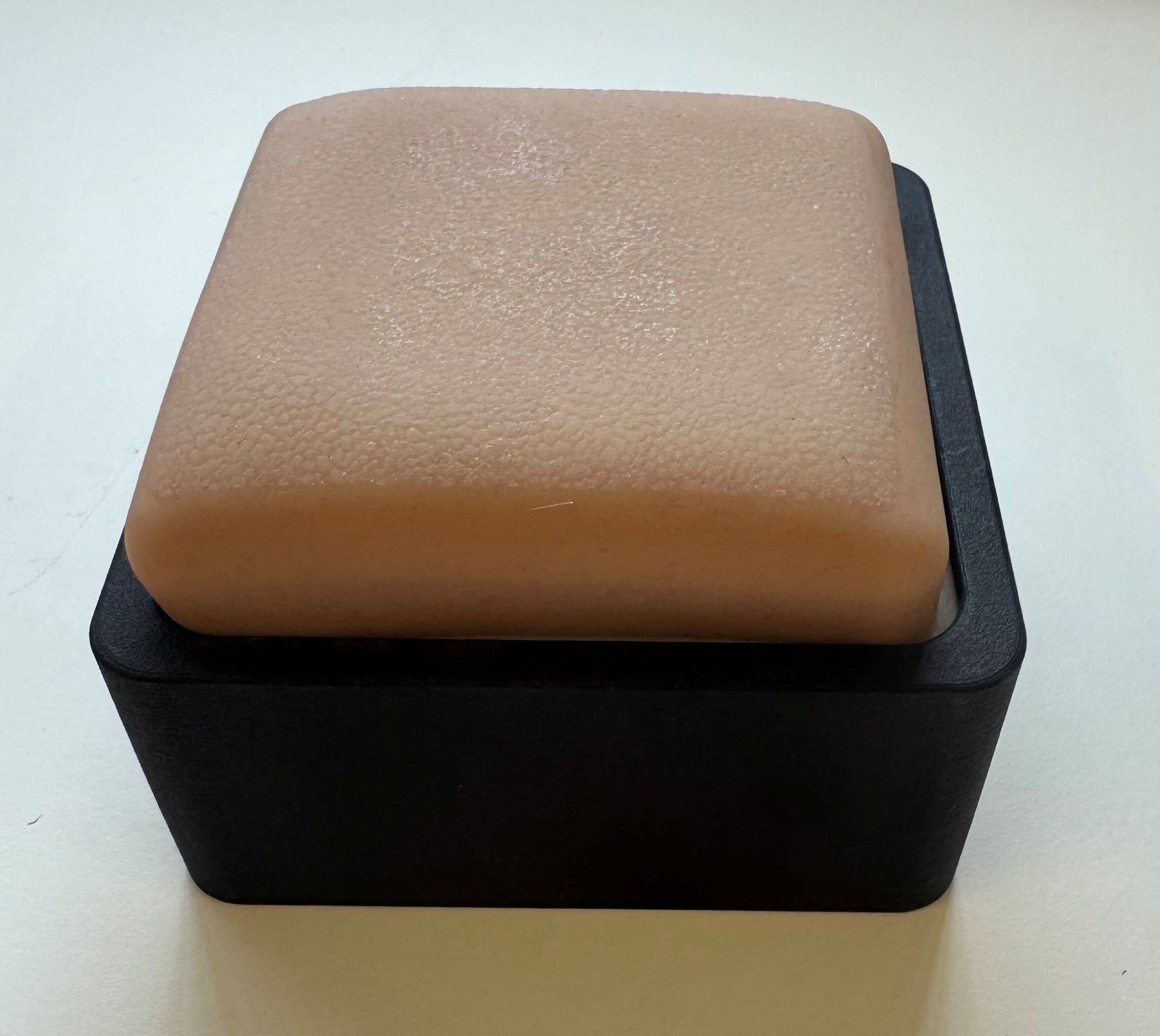
Anthrotek’s best-known product is the AnthroPad®, a multilayer system designed to reproduce the epidermis, dermis and hypodermis of human skin. But skin is only part of the challenge. The company also develops realistic organ models, including kidneys and livers. Creating them requires more than simply making something that looks anatomically convincing—the mechanical response also needs to be right.
Anthrotek’s seven-person team, which includes four PhDs, starts with published research on the mechanical properties of human tissue. “There is a lot more [literature] than you would think. Almost all the organs are accurately documented in terms of mechanical behavior,” Peltier says.
When published data isn’t enough, the team turns to surgical videos and hands-on measurements. Force, displacement and surface hardness measurements can be taken at customer facilities or even at local butchers to help the engineers understand how biological tissues behave. That process occasionally leads to unexpected discoveries. “I had no idea that a kidney was so similar to a chicken breast,” Peltier says.
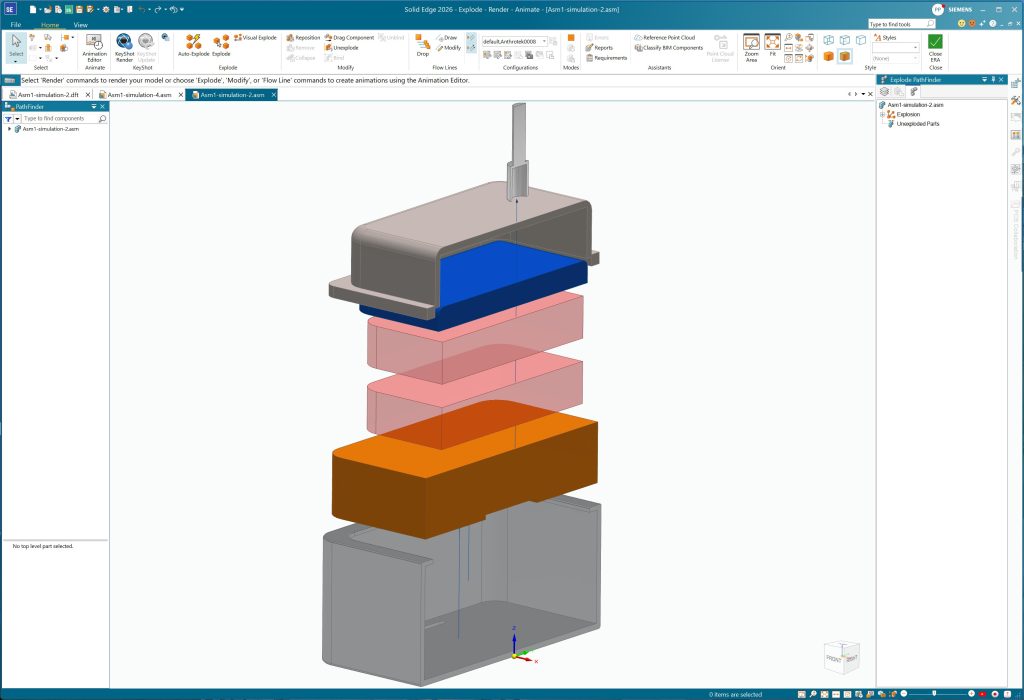
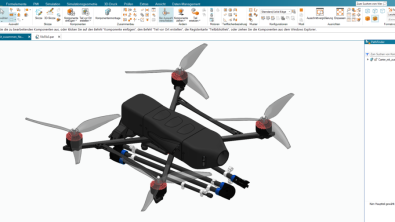
AnthroPad® model in Designcenter Solid Edge. (Image: Anthrotek.)
More Than Looking Real
The distinction between looking realistic and behaving realistically is central to Anthrotek’s work.
The company currently operates across three main product areas. One focuses on custom medical simulation models, including thoracic, abdominal, endoscopic, and laparoscopic models. Depending on the application, these can incorporate internal fluidics that reproduce blood flow and pressure, suturable tissue and imaging-accurate organs that interact appropriately with CT contrast agents.
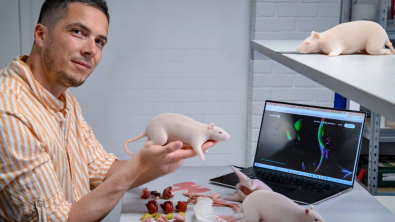
Another area is animal-replacement training. Anthrotek has developed a dissectible rat model with interconnected internal organs that has recently been made CT-accurate. The goal is to provide an alternative that can help reduce the number of live animals required for training.
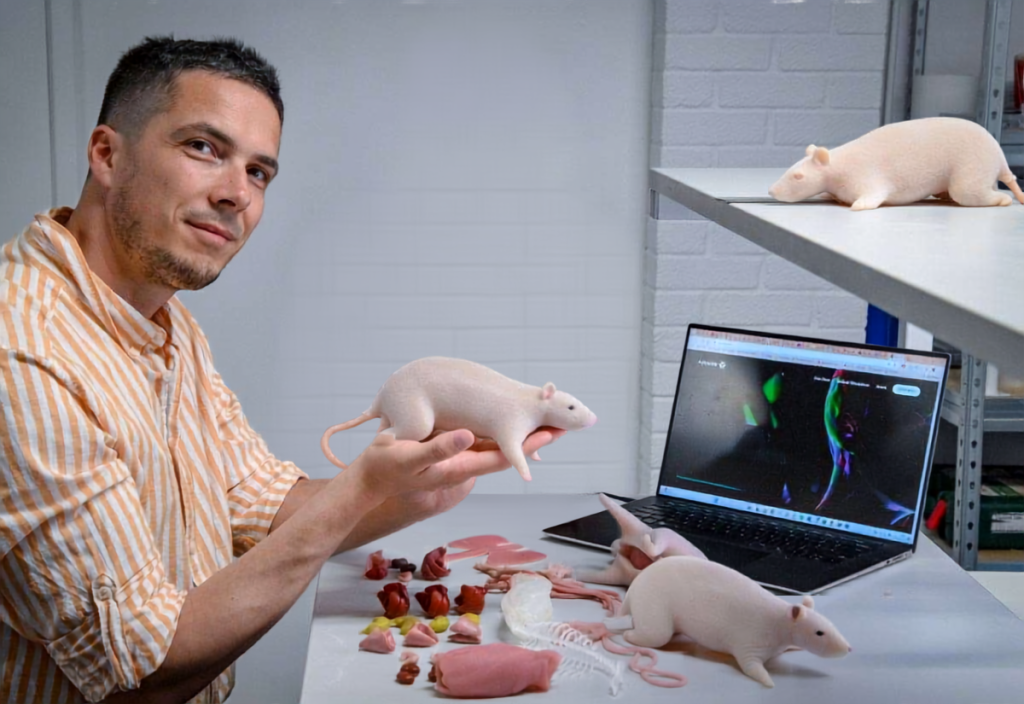
Dr. Raoul Peltier, Anthrotek’s co-founder and CEO, inspecting 3D prints. Anthrotek develops animal-replacement training models designed to help reduce the use of live rats in medical training. (Image: Anthrotek.)
The third area—and currently around 60 percent of Anthrotek’s business—is the AnthroPad®.
Its multilayer construction allows engineers to independently adjust properties such as layer thickness and hardness. That means the same basic system can be configured to represent very different patients, from the abdominal skin of an elderly person to the skin on an infant’s leg. Achieving that level of accuracy is more complicated than selecting several materials with the right individual properties.
“The final behavior is not simply the sum of the behavior of each single material,” says Dr. Pooyan Parnian, who leads engineering design and prototyping at Anthrotek. “Combining different layers of materials doesn’t have the same behavior as each individual layer. For me, the real engineering challenge is translating the behaviour of biological tissue into a repeatable and manufacturable mechanically accurate product.”
For a particular skin type, Anthrotek may need to match a specific compression response or needle force-displacement curve. Reaching that target can involve numerous rounds of design, manufacturing and physical testing.
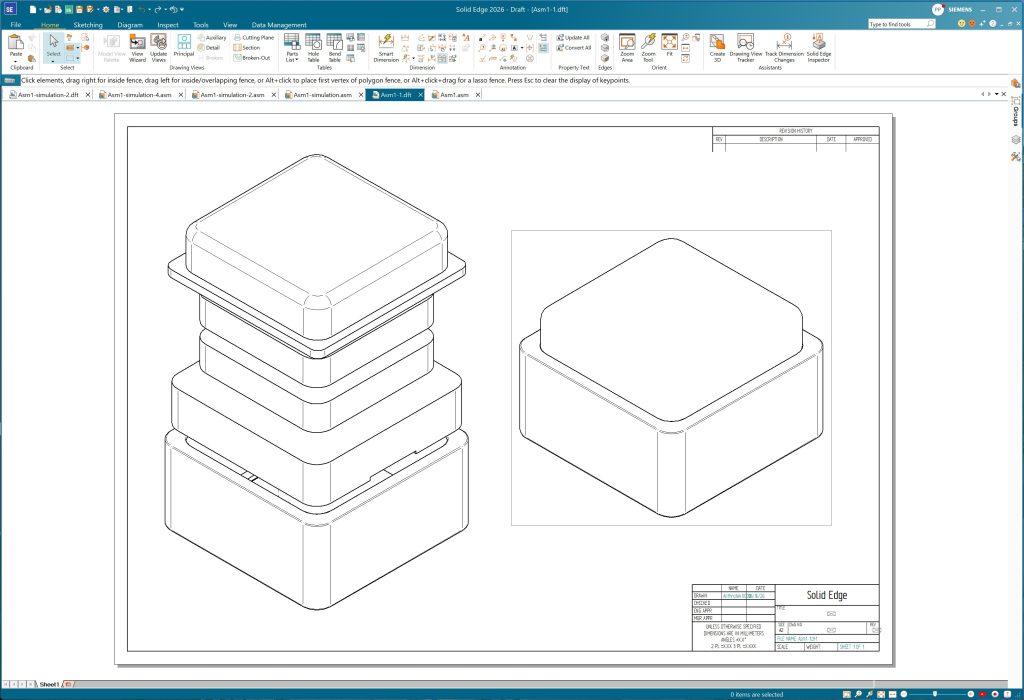
Anthrotek uses Designcenter Solid Edge to support the multidisciplinary design and development of its multilayer and multimaterial products. (Image: Anthrotek.)
Bringing the Design Together in Designcenter Solid Edge
Designcenter Solid Edge sits at the center of much of that development process.
Parnian typically begins with a conceptual sketch before moving into CAD to define the geometry and individual components of the design. The complete structure can then be assembled digitally before the team moves into physical prototyping.
For Anthrotek, that connection between design and manufacturing is particularly important. The company operates a bank of FDM and SLA 3D printers, and the integrated additive manufacturing capabilities in Designcenter Solid Edge allow the team to move quickly from a CAD model to the STL files needed for production.
“The software has an integrated additive manufacturing tab,” Parnian says. “We can get the STL file out of the design very quickly, and we can even use the simulation tab that’s already integrated into the software to compare results,” before committing a design to physical prototyping.
Designcenter Solid Edge 2026 introduces additional capabilities in the field of AI that can help streamline this workflow. Its predictive user interface can anticipate likely next commands based on the current workflow, reducing repetitive interactions during common part, assembly and drafting tasks.
Magnetic Snap Assembly can also make it faster to position components and establish assembly relationships. “With this function, we can create and define assembly relationships faster, while still allowing us to manually define constraints where complex geometry requires them,” Parnian says. “This is particularly beneficial for our multilayer and multimaterial designs.”
Automatic 2D drawing generation provides another opportunity to reduce repetitive work. Drawing views and dimensions can be generated from the 3D model, helping the team prepare manufacturing documentation when components need to be produced by outside fabrication partners.
Anthrotek has also been exploring the integrated Copilot AI as a context-aware assistant for navigating commands and workflows. “It’s like having an assistant during the design process,” Parnian says. He sees further potential if future versions of Copilot are able to move beyond guidance and directly execute more commands and design operations.
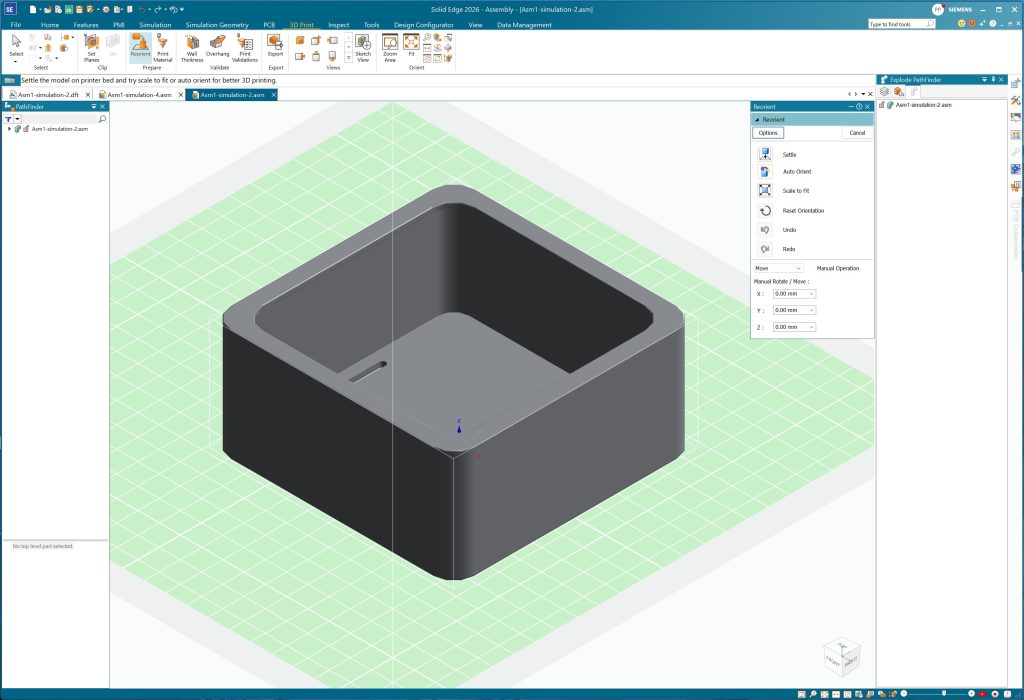
Preparing the AnthroPad® for 3D printing (Image: Anthrotek)
Parnian previously worked with other CAD software tools, but says the value of Designcenter Solid Edge for Anthrotek comes from having multiple capabilities available in one environment rather than from any single feature. CAD, assembly, basic finite-element simulation, 2D drafting and manufacturing preparation can all support different stages of the company’s workflow.
The next step could be to make simulation an even bigger part of the process. Peltier envisions building a library of measured tissue properties that engineers could use to predict the appropriate material stack for a new AnthroPad® configuration before producing physical prototypes.
Adding Intelligence to the AnthroPad®
One of Anthrotek’s next projects is designed to make its simulated skin more than mechanically accurate.
Supported by a recent £100,000 Innovate UK grant, the company is developing a sensorized version of the AnthroPad®. Still in early prototyping, the new system will incorporate sensors capable of measuring both the magnitude and location of an applied force.
That could be particularly useful for manufacturers of autoinjectors and other needle-based devices. Rather than simply knowing whether a device works against realistic skin, developers could gather information about how a user actually presses the device against the body.
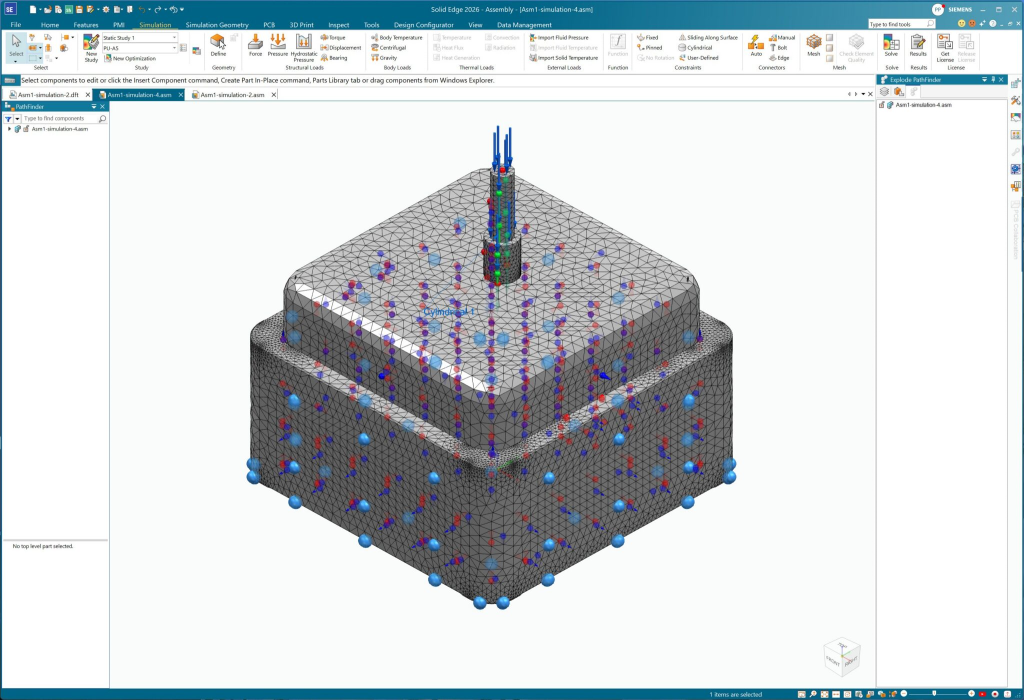
Anthrotek is using simulation capabilities in Designcenter Solid Edge as it works toward embedding sensors into its AnthroPad® system. (Image: Anthrotek.)
The company is also continuing to explore opportunities beyond medical simulation. A PhD collaboration with the University of Warwick is investigating novel antibacterial silicones that could eventually have applications in social and assistive robotics. “It would solve quite a big problem with social robots or courtesy robots that help people in their house. Would you let that robot change your wound dressing after he’s cleaned your toilet?” Peltier asks.
Anthrotek has also held early conversations with Cambridge-based Revolve Labs about combining its physical models with VR surgical and cadaver-training environments. Longer term, Peltier wants Anthrotek to provide more than realistic models. The goal is to build services around those products, helping customers use them throughout testing, training and the regulatory approval process.
A Better Stand-In for the Human Body
Medical device developers have traditionally relied on everything from fruit and foam to costly cadavers for testing and training. As devices become more specialized and validation requirements evolve, the need for more realistic alternatives is growing.
Anthrotek’s models are designed not only to look like the human body, but to reproduce its mechanical behavior in a controlled and repeatable way. “The skin works really well,” Peltier says. “It’s pushed the company forward.” After decades of testing injections on oranges, Anthrotek is offering a more human-like alternative.
Learn more about Siemens’ solutions for hardware technology startups with Designcenter Solid Edge for Startups.