Catching Drones with Drones: Inside an AI-Powered Interceptor
The cheap drone problem stopped being hypothetical a while ago. For a couple thousand dollars and some open-source software, almost anyone can assemble an airframe that flies autonomously, resists jamming and carries a payload. Footage from Ukraine has made that capability common knowledge, and the leap from the battlefield to civilian airspace is already happening.
That leap is what three German master’s students had in mind when they founded Daedalus Defence.
“In Europe, at all the Christmas markets, we already have big barriers because there have been threats of terrorist attacks involving vehicles driving into crowds,” said Ferdinand Lorenz, who handles product development and business strategy for the company. “We thought of a similar thing, but in the air: protecting places where people are crowded and potentially vulnerable.”
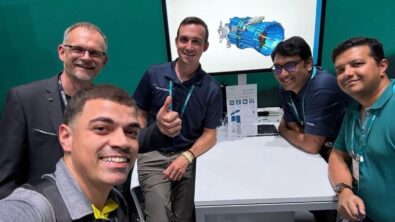
Ferdinand Lorenz(L), Marius Kienzle (C) and Felix Pfeifer (R) launched Daedalus Defence as part of a business challenge at their university. (Image: Daedalus Defence.)
Lorenz, Marius Kienzle and Felix Pfeifer are finishing their master’s degrees, all with bachelor’s degrees in engineering behind them. Pfeifer and Kienzle have known each other since kindergarten, while Lorenz joined the group a few years ago. The company itself started the way a lot of startups do: with a conversation that got away from everybody.
“We sat down, talked about concepts, and as we are all engineers, we kind of started developing ideas right away,” Lorenz said. “And we’re like, ‘No, no, this is the best idea. This is the best idea.’”
A small university business challenge gave the idea somewhere to go, and development work began in October 2025.
The Catch, Not the Kill
Plenty of counter-drone concepts end with a target dropping out of the sky. Daedalus Defence is built around the premise that bringing the target down is the easy part. Over a crowded space like an arena or major metro area, however, simply knocking a hostile drone out of the sky can create serious collateral damage.
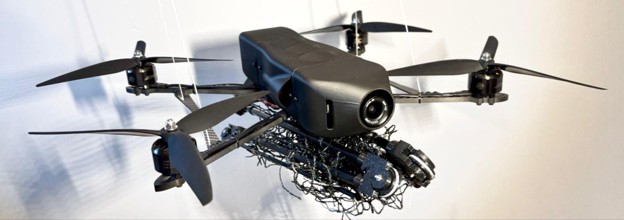
The Daedalus interceptor carries a patented folding net structure that deploys mid-flight and wraps around the target. The interceptor then carries the captured drone out of the protected area so it can be dealt with away from populated spaces. Nothing falls on anybody.
“Even if it doesn’t [carry a payload], if you’re flying over people or critical infrastructure, debris falling from a hundred meters can still damage or hurt people,” Lorenz said. The net drops away afterward, and the interceptor can fly again. That reusability is deliberate. “We don’t want these to be one-use drones,” Lorenz said. “That way, we save the users a bit of money.”
The first product targets a specific regulatory band: a system weighing less than 4 kg and capable of catching drones up to about 2.5 kg. Bigger interceptors for bigger targets are on the roadmap, but the team is concentrating on refining this first system. According to Lorenz, a single unit could be enough to cover a small site, such as an electrical substation, while a major airport might need around 20.
The company’s system also logs forensic data during pursuit, based on the idea that a captured drone and a record of its flight are worth more to an operator than a pile of wreckage.
Where the AI Goes—and Where It Doesn’t
Daedalus Defence is selectively an AI company, much like a growing number of hardware startups.
“Our plan is to make the object detection and recognition with AI, but flight planning should be algorithmic,” said Felix Pfeifer, who handles the software side. “So it’s deterministic, and it’s the same every time.”
There’s a practical reason for that distinction. The simulation-to-reality gap in AI flight control is real, and betting on a learned policy to control a 4 kg aircraft flying over a crowd isn’t a risk the team wants to take yet. Reinforcement learning for flight control is on the bench as an experiment, but it isn’t part of the product.
Detection has its own failure modes. That’s why the camera feed is cross-checked against LiDAR and ultrasonic sensors, and why a human currently makes the go/no-go decision before a capture. Under current European regulations, a fully autonomous system isn’t legal anyway, and Lorenz doesn’t seem to mind.
“For now, I’m quite happy that there are regulations and there’s a person watching and deciding,” he said. “The trust in the end is more on the human side.”
The drone flight system still requires a human pilot, but the team is using AI and algorithmic flight design to make it increasingly independent of an operator. (Image: Daedalus Defence.)
Marius Kienzle focuses on piloting the current system. He explained that the challenges of autonomy and AI vary depending on where the drone is operating. Restricted airspace does some of the classification work for you. In a zone where no drone is permitted, the identification problem becomes considerably simpler.
The hardware is currently built from off-the-shelf components, with purchased motors, flight controllers and camera modules assembled for a job no stock airframe is designed to do.
“We need something with way more power than commercial drones offer,” Lorenz said.
A typical DJI-class motor won’t carry and stabilize an aircraft while it captures and carries a second aircraft. The flight stack is open source. The team tested three designs and ultimately moved to the hardest one to configure because the easier options didn’t offer enough room for tuning.
Leveraging Designcenter Solid Edge
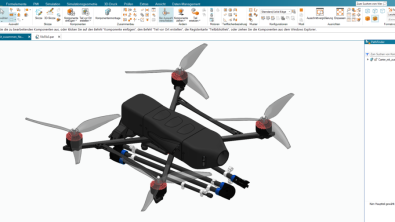
The design workflow is refreshingly unglamorous, and it’s one that most early-stage hardware teams would recognize. It starts on paper, with working principles sketched out. From there, it moves into Designcenter Solid Edge, where Kienzle models the assembly, imports the open-source frame and motor geometry, and produces renderings the team can put in front of people before the physical hardware exists. Then it goes to the 3D printer.
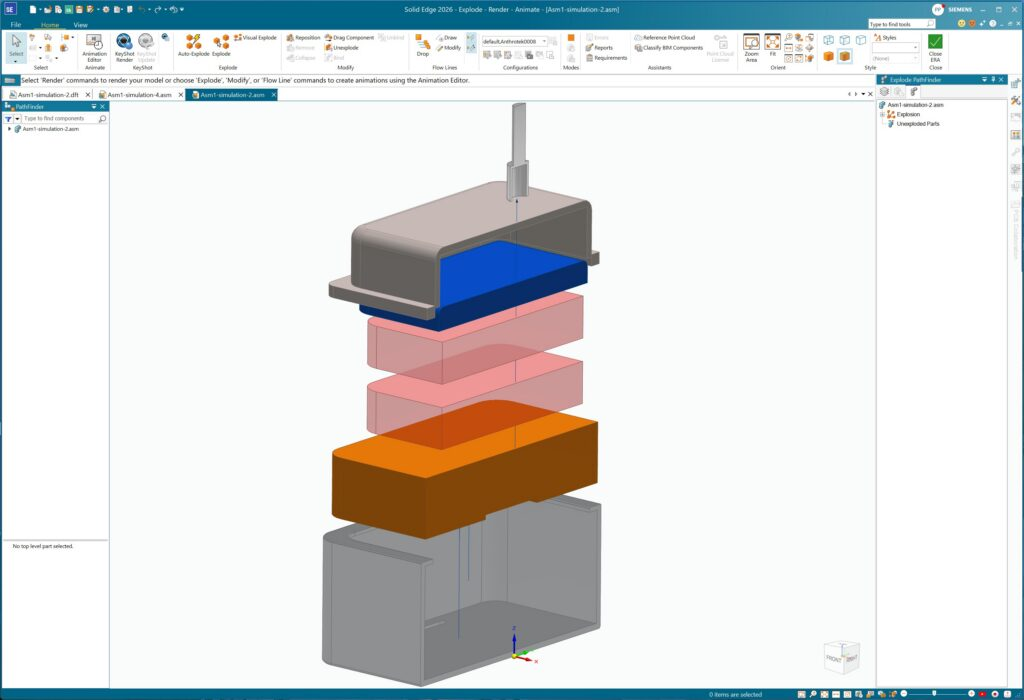
“We immediately started 3D printing because we like hardware and seeing our progress,” Lorenz said. “And from then on, it was iteration by iteration. Solid Edge, 3D printing, Solid Edge, 3D printing. And in between, always flying.”
The net mechanism is now somewhere around its seventh iteration. Different airframes, net sizes and mounting adapters have all cycled through the same loop. Kienzle exports STL geometry with material data into an open-source simulation platform he built himself as part of his thesis, creating a virtual environment for testing flight behavior before anything is committed to the air.
For now, the CAD workflow is focused squarely on CAD. “We only use Solid Edge as our CAD software, because that’s the only thing that we can use with our university license,” Kienzle said.
Through its startup support program, Siemens has since provided the team with a Designcenter Solid Edge Premium license, removing the student-version limitations they had been working around. “We are not that deep in production or in special aerospace simulation. So we don’t have the linkage of a PDM system the whole way through,” Kienzle explained.
Right now, the job is hinges, brackets and printed adapters, and according to Kienzle, the Designcenter Solid Edge toolset clears that bar with room to spare.
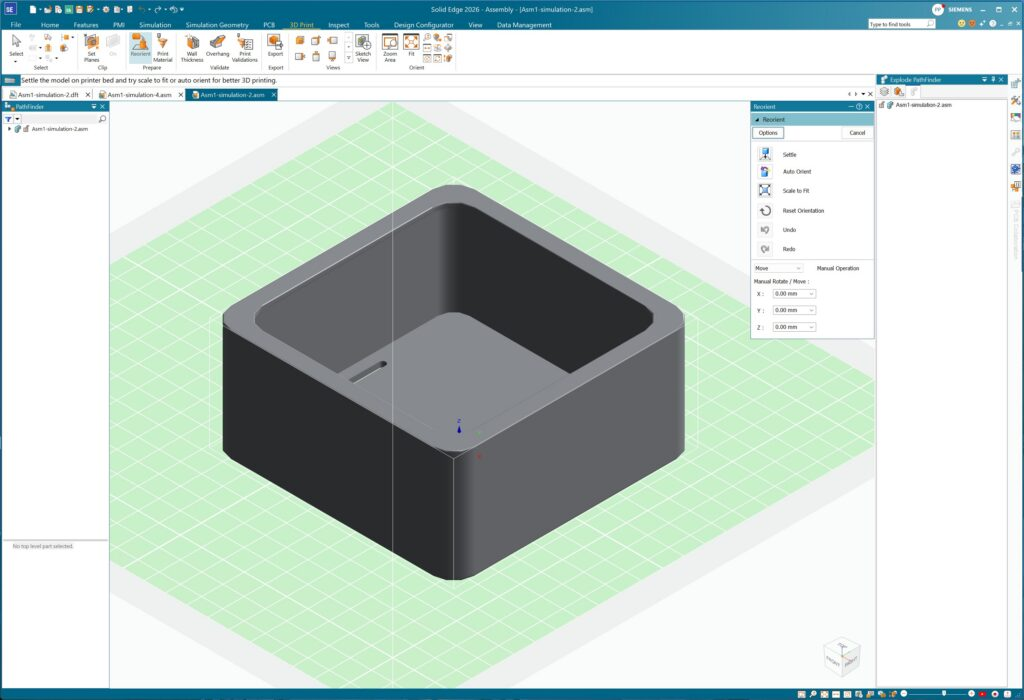
Production planning follows the same logic. The net is single-use and can be made from inexpensive materials. The impact-bearing structural parts will almost certainly be tooled and injection molded eventually, but which components remain 3D printed will depend partly on stiffness regulations for flight over people that don’t exist yet.
“We have to look at every part and decide at the right stage,” Lorenz said.
The next year is about pilot deployments at real sites, in real conditions, and gathering more data. The team is actively looking for partners willing to host one of its drones and, like most startups, will also be looking for investors.
“Money means speed,” Lorenz said. “And in this environment, speed means money.”
The engineering work, meanwhile, is shifting toward making the prototype perform reliably in the air.
“Our next major step is to focus on stabilization and high-speed flight simulations. This will allow us to verify and further improve our setup, particularly regarding air drag,” Kienzle said. “At the moment, we are not focusing on producing new or improved renderings or animations. Our priority is to reach a point where we can reliably demonstrate our prototype in real flight.”
For a startup that began with three engineering students arguing over their best idea, that’s a fitting next milestone: less rendering, more flying.
Learn more about Siemens Designcenter Solid Edge for Startups.