Star Wars – How AI-powered structural optimization could have saved the Empire’s AT-ST Walker

This article demonstrates how Simcenter’s AI-powered simulation tools optimize vehicle crashworthiness. For entertainment’s sake, we are using Star Wars’ AT-ST Walker as a case study for industrial engineers.
Could the Imperial Forces have won the Battle of Endor?
I’m not saying I’m veering on the dark side, but one thing I can’t help but admire about the Galactic Empire is that they were prolific engineers. They seemed to specialize in weapons development on a massive scale with all the TIE fighters, AT-ATs and Star Destroyers – not to mention they were able to design, engineer and build two moon-sized Death Stars within a single person’s lifespan.
But as an organization full of engineers, we couldn’t help but wonder if focusing on speed and quantity over quality was the Empire’s downfall. If they had access to the Simcenter Hyperworks simulation and design platform, we mused, they might not have had to choose between quantity and quality.
Simcenter is a comprehensive design and simulation platform that covers all facets of multiphysics. It’s the market’s most powerful, most versatile open design and simulation platform, empowering engineers with a frictionless, comprehensive suite of computer-aided engineering (CAE) software for a wide range of industries. If the Empire had access to the tools available within Simcenter – including Simcenter Hypermesh, a leading tool for pre- and post-processing solutions – the possibilities for improved vehicle designs and structural optimization would’ve been endless.
Using Simcenter’s simulation and AI tools, we reverse-engineered the AT-ST to show how topology optimization and crash simulation could have achieved a 15% mass reduction while dramatically improving pilot safety, the same workflow used today by automotive and aerospace engineers.
Simulating the design of the AT-ST
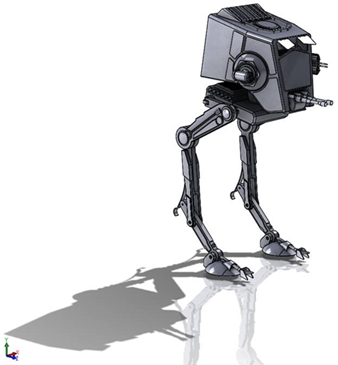
Let’s take the famous Battle of Endor from Episode VI as a case study for how things could have worked out differently for the Empire. If you recall, in this battle, the Rebels and allied Ewoks were doomed, and the Imperial Forces were bringing the business. The All-Terrain Scout Transport (AT-ST) was a major vehicle capable of doing massive damage (see Figure 1). However, the AT-ST wasn’t invincible. The Ewoks used their smarts to take out these vehicles of mass destruction with their primitive weapons, namely tree trunks.
We leveraged our Simcenter Engineering and Consulting Services group to investigate the AT-ST’s design to improve performance and safety. We treated this internal project the same way we do the many customer optimization projects we’ve executed: by leveraging Simcenter’s simulation and data analytics software. We replicated the AT-ST and said tree trunks, then used Simcenter Radioss, our explicit solver, to simulate the AT-ST’s demise. Simcenter Radioss is an explicit dynamics solver designed for the simulation of high-speed impact and large-deformation scenarios. Often used in automotive crash simulations, it’s an ideal solution to test the AT-ST’s run-in with the Ewok booby-trap. Just as a car chassis becomes distorted from severe loads during a traffic accident, so too does an AT-ST when it’s flattened between two massive swinging tree trunks.
For the simulation, we assigned each of the tree trunks with a mass of 5,651 kilograms (roughly 12,458 pounds) and a speed of 18 meters per second. To put this into perspective, that makes each of these trunks equivalent to a fully loaded ambulance traveling at 40 mph.
With a representative baseline crash simulation and Simcenters’ optimization and generative design tools, we quickly developed improved designs for the AT-ST. We focused our efforts on analyzing the crashworthiness and safety of the vehicle’s head, which bore the fury of the massive tree trunks. The optimization tools available with Simcenter Optistruct showed us how to efficiently use and manipulate the structure to maximize the vehicle’s performance. By generating designs that meet performance objectives (in this case, an Ewok tree trunk attack), optimal designs can be generated with minimum mass and maximum stiffness to survive even the most vicious battle. Additional impact locations were added to the optimization studies to ensure the structure wouldn’t be tuned for a single case.
Initial results that could have changed the course of the Star Wars battle
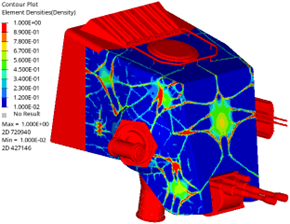
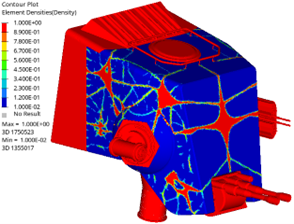
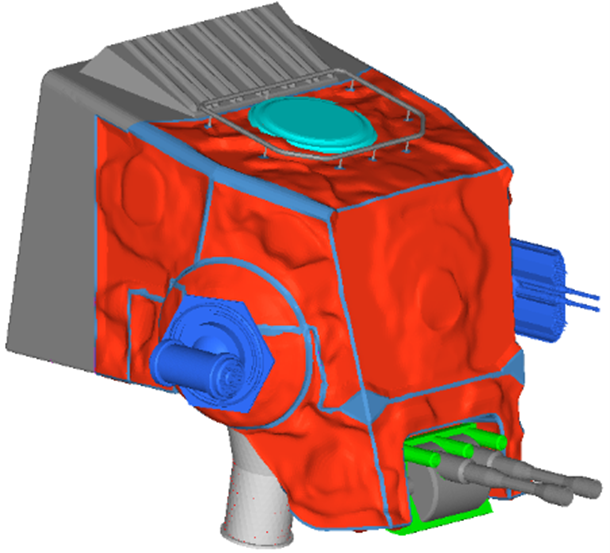
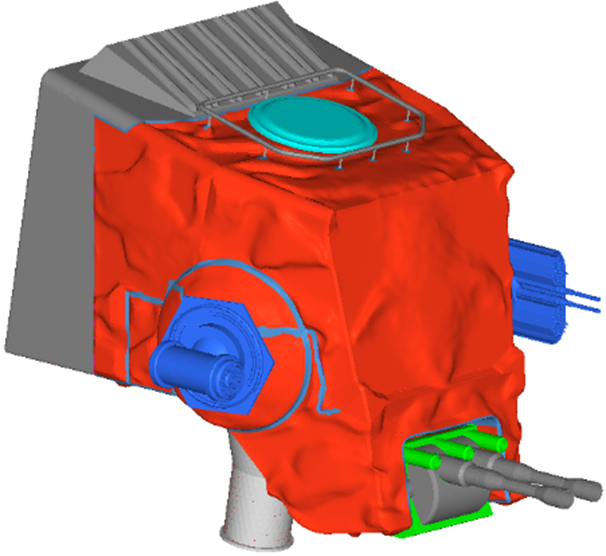
Topology optimization results provided insight into where material was needed and where it wasn’t. These results greatly improved the efficiency, safety, and performance of the AT-ST head. Through free shape optimization, we saw where topographical features could further improve the structural stiffness that helped strengthen the structure without adding significant mass. These features were considered when interpreting the new optimized design.
Further simulation and optimization
These initial optimization studies provided design direction for where the structure and strengthening features should go. To begin assessing crashworthiness and safety, we created a low-fidelity interpretation of the optimization results and imported it back into the Simcenter Radioss simulation. This technique is comparable to Simcenter’s concept development “C123” process which is used extensively for automotive body architecture. In the low-fidelity AT-ST model, we used 1D elements and a coarse shell mesh to allow for rapid design exploration while assessing crash performance.
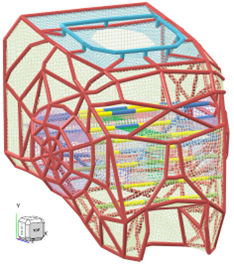
We started by running several iterations with different 1D beam connections to improve the crash performance. Once we were happy with the primary structure, we used Simcenter Hyperstudy to further optimize the structure by tuning the thicknesses of the shell panels and cross-sections of the 1D beam elements. Simcenter Hyperstudy is a multidisciplinary design study software that efficiently and intelligently explores the design space of any system model. Users are guided to understand data trends, perform trade-off studies, and optimize design performance and reliability while considering multiphysics constraints.
With the knowledge gained from the low-fidelity model, we created a much higher fidelity interpretation and ran a final Simcenter Hyperstudy gauge optimization study. The design goals of this study were to reduce the overall mass while meeting safety requirements.
Improving the well-being of the Imperial Soldiers
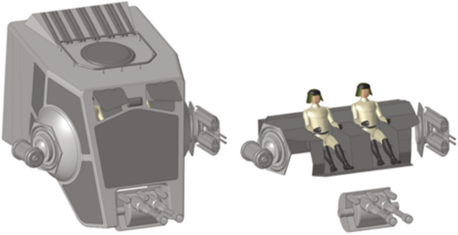
In our case, we wanted to limit the deformation of the AT-ST’s two internal seats. Additionally, if you watch the scene in the movie, you’ll see a large explosion once the AT-ST’s head is crushed. We hypothesized that the crushing of the main central MS-4 twin blaster cannons may have caused the explosion. Preventing this explosion was critical to the safety of the Imperial soldiers piloting the AT-ST and therefore, we added a constraint to minimize damage to the central twin blaster cannons. With the higher fidelity model, the simulation run-times increased, but with access to Simcenter’s high-performance computing (HPC) cluster, we could run this Simcenter Hyperstudy gauge optimization study overnight.
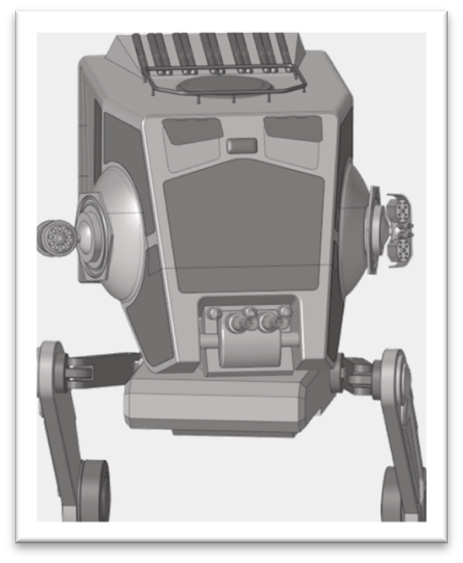
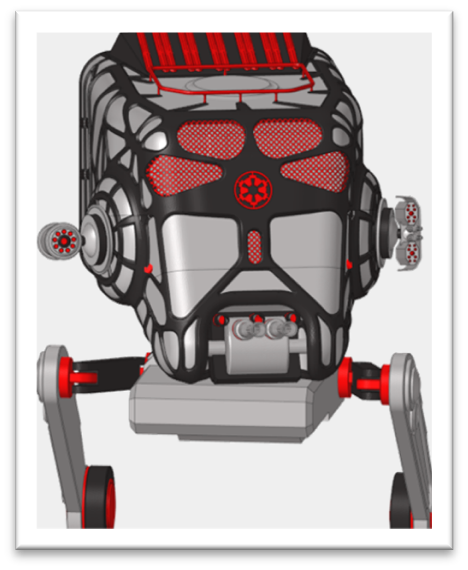
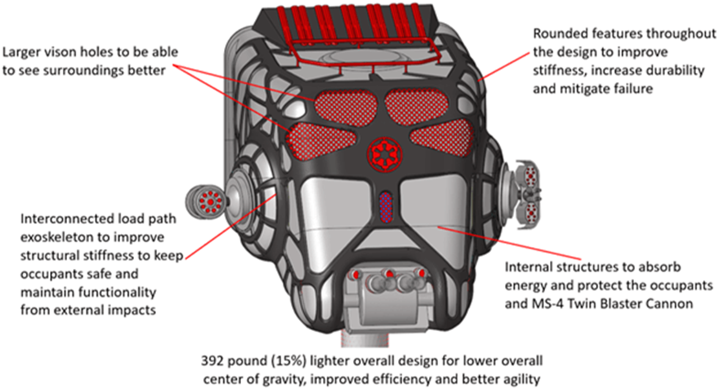
Final design of head reduced mass by 15%
In the end, the final design allowed the two seats to retain their shape with minimal distortion from the log impact – of course, this also helped the AT-ST’s two Imperial pilots retain their shape, too! The overall structure became better for a crash situation, which reduced the overall impact and more specifically, reduced the stress absorbed by the MS-4 twin blaster cannons that presumably produced the massive explosion during the crash. The central blaster cannons appeared to receive minimal critical damage, thereby potentially maintaining functionality.
Lastly, but possibly most impressively, the overall mass of the improved AT-ST’s head was reduced by more than 392 pounds (a 15% reduction) compared to the original AT-ST head design. The lighter head structure also lowered the vehicle’s center of gravity, making the machine more agile so it can better maneuver through Endor’s thick forest landscape.
Overall mass of the AT-ST’s head was reduced by more than 15% (392 lbs.)
Putting the new design to the test
To put our optimized AT-ST head design to the test, we created a Simcenter Hyperstudy design of experiments (DOE) where we changed the impact locations to see how well the structure would hold up. We simulated 200 additional impact locations, again leveraging Simcenter’s HPC cluster. For most impact locations, the seats and MS-4 twin blaster cannons held up well and met our safety requirements. At a few locations, the seats and blaster cannons were still intact, but the upper head structure still suffered damage that would have likely caused injuries (see Run 24, below). This illustrated the need to adjust how we defined our design criteria for the region above the seats.
Figure 11: Evaluating optimized design for different impact locations
AI vs the Empire – Almost 166 times faster results
Finally, with all the simulation data we created from the impact location DOE, we used Simcenter PhysicsAI to create a predictive model. We used 180 of the 200 impact location simulations to train the AI model and kept 20 of the simulations to test the prediction. Initially, we were eager to see how Simcenter PhysicsAI would handle the geometric complexity in the model and the large deformations in the results.
Additionally, the different impact locations produced a wide range of crush results in the Simcenter Radioss simulations that were very sensitive to the impact location. Overall, we were very impressed with the predictive model’s performance. Not only did it do a great job of predicting the global behavior of the crash events, but it was also able to provide the prediction results in 26 seconds compared to 72 minutes for the finite element simulation – making it almost 166x faster.
In the animations below comparing the prediction to the test simulation results, there were local areas where the results were “noisy.” Further Simcenter PhysicsAI parameter and algorithm studies are needed to determine whether this can be improved, but overall, the predictions were impressive given the tool’s handling of the diversity of results.
Figure 12: Comparing Simcenter PhysicsAI predictions to Simcenter Radioss crash simulations
Conclusion: Could Simcenter have been the key for the Galactic Empire on Endor?
The question remains: What if the Imperial Empire could leverage Simcenter’s software solutions to improve the structure and safety of its AT-STs? Could they have won the Battle of Endor?
There are many factors that come into play when you look at the Battle of Endor. You must consider the number of soldiers on each side, the battlefield terrain, tactical strategies for either side, and so much more. But one thing is certain: soldiers of the Imperial Forces who were piloting the AT-ST would have had much higher odds of surviving a crash had they designed their walkers with AI-powered structural optimization, resulting in fewer casualties and stronger fighting machines.
Who knows, maybe the Ewoks and other Rebels would be interested in Simcenter’s Engineering and Consulting Services and Simcenter Hyperworks software so that they will be ready the next time the Empire Strikes Back.
However, at the end of the day, we’re thankful that the Empire didn’t use our solutions – the Ewok victory cemented the triumph of the Rebel Alliance and the destruction of the second Death Star. Though we like great engineering, we like galactic peace and freedom even more. To that end, a few crunched Imperial AT-STs is a price well worth paying.