Data center thermal management: Simulating airflow and cooling performance before construction

This article explains how data center design engineers use Simcenter simulation software to identify airflow inefficiencies, validate cooling capacity and test failure scenarios before construction begins. This guest post comes from Applied CAx, a Siemens Digital Industries Software partner that provides software, training and technical support for Simcenter tools.
Accelerating need for data center infrastructure
The rapid expansion of cloud computing and artificial intelligence has accelerated the construction and modernization of data centers around the globe, making reliable thermal performance a critical design challenge. Even well-designed facilities can experience airflow inefficiencies and localized thermal issues that are difficult to identify prior to construction. Hot spots, flow imbalances, and recirculation issues are rarely discovered until the equipment is already running hot.
The Simcenter portfolio of fluids and thermal simulation tools gives engineers a way to address these challenges at every scale, from the electronics inside each server to the facility and the site around it. This post focuses on facility-level airflow studies performed with Simcenter STAR-CCM+, in which simulation engineers can interrogate server floor layouts, generator and chiller placement, and failure scenarios, among others, to identify potential failures or design improvements before ground has even been broken. In doing so, both engineers and stakeholders can be confident in the chosen design and can better understand what could happen if something goes wrong.
Simcenter identifies hot spots before data centers are build
When designing a data center, one question looms large: will the cooling system keep pace with the planned heating load during operation? A simple heat balance equation may suggest that temperatures should remain within set limits but lacks the fidelity to analyze the local cooling performance at specific points within the building. Localized hot spots could bring down entire banks of servers and would be missed from a simplified analysis.
By simulating the full layout of a data center and supplying known operational parameters, hot spots within the data center can be identified and correlated with specific design choices. Beyond that, temperatures at server inlets can be mapped to predict the deviation from design specifications, allowing engineers to better understand potential cooling inefficiencies throughout the data center.
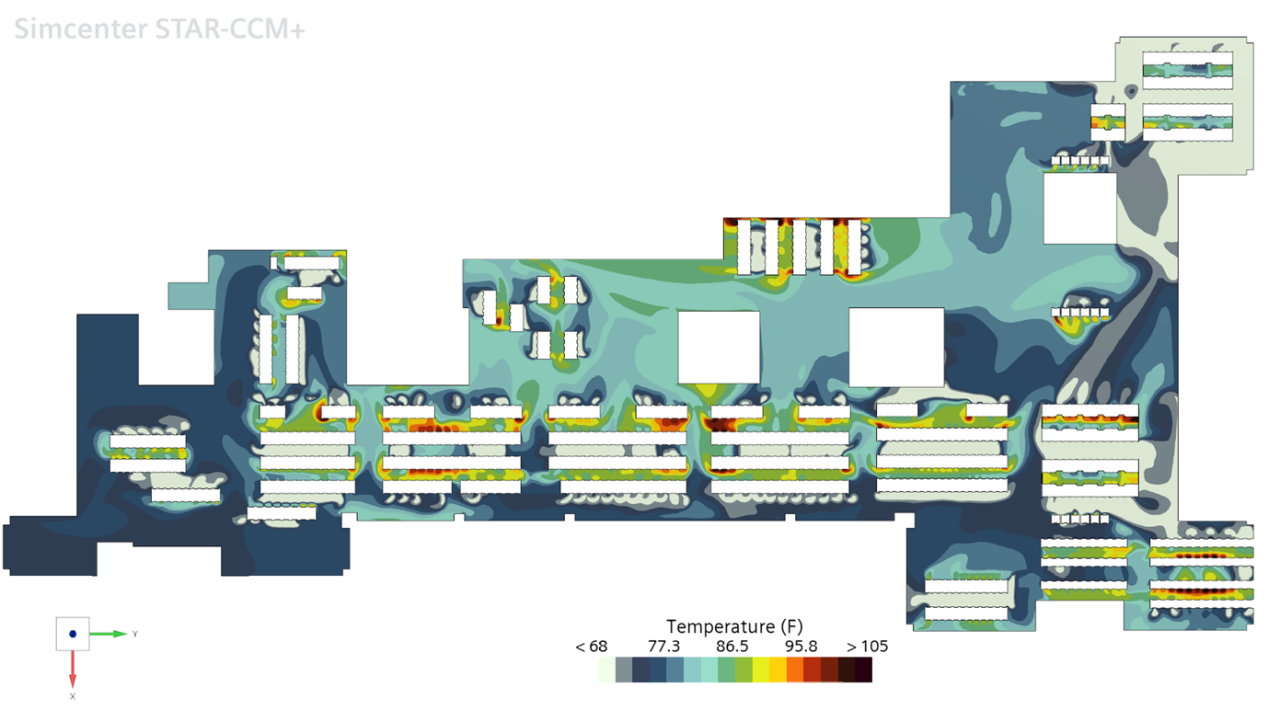
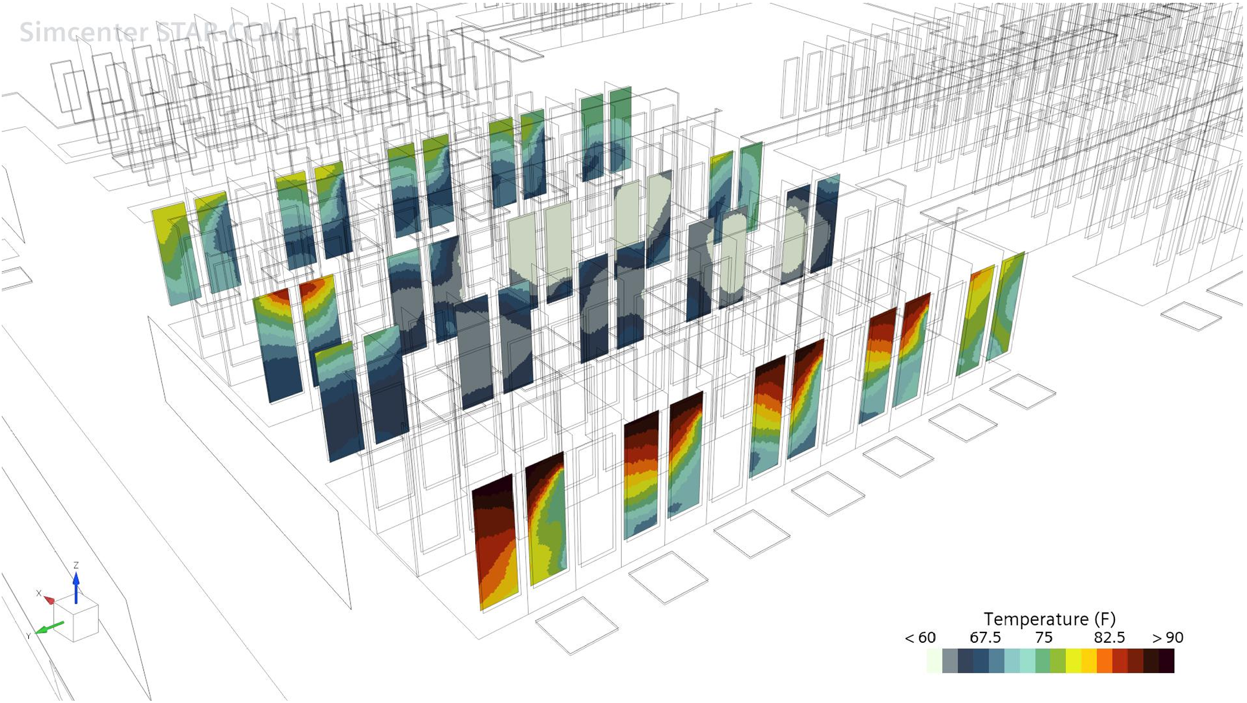
Left: Temperature distribution across the data hall floor plan in Simcenter STAR-CCM+, showing localized hot spots Right: Temperatures mapped on the rack faces to show where server inlet temperatures depart from design specifications
Testing resilience under failure conditions
Data center cooling systems are rarely evaluated under the one condition that matters most: partial equipment failure. Depending on the equipment failure, different airflow distributions and cooling behaviors will develop within the data center. Through simulation, engineers can confirm that adequate cooling exists for high-power equipment, even during failure of CRAC (computer room air conditioning) units. CRAC units are precision cooling systems designed to maintain stable temperatures in data centers.
These kinds of insights are nearly impossible to get without physically inducing a failure, which requires the data center (or a representative layout) to already be constructed.
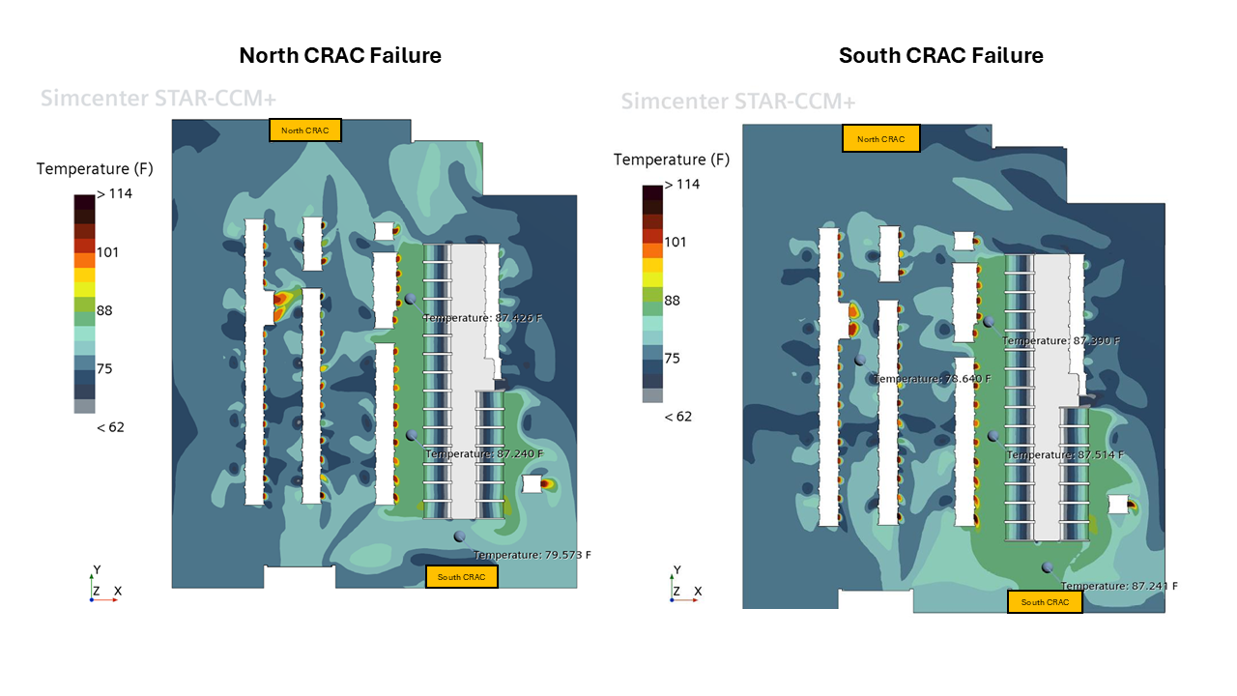
Comparing design concepts under extreme conditions
When multiple design layouts are on the table, choosing between them should come down to more than just intuition or a back-of-the-envelope calculation. The performance of rooftop chillers can be significantly impacted by layout, environmental conditions, and ground-level generator placement, and careful consideration should be given to the chosen chiller layout. By using representative wind data, simulations can predict chiller intake temperatures under extreme ambient conditions, allowing engineers to compare different design layouts to ensure that chiller performance is maximized.
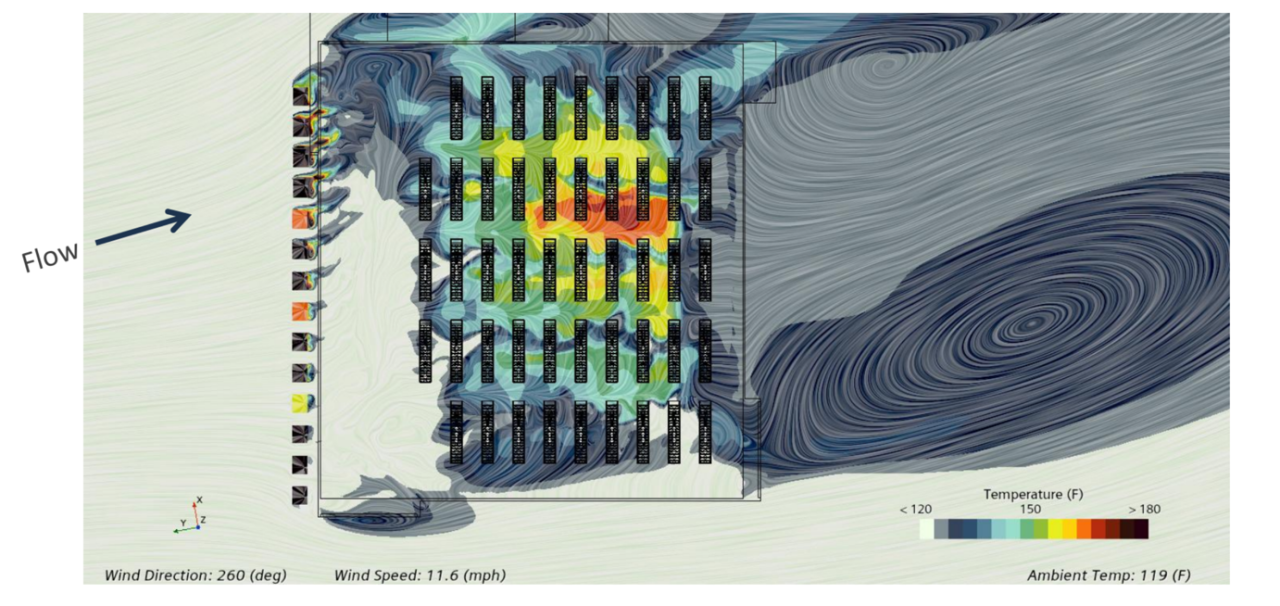
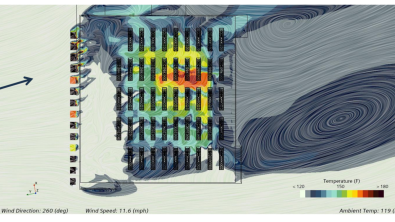
Airflow and rooftop chiller intake temperatures under extreme conditions (wind from 260°, 11.6 mph, 119°F ambient)
Multi-scale simulation: From component to facility level
The studies above focus on the data hall and the site around it, where Simcenter STAR-CCM+ is well suited to resolving large, complex airflow domains alongside external effects such as wind. Thermal management, however, starts long before air reaches the room. Simcenter Flotherm, purpose-built for electronics cooling, lets engineers model the servers and racks themselves, using ready-made SmartParts for components such as fans, heat sinks, and enclosures to evaluate component temperatures and internal airflow paths early in the design. Simcenter Flotherm can also generate compact and reduced-order thermal models of that equipment for use in larger system-level analyses.
That said, not every question requires a detailed 3D model. Many of the biggest decisions in a data center involve the cooling infrastructure as a whole, including how chillers, pumps, cooling towers, piping, and controls work together and respond over time. This is where 1D system simulation comes in. Simcenter Flomaster models complete thermo-fluid networks, allowing engineers to size pipes, pumps, and valves, confirm flow rates and pressure drops throughout the system, and evaluate pressure surges across operating scenarios. Reduced-order models from Simcenter Flotherm can be connected directly into these Simcenter Flomaster networks, linking component temperatures to the behavior of the cooling loop. Simcenter Amesim takes a broader, multi-domain view, combining fluid, thermal, electrical, and control models to study transient behavior, control strategies, energy use, and redundancy across facility equipment such as chillers, cooling towers, economizers, and thermal energy storage.
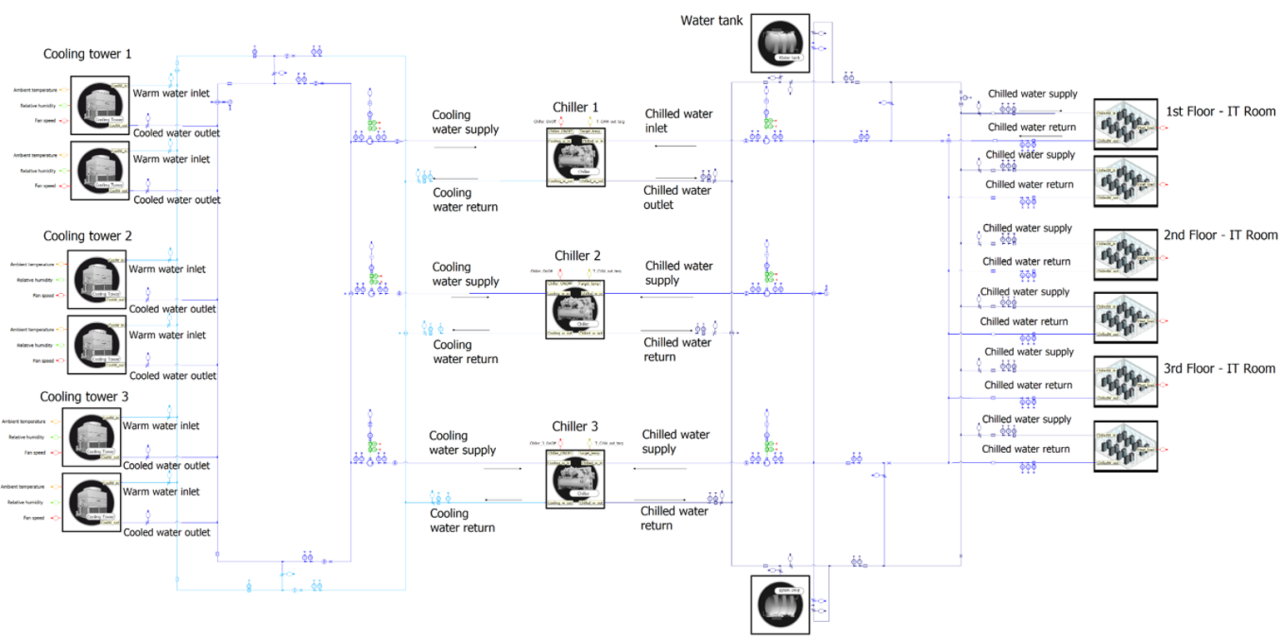
Because these 1D models run much faster than 3D CFD, engineers can explore far more what-if scenarios at the system level and reserve detailed CFD for the places where it matters most. Used together, these tools let teams carry thermal insight from the chip all the way up to the building and its cooling plant.
Looking ahead: Liquid cooling
The examples in this post focus on air cooling, which remains the backbone of most facilities today. However, as AI and high-performance computing workloads push rack power densities higher, liquid cooling is quickly moving into the mainstream, whether through direct-to-chip cold plates, rear-door heat exchangers, or full immersion. Liquid cooling raises its own design questions: Is coolant distributed evenly to every rack? What happens if a pump or CDU (coolant distribution unit) fails? How do air and liquid systems share the load in a hybrid facility?
The Simcenter portfolio supports these analyses as well. Simcenter STAR-CCM+ can resolve conjugate heat transfer through cold plates and model single-phase and two-phase immersion cooling, Simcenter Flotherm can evaluate cold-plate-cooled electronics at the board and server level, and Simcenter Amesim can simulate the complete cooling loop, including CDUs, manifolds, chillers, and cooling towers, to size equipment and test redundancy and failure scenarios at the system level. The same simulation-first approach shown here for airflow carries directly into these newer cooling strategies.
The bigger picture
What makes simulation valuable for data centers isn’t a specific use case, but the visibility it provides at every stage of a data center’s lifecycle. By the time a temperature or airflow issue is caught by monitoring equipment, it’s already affecting the equipment. Simulation shifts the timeline forward, allowing engineers to see how a facility will actually perform before it’s built or before a failure occurs. As data centers grow denser, cooling margins get tighter, and liquid cooling joins air in the data hall, Simcenter fluids and thermal simulation tools such as Simcenter STAR-CCM+ and Simcenter Flotherm are becoming an integral part of the design process and a standard part of how these facilities get designed, commissioned, and operated.
To learn more, explore Applied CAx’s Simcenter STAR-CCM+ and Simcenter Flotherm solutions and training.