Simcenter System Simulation for solar photovoltaic design: A game-changer in renewable energy
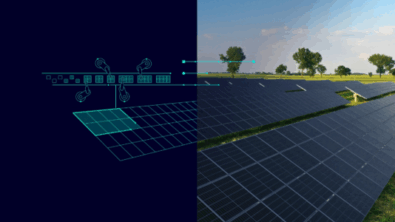
This blog post highlights how Simcenter System Simulation helps addressing your industrial Solar Photovoltaic (PV) challenges.
SolarPV systems are complex systems since they’re often combined with other surroundings like residentials, fast charging stations for electric vehicles, BESS (battery energy storage systems) or microgrids, up to space stations and satellites.
It requires many different physics inside (electrics, thermal, semiconductors, …) with important aspects of system integration, controls, up to the techno-economic analysis to be successful (OPEX/CAPEX, weather conditions, load balancing).
With its costs declining and technology advancing, more organizations are turning to solar as a leading option for power generation. Solar Photovoltaic tends to become the first source of renewables energies worldwide, before wind turbines hydroelectric powers or nuclear. This is an amazing increase of its installed capacity. Solar power is today mandatory to ensure great successes in the decarbonization path towards a more sustainable world.
Let’s see how System Simulation is driving the digital transformation to tackle all your Solar Photovoltaic challenges.
Solar photovoltaic (PV) is key in many industries
♻️☀️🔋🔌 Solar Photovoltaic (Solar PV) is a technology for converting the sunlight (solar radiation) into electricity with semiconductors.
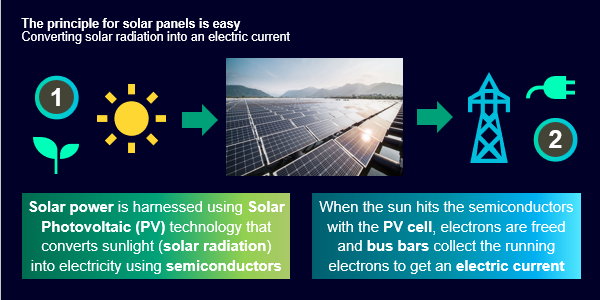
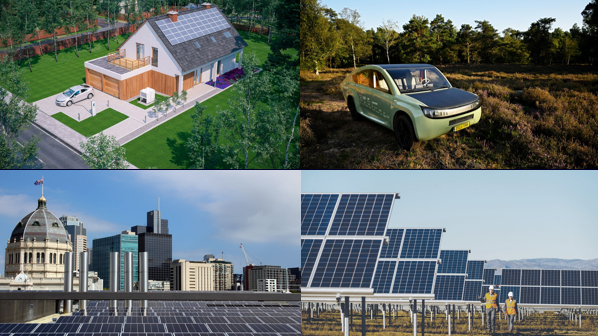
Solar photovoltaic systems are today present in all industries, from stationary applications (residentials, …) up to mobility (space, marine, …) and for sure in the Energy sector with its always keep-growing part in the power generation from renewables (sun, wind, hydropower, waves, heat, …).
Below is an example of a satellite power system represented in Simcenter Amesim, part of the Simcenter System Simulation portfolio. The digital twin with System Simulation helps for the preliminary sizing of the solar panel and battery pack to reach the requirements.

Just to say, as claimed by the “Internation Energy Agency” (IEA), that the solar PV is set to become the largest renewable energy source by 2029. We observed a boom in solar PV deployment, with its global capacity now growing at a historic pace. From 2018 to 2023, it tripled.
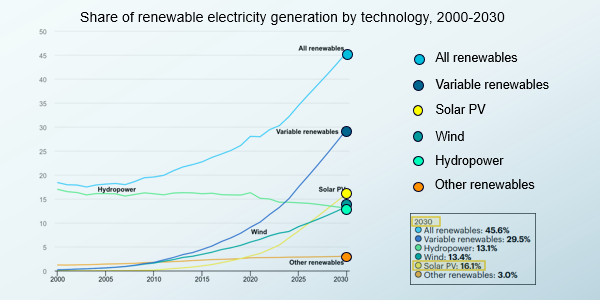
Between 2024 and 2030, the solar PV technology is expected to account for 80% of the growth in global renewable capacity. While solar PV is planned to become soon the largest renewable source, surpassing both wind and hydropower, which is currently the largest renewable generation source by far.
Top things to know
While solar PV is a well-known technology for years, it’s quite recently that the interest grew up in System Simulation to better predict its behavior, either focusing on the component itself or regarding its complete integration within larger systems with advanced controls and fluctuating scenarios (weather conditions, energy demand within the day, energy price evolution, smart adaptative controllers, …).
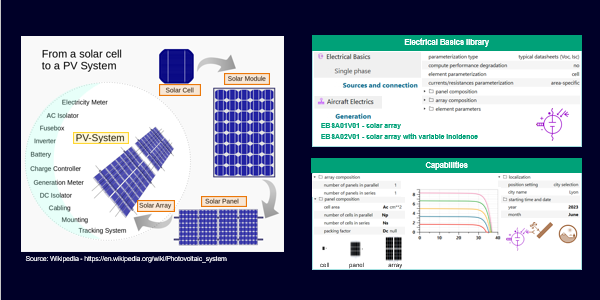
With Simcenter Amesim, you can predict the solar panel energy production to help reaching great successes for the energy transition 🌱🌻🌏.
You can size the solar panel from the number of solar arrays, the number of cells and the single cell area. You can enter the city you’re located or its GPS position, the weather conditions to consider if it’s cloudy or not, the ground reflection coefficient or the turbidity factor. Then you’ll get the energy produced over the day or over the months so you’ll know the results for all the seasons 🍂☃️🌱🌻

Simcenter Amesim is typically used for system integration combining the different subsystems involved like { solar PV + controls + power electronics + microgrids + residentials + consumers }.
With Simcenter Amesim, you can address and solve all these challenges from solar panels to smart integrated systems :
📐 Sizing and performances
♻️ System efficiency
❄️ Thermal management, cooling
💧 Green Hydrogen production
🔋 BESS (battery energy storage systems)
🔌 Connection to the grid/micro-grid, power converters, inverters
💡 Maximum Power Point Tracking (MPPT)
🧭 Panel trackers, best solar spots
🏠 Industries: residential, water-heaters, ships, cars, EVs, airplanes
The users can drag and drop the predefined components (no coding) to assemble them together to get their complete systems. While the execution is very fast ⏱️, it takes only few seconds/minutes of CPU-time to compute the complete day / week / year with economical aspects included.
Why Simcenter Amesim is perfect for solar photovoltaic
Well, Simcenter Amesim offers all what you need to investigate your solar photovoltaic systems. It comes with off-the-shelf libraries of physical components (electrics, thermal, …) that can be combined in one environment, also with great solvers to reach advanced integration and real-time system monitoring. Up to the virtual commissioning with advanced control strategy testing before the real system exists.
You have great benefits using the solar photovoltaic components to:
- set up the model parameters from datasheet information
- scale up the PV cell easily into solar panel or array
- account for the temperature and solar irradiance on the electrical performance of the PV cell
- get solar irradiance according to GPS coordinates, altitude & date
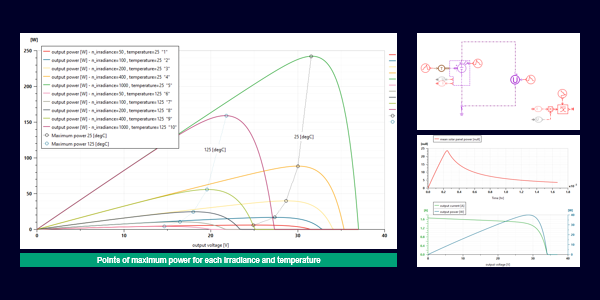
There’s indeed a huge variability in the configurations due to the different locations (Berlin, Xinjiang, Mexico, Abu Dhabi) and weather conditions (summer, winter), that directly impact the system performances for the local implementation onsite. That’s the reason why users need to explore solar PV digitally to reduce expensive testing time and gain confidence in their products early in the design cycles.

Practically there are many challenges to solve. They come from the usual sizing or thermal management / cooling to improve its efficiency, up to more advanced analysis like the control strategy development with “Maximum Power Point Tracking” (MPPT) optimization, the integration with BESS (battery energy storage systems) or the connection to the grids/micro-grids with power electronics components (converters, inverters, …).

It’s also easy to address the complete Green Hydrogen Production over days/months of operations. Also generating automatically some optimal controllers to take into account the weather forecast or the energy price evolutions with Artificial Intelligence (AI) thanks to Reduced Order Models (ROM), Neural Networks (NN) or Reinforcement Learning (RL).
Complete system integration
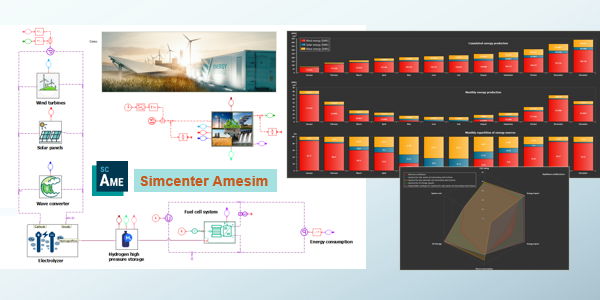
Let’s go through a couple of examples with Solar photovoltaic systems integrated into larger installations. Just to show how we can go from solar panels to smart integrated systems thanks to the multiphysics and scalable digital twins.
So that engineers can handle complex interactions between different physical phenomena and model the complete energy conversion chain from solar radiation to electrical output. It practically allows them to match the dynamic load profiles, to optimize the peak power, to achieve the appropriate cost-effective system dimensioning.
While combined with the built-in powerful analysis tools coming with Simcenter Amesim, users can investigate their energy yield predictions, the performance ratio calculations, or the power loss analysis, all with some detailed parametric studies. Going up to the monitoring of the system efficiency in real-time over some short (minutes) to long periods (months) of simulated time. What a valuable achievement!
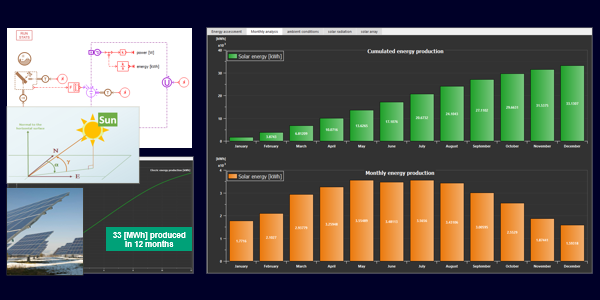
For example, the model shown here predicts the performances of the system depending on the meteorological (weather) conditions and the localization of the system.
After running quick simulations executed in few minutes for the complete 1 year (12 months), several architectures or component sizing choices can be rated to select the most efficient and profitable designs.
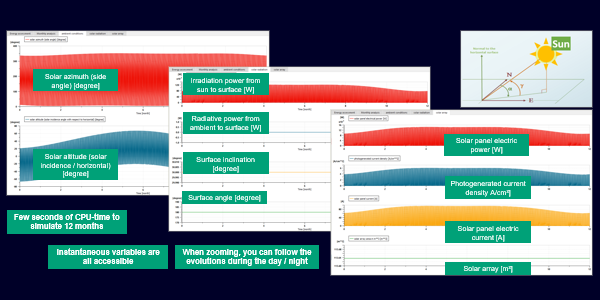
For the solar panels, you can consider the solar azimuth (side angle), the solar altitude (solar incidence / horizontal), the irradiation power from sun to surface [W], the radiative power from ambient to surface [W], or the surface inclination. To access any types of results like the solar panel electric power [W], the photogenerated current density [A/cm²] or the solar panel electric current [A]. And when zooming, you can even follow the evolutions during the current day / night.
Another application is the sustainability and energy efficiency in the Data Center industry. Today they are responsible for up to the 3% of the global electricity consumption and they will reach 4% by 2030. That’s why the market decided to take actions towards a reduction of their carbon footprint and to make the energy consumption more efficient, also due to expected tighter regulations. One possibility is the consider renewable energies for power generation, typically with solar panels.

With Simcenter Amesim, you can properly size the solar panel arrays based on the location and cloud coverage. We compare here 3 different cities simply selecting them in a menu and we see that the solar radiation in Paris at a specific date and hour is almost the half than in Tokyo or New York. It’s really nice to know this upfront, before you’ll try to adapt all parts onsite!
Regarding the electric power distribution architectures, their performance can be improved using high-efficiency transformers and converters, with the deployment of renewable energies and the loads balancing. All these aspects need to be checked and it’s where System Simulation can definitely help to take the right decisions. And to finally verify virtually that your new system design is fully compatible with the electric load, and that everything can be supplied properly to the grid.
Then you can even go one step further in the analysis for predicting the controller parameters appropriately depending on weather forecast and streamed data. It’s the new challenge to come, so that you could improve your right decisions for OPEX (operating expenses) and CAPEX (capital expenditures).
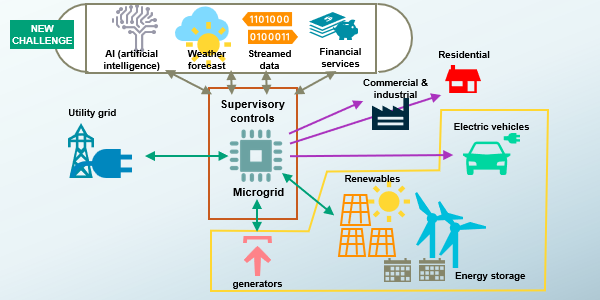
It’s a good way to manage real-world scenarios, including partial shading (cloud cover variations, temperature fluctuations, seasonal changes, load demand variations). And in some extend, to investigate the grid disturbances during huge variations of boundary conditions and cascading events.
System Simulation is the right approach to use for a large audience going from solar PV system designers, energy system integrators, research institutions, utility companies or energy consultants.
Just to say that System Simulation is perfect and well appropriate to reach nice achievements for sustainability through solar PV in your company.
System simulation plays a crucial role
To conclude, let’s summarize how System simulation plays a crucial role in the techno-economic assessment of solar photovoltaic (PV) systems.

You can address some key aspects like: 1. Performance prediction, 2. Design optimization, 3. Environmental impact analysis, 4. Economic analysis.
Overall, system simulation provides a comprehensive framework for evaluating the technical and economic feasibility of Solar Photovoltaic projects, helping stakeholders make informed decisions about investments and operations.
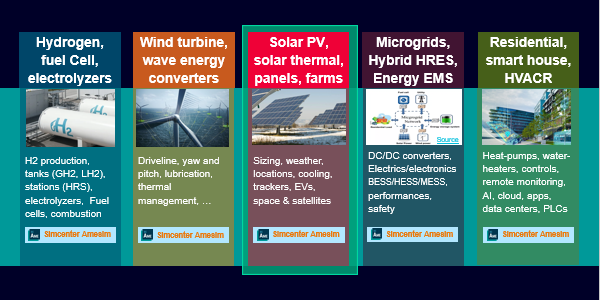
In summary, embracing Solar Photovoltaic systems in product development requires a strategic approach, early-stage considerations, and advanced tools like physics-based digital twins to navigate the complexities and leverage Solar Photovoltaic (PV) as a competitive advantage.
System Simulation definitely helps being successful in your Solar Photovoltaic journey thanks to digitalization.
Learn more about Siemens Simcenter Amesim
Simcenter Amesim is the leading integrated, scalable system simulation platform, allowing system simulation engineers to virtually assess and optimize the performance of mechatronic systems.