HBM3e and HBM4: IC design guide for next-generation high bandwidth memory

HBM3e (High Bandwidth Memory) is the current production-grade high bandwidth memory architecture, delivering over 1.2 TB/s per stack and powering the AI accelerators reshaping data center infrastructure today. HBM4 is its successor, built on a fundamentally wider architecture that targets 2.0 TB/s and beyond when it reaches production in 2026. For IC design engineers, both generations raise the bar on what it takes to ship a successful design: thermal management becomes an architectural decision, signal integrity tolerances tighten and physical verification spans more die, interposer and package combinations than prior memory generations required.
This guide covers what HBM3e and HBM4 are, how they compare, the specific design challenges each creates and the EDA solutions available to address them, along with a look at the roadmap through 2027 and beyond.
Why HBM matters for AI
Training large language models (LLMs), running real-time inference and processing massive datasets all depend on feeding data to accelerators fast enough to keep them utilized. Without sufficient bandwidth, even the most advanced GPUs sit idle. Thus, modern AI system performance is increasingly memory bandwidth bound.
For years, mainstream memory technologies like LPDDR and DDR have relied on 2D scaling. While engineers have pushed bandwidth higher by increasing channel counts and improving signaling speeds, there’s a fundamental limitation: the number of channels, and therefore total bandwidth, is physically constrained.
HBM fundamentally breaks this bottleneck of traditional planar memory design by adopting a 3D stacked architecture. By stacking multiple memory dies vertically and connecting them using Through-Silicon Vias (TSVs), HBM enables an unprecedented level of parallel data access:
- 2015: Early HBM delivered ~2Gb capacity / 1 Gbps speed
- 2025: (HBM4): Expected to reach ~24Gb capacity / 11.7 Gbps speed
For workloads that iterate billions of times, these microseconds gain compounds into meaningful reductions in total training time. In addition to higher throughput, HBM achieves significantly higher energy efficiency per bit transferred compared to traditional DDR-based systems, thanks to shorter interconnects and lower signaling overhead. This is critical in data centers where power delivery and thermal limits increasingly define system architecture.

What is HBM3e?
HBM3e is the fifth-generation high bandwidth memory architecture, delivering over 1.2 TB/s per stack through a 1024-bit wide interface and 16 independent channels. As an extension of HBM3, it pushes per-pin data rates beyond 9 Gbps, enabling significantly higher throughput for AI and HPC workloads. HBM3E is now entering high-volume production, with SK hynix, Samsung and Micron supplying memory for next-generation AI accelerators.
HBM3E provides an all-time high bandwidth of up to 1180 gigabytes per second (GB/s) and an industry-leading capacity of 36 gigabytes (GB). The ‘e’ designation signals an extended or enhanced revision of HBM3 as an intermediate, pin-compatible upgrade, enabling 50% higher performance and better power efficiency for GPUs. This performance gain is driven by higher per-pin data rates, scaling from 9.2 to 12.4 Gbps and larger stack configurations, increasing from 24 GB (8-high) to 36 GB (12-high). At the same time, architectural improvements in power delivery—such as all-around power TSVs and a significantly higher TSV count—reduce IR drop by up to 75%, improving signal integrity and stability under heavy workloads. The result is a substantial 2.5× improvement in performance per watt compared to HBM2E, while maintaining backward compatibility with existing HBM3 controllers. With HBM3E already deployed in systems like NVIDIA’s H200, it has effectively become the baseline memory technology for today’s AI training, HPC and data center acceleration platforms.
What is HBM4?
HBM4 is the sixth-generation high bandwidth memory architecture, doubling the interface width to 2048 bits and 32 independent channels to deliver over 2.0 TB/s per stack, up to 3.3 TB/s in advanced configurations. It is the next-generation standard, with production expected from Samsung, SK Hynix and Micron in 2026.
HBM4 is not an incremental speed bump to HBM3e, but a redesign of the memory interface and shift in memory architecture by integrating logic die and turning the memory stack into a co-processor. It doubles the interface width to 2048 bits and increases speeds to over 2 TB/s per stack.
Where HBM3e delivers up to 1.33 TB/s per stack, HBM4 targets over 2.0 TB/s and reaches 3.3 TB/s in advanced configurations. Pin speeds extend to 12.8 Gbps with Samsung having demonstrated 13 Gbps. Stack capacity reaches 64GB per stack via 16-high configurations with 32Gb layers. Core voltage drops to 1.05V from 1.1V in HBM3/3e, contributing to a 60% efficiency improvement over HBM2/2E. A new Directed Refresh Management (DRFM) capability improves reliability at these stack heights.
These gains come with non-trivial design implications. HBM4 represents a significant leap forward from its predecessors—HBM3E, HBM3 and earlier generations—in terms of bandwidth, capacity, efficiency and architectural innovation. In the meantime, the wider interface, increased TSV density and taller stacks pose new design and verification challenges in signal integrity, thermal management and power delivery.
HBM3e and HBM4 specifications compared
HBM3e key specifications
HBM3e is standardized by JEDEC (JESD238), with production shipments underway from SK Hynix, Samsung and Micron:
- Interface: 1024-bit, 16 independent channels, 32 pseudo-channels
- Pin speeds: 9.2 to 9.8 Gbps typical, up to 12.4 Gbps in advanced implementations
- Bandwidth: Over 1.2 TB/s per stack (up to 1.33 TB/s)
- Capacity: 24GB at 8-high to 36GB at 12-high stack
- Power efficiency: 2.5X improvement per watt vs. HBM2E
- Interconnect: Through-Silicon Via (TSV) stacked die architecture
- Power delivery: All-around power TSVs, 6X increase in TSV count, 75% lower IR drop
- Controller compatibility: Backward compatible with HBM3 controllers
HBM4 key specifications
HBM4’s standard was published by JEDEC as JESD270-4 in April 2025. It is a fundamental architectural overhaul:
- Interface: 2048-bit, 32 independent channels, 64 pseudo-channels
- Pin speeds: 6.4 to 12.8 Gbps, demonstrated up to 13 Gbps by Samsung
- Bandwidth: Over 2.0 TB/s per stack, up to 3.3 TB/s in advanced configurations
- Capacity: Up to 64GB per stack via 16-high stack with 32Gb layers
- Core voltage: 1.05V vs. 1.1V in HBM3/3e, 60% improved efficiency over HBM2/2E
- New reliability feature: Directed Refresh Management (DRFM)
- Controller compatibility: Not backward compatible with HBM3/3e
Side-by-side comparison
| Specification | HBM3e | HBM4 |
| Interface width | 1024-bit | 2048-bit |
| Independent channels | 16 | 32 |
| Pin speeds | 9.2 to 12.4 Gbps | 6.4 to 12.8 Gbps (up to 13 Gbps) |
| Bandwidth per stack | >1.2 TB/s (up to 1.33 TB/s) | >2.0 TB/s (up to 3.3 TB/s) |
| Capacity per stack | Up to 36GB | Up to 64GB |
| Core voltage | 1.1V | 1.05V |
| Power efficiency gain | 2.5X vs. HBM2E | 60% vs. HBM2/2E |
| HBM3 controller compat. | Yes | No |
| Production status | In production | 2026 (Samsung, SK Hynix, Micron) |
HBM3e and HBM4 advantages for AI / HPC applications
What HBM3e enables today
HBM3e is shipping now and solving real problems. Over 1.2 TB/s per stack meets the throughput demands of current-generation AI training, and its power efficiency allows data centers to pack more compute into the same thermal envelope. The compact form factor saves meaningful board space compared to discrete DRAM solutions.
HBM3E is already deployed in platforms such as NVIDIA’s H200 and AMD’s MI300 series, with SK hynix, Samsung and Micron all ramping production. This growing multi-vendor ecosystem is improving supply availability and making HBM3E a practical choice for current-generation AI, HPC and data center accelerator designs.
What HBM4 makes possible in 2026
HBM4 is purpose-built to support the next scale of data-intensive workloads that are beginning to stretch the limits of HBM3E: next-generation large language models and real-time inference at scale. The bandwidth jump from 1.2 TB/s to over 2.0 TB/s directly impacts how efficiently large models can be trained and deployed, improving utilization, reducing bottlenecks and enabling more predictable scaling at the system level.
Looking ahead, next-generation accelerator architectures are expected to integrate larger numbers of HBM stacks and higher channel parallelism, providing greater flexibility for multi-chiplet designs and more balanced memory-to-compute ratios. This increased parallelism is particularly important as systems move toward disaggregated and heterogeneous architectures.
Beyond AI, HBM4 will play a critical role in workloads where both latency and throughput are tightly constrained, including autonomous driving, scientific simulation and real-time analytics. In these domains, memory bandwidth is no longer a secondary consideration—it is a primary limiter of system performance.
Critical design considerations for HBM3E and HBM4
Signal integrity challenges in HBM3e and HBM4 interfaces
HBM3e runs >9.2 Gb/s per pin across a 1024-bit interface, organized into multiple independent channels and pseudo-channels. Maintaining signal quality at those speeds across more than 1,000 I/O connections requires tightly coordinated optimization across the base die, interposer and package, including power delivery network (PDN) design, clock distribution and tight control of impedance discontinuities.
HBM4 raises the complexity significantly. The interface is expected to expand to 2048 bits, effectively doubling I/O density and routing demand. Combined with higher data rates (~12 Gb/s and beyond), this drives tighter jitter budgets, increased susceptibility to crosstalk and greater sensitivity to reflections across multi-die interconnect paths. As a result, signal integrity can no longer be treated as a later-stage verification step. It must be addressed early and at the system level.
HBM thermal management in 3D IC integration
HBM’s vertically stacked architecture fundamentally changes how heat is generated and dissipated. Heat must travel through multiple layers of silicon, bonding interfaces and packaging materials, creating complex vertical thermal gradients that are difficult to predict without detailed modeling.
HBM3E already requires careful thermal design to manage localized hotspots in logic and I/O regions. HBM4 intensifies these challenges by increasing I/O density, stack height and overall power delivery demands. Taller stacks introduce additional thermal resistance, while higher bandwidth operation increases heat density in a confined volume.
These effects make thermal behavior a first-order design constraint. Early, coupled thermal analysis across die and package is essential to avoid late-stage design iterations and ensure reliable operation under real workloads.
Chiplet architecture and HBM integration
Compared to HBM3e, HBM4 supports more complex multi-chiplet data flows with greater parallelism and routing flexibility. Achieving this requires advanced 2.5D / 3D packaging technologies, particularly silicon interposers and bridge-based integration approaches, which support the fine-pitch routing needed for HBM-class interfaces. Siemens Innovator3D IC solutions provide the integrated planning and verification workflows that manage this complexity across die, interposer and package simultaneously.
Physical design: TSVs, routing and microbump precision
At the physical level, HBM introduces unique manufacturing and design challenges.
Through-silicon vias (TSVs) enable vertical connectivity but introduce mechanical stress, layout constraints and additional process complexity. Wafer thinning, high-aspect-ratio etching and precise copper fill must all be tightly controlled to maintain yield and reliability. As stack heights increase in newer generations, these challenges compound. More layers mean more interfaces, tighter alignment tolerances and increased sensitivity to defects.
In addition, HBM interfaces require fine-pitch interconnects beyond standard PCB capabilities, pushing designs toward silicon interposers and advanced packaging technologies. At these geometries, signal integrity, routing congestion and manufacturability are tightly coupled problems. Microbump and hybrid bonding precision also become yield-critical, requiring tight process control across the entire assembly flow.
HBM roadmap through 2027 and beyond
Near-term: 2026 to 2027
HBM3E continues to power today’s AI infrastructure, but the transition to HBM4 is already underway. HBM3e is in mass production ramp across the AI accelerator ecosystem and will remain the dominant design target through 2025. HBM4 production from Samsung, SK Hynix and Micron is expected in late 2025 to 2026. The NVIDIA Rubin and AMD MI455X are the platform milestones that will pull HBM4 into volume. Customized HBM4 base die configurations with embedded logic or accelerator circuitry are expected to emerge as a differentiation layer.
Long-term roadmap: 2027 and beyond
Beyond first-generation HBM4 deployments, the roadmap points toward higher per-pin data rates, greater per-stack bandwidth and more customized HBM base-die designs. Vendors are already signaling follow-on products such as HBM4E and custom HBM, but exact performance targets and packaging directions should still be treated as evolving rather than fixed. What is clear is that future HBM generations will continue to push memory, packaging and system design closer together, increasing the importance of co-optimizing the base die, interposer, package and cooling architecture.
Growing market adoption
AI and ML training and inference are the dominant driver. HPC and scientific computing represent a large established segment. Data center acceleration and cloud AI services continue to pull HBM demand. Automotive, including autonomous driving and ADAS, requires HBM’s real-time throughput. As demand grows, HBM is reshaping the broader ecosystem:
- Memory vendors are pushing new architectures and higher stack densities
- Foundries and OSATs are scaling advanced packaging technologies like silicon interposers and hybrid integration
- System companies are redesigning architectures around bandwidth rather than just compute
Designing HBM Systems Requires a Different Approach
Traditional flows separate die, package and system concerns. HBM breaks that model. What is required instead is a system-driven design approach. To meet bandwidth, power and thermal targets simultaneously, engineers need to:
- Evaluate trade-offs across die, interposer and package together
- Understand thermal behavior before layout is fixed
- Anticipate signal integrity and PDN challenges early, not at sign-off
- Iterate quickly across architecture and implementation without breaking the flow
This is where a unified 3D IC design platform becomes essential.
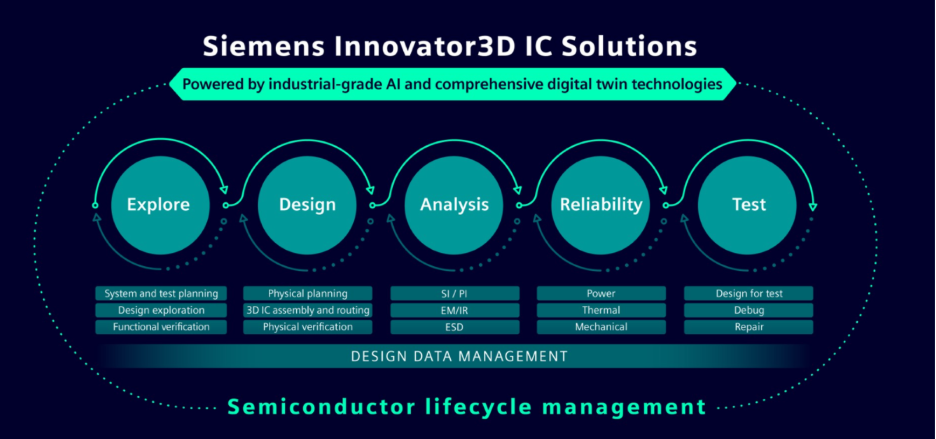
Siemens Innovator3D IC solutions enables a true system-driven design flow for HBMs, connecting early architectural exploration through implementation and sign-off within a single, integrated environment.
- Chip-package co-design allows engineers to optimize across die, interposer and package simultaneously, rather than in isolation
- Multi-physics analysis integrates electrical, thermal and mechanical effects into the design process from the very beginning
- Unified data and workflows reduce iteration cycles and improve predictability across complex HBM-based systems
Explore Siemens’ 3D IC resources and technical content to what a system-driven workflow for HBM design looks like in action.
Frequently asked questions about HBM3e and HBM4
What is HBM3e?
HBM3e (High Bandwidth Memory 3e) is the fifth-generation high bandwidth memory architecture, delivering over 1.2 TB/s per stack through a 1024-bit interface and 16 independent channels. It stacks multiple DRAM dies vertically using Through-Silicon Vias (TSVs) and sits adjacent to the compute die on a silicon interposer. HBM3e is the current production standard, deployed in the NVIDIA H100, H200 and AMD MI300 series, with volume supply from SK Hynix, Samsung and Micron.
What is HBM4?
HBM4 (High Bandwidth Memory 4) is the sixth-generation high bandwidth memory architecture, doubling the interface to 2048 bits and 32 channels to deliver over 2.0 TB/s per stack. It is a fundamental redesign of HBM3e: controllers, PHY IP and base logic die are all incompatible with prior generations.
What is the difference between HBM3e and HBM4?
The core difference is interface width and bandwidth. HBM3e uses a 1024-bit interface across 16 channels and delivers up to 1.33 TB/s per stack. HBM4 doubles both to a 2048-bit interface across 32 channels, delivering over 2.0 TB/s and up to 3.3 TB/s in advanced configurations.
Is HBM4 backward compatible with HBM3e controllers?
No. HBM4 is not backward compatible with HBM3 or HBM3e controllers. The doubled interface width and architectural changes require new PHY IP and memory controllers. Programs targeting HBM4 are starting a new design cycle.
What chiplet packaging technologies support HBM3e and HBM4?
The two popular advanced packaging technologies for HBM integration are TSMC CoWoS (Chip-on-Wafer-on-Substrate) and Intel EMIB (Embedded Multi-die Interconnect Bridge). Both support the routing density required for HBM interfaces.