The AI context layer: Why your AI agents need a knowledge graph to think

Enterprise AI is getting smarter – but most deployments are still underdelivering. This article explains why the bottleneck isn’t the models, it’s the context beneath them. From the limits of Retrieval-Augmented Generation (RAG) to the rise of agentic AI, it traces the path to the AI context layer – and why Intelligence Center X Graph Studio is built to be it.
The AI context layer: Why your agents are only as smart as the context beneath them
Enterprise AI is getting smarter. The models are better, the infrastructure is more capable and the budgets are larger.
Yet, most enterprise AI initiatives are still underdelivering.
The models aren’t the problem. The context is.
What is an AI context layer – and why does it matter?
When an AI agent answers a question, it doesn’t think. It retrieves. It reasons over whatever context it has been given – and if that context is complete, siloed, or structurally disconnected, the answer will be too.
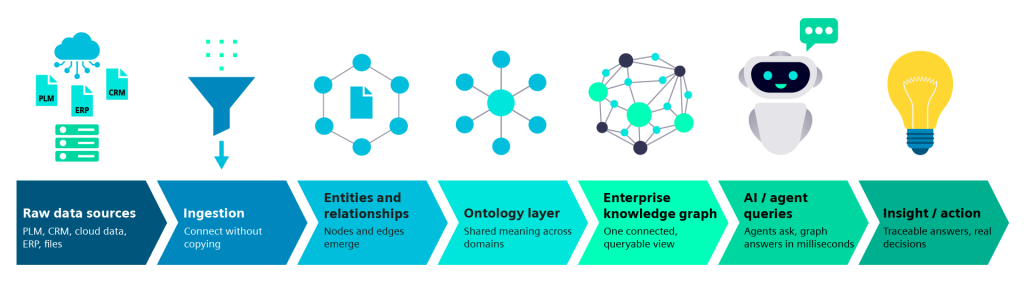
This is the fundamental challenge facing enterprise AI today. Your data exists. It lives in ERP, PLM, MES, CRM, quality systems and supply chain platforms. But it doesn’t connect. Each system speaks its own language, uses its own identifiers and is unaware of the others. Your AI agents inherit all those blind spots.
Your AI context layer is the missing piece. It’s the semantic layer that sits above your existing data platforms, connects what they hold and gives your agents a navigable, queryable map of the enterprise – so they can reason across domains, not just within them.
Without your AI context layer, your agents are powerful engines with no road to drive on.

Why RAG isn’t enough
Most teams start with RAG. The idea is sound: chunk your documents, store them in a vector database, retrieve the most relevant passages at query time and feed them to the Large Language Model (LLM) as context.
RAG works well for document Q&A. “What does our warranty policy say?” – retrieve the right document, summarize it, done.
But RAG breaks down the moment the question requires reasoning across structured, connected enterprise data:
- “Which components in our active product lines come from suppliers with open quality issues?”
- “If this batch fails, which customer orders are at risk?”
- “What is the downstream impact of this engineering change across manufacturing and service?”
These questions don’t live in a document. They live in the relationships between entities across multiple systems, and a vector database has no concept of relationships. It finds similar text. It cannot traverse a supply chain.
GraphRAG was the next step – using a knowledge graph to add structure and entity resolution on top of vector search. It was a meaningful improvement. But it still left a ceiling in place, because GraphRAG could be implemented by any lightweight graph database, which meant the instinct was to start small: one domain, one team, one use case.
That ceiling is now the problem.
From GraphRAG to context graphs: The agentic shift
Agentic AI changes the requirements entirely.
A generative AI (genAI) assistant retrieves and responds. An AI agent plans, reasons and acts – across multiple steps and systems, often autonomously. To do that reliably, agents need context that spans the enterprise, not a department. They need to know not just what a document says, but how a product relates to a supplier, how that supplier connects to a batch, how that batch maps to a customer order and what the quality status of that batch is right now.
That is what a context graph provides – a knowledge graph purpose-built for agentic AI. And the requirements for a context graph are fundamentally different from a point-solution GraphRAG implementation:
| GraphRAG point solution | Enterprise context graph |
| One domain, one team | Cross-domain, enterprise-wide |
| Static schema | Evolving ontology that grows with the business |
| Query tool | Context layer for AI agents |
| Department-level | 10s of billions of facts in production |
| One application | Foundation for every agentic AI initiative |
The knowledge graph that serves agentic AI cannot be a point solution. It must be institutional-grade and enterprise-scale.
The five technical requirements of a production AI context layer
Not all knowledge graphs are built for this. Here is what a production-grade AI context layer actually requires – and where most platforms fall short.
1. Massively Parallel Processing (MPP) at enterprise scale
Agents fundamentally change the query profile of a knowledge graph. They don’t run one query and wait. They explore, iterate and chain queries across multiple reasoning steps – often in real time.
At that query profile, performance is not a nice-to-have. It is the difference between agentic workflows that complete and workflows that time out.
Intelligence Center X Graph Studio is built on an in-memory MPP engine – the Graph Lakehouse – that parallelizes complex, multi-hop queries natively. Tens of billions of triples in production. Benchmarked to one trillion triples. Complex cross-domain queries that used to take hours return in seconds.
This is the scale where most graph databases struggle. It is the scale where agents need to operate.
2. In-graph transformation – no external ETL required
Traditional graph databases are destinations. You shape your data outside, then load it in. If your schema changes – and in a growing enterprise knowledge graph, it will – you rebuild.
Graph Studio transforms data inside the graph, in-memory, at MPP scale. Ontologies evolve. New relationships are added. Data is enriched and refined without moving it to external tools and without rebuilding from scratch.
This is not a convenience feature. It is what makes a knowledge graph a living context layer rather than a static snapshot.
3. Formal ontology – the semantic foundation agents actually need
An ontology is the blueprint that defines what things are, what properties they have, and how they relate to each other. Without it, your agents have data but no meaning. They can find records, but they cannot reason about what those records represent or how they connect.
With a formal ontology, agents can:
- Reason across any domain in the graph.
- Understand business context, not just data structure.
- Provide traceable, explainable answers grounded in your actual data.
- Answer new cross-domain questions without custom engineering for each one.
Graph Studio uses data-driven ontology extraction and MCP-assisted construction to generate ontologies from your existing data sources, rather than requiring months of manual modeling. What traditionally took six to twelve months can now be delivered in weeks.

4. W3C open standards – no vendor lock-in
Graph Studio is built on a W3C semantic standards stack: RDF for data representation, OWL for ontology definition, SPARQL for querying and SHACL for validation.
This matter for three reasons:
- Portability: Your ontology is yours. It travels with you, independent of any vendor.
- Interoperability: AI agents, BI tools, and downstream systems can all work with standard formats without customer translation layers.
- Governance: Named graphs give every triple provenance and lineage, natively. You know where every fact came from.
Platforms that bolt on ontology features to relational or proprietary architectures cannot deliver this. The standards have to be deep in the architecture, not applied as a layer on top.
5. Native MCP integration – built for the agentic ecosystem
The Model Context Protocol (MCP) is the emerging open standard for connecting AI agents to enterprise tools and systems – think of it as the USB standard for agentic AI. Any MCP-compatible agent (Claude, GitHub Copilot, LangChain, CrewAI, customer frameworks) can connect to any MCP server.
Graph Studio is an MCP server.
That means any agent your tea builds or buys can query the knowledge graph, discover ontologies, run SPARQL queries and navigate cross-domain context through a single, open, standardized interface. No proprietary integration. No LLM lock-in. No rebuilding when you switch frameworks.
Graph Studio’s MCP integration serves two personas:
- Runtime (query persona): Application agents query the graph for facts, relationships and cross-domain context in real time.
- Design-time (construction persona): Coding agents (Claude Code, Cursor, GitHub Copilot) build and evolve the graph itself – generating ontologies, creating data layers, validating transformations.
The same MCP surface serves both. And because Graph Studio was API-driven and metadata-rich from day one, the initial MCP integration took just one to two weeks – no rearchitecting required.
The agentic virtuous cycle
Here is what makes a mature context graph deployment self-reinforcing:
Agents build the graph. The graph enables agents.
At design-time, AI agents accelerate the construction and enrichment of the knowledge graph – generating ontologies, creating data layers and validating transformations. Months of expert effort compress into days or weeks.
At runtime, those same agents use the knowledge graph as their operation context – querying it to answer questions, grounding their reasoning in factual enterprise data rather than generating plausible-sounding outputs.
The richer the graph, the more capable the agents. The more capable the agents, the faster the graph grows. This is not theoretical – it is how Graph Studio’s MCP integration works in practice today.
What this is not
A few things worth being direct about:
It is not a replacement for your data platform. Graph Studio sits on top of Databricks, Snowflake, Microsoft Fabric, AWS and SAP – as a semantic overlay. Data stays where it lives. The knowledge graph connects and contextualizes it in place. You do not need to migrate anything.
It is not a document search tool. If your use case is enterprise search across SaaS applications, there are purpose-built tools for that. A context graph is for operational data – the structured, relationship-rich data that lives in your enterprise systems and that your AI agents need to reason across.
It is not a graph database. A graph database is a query tool for a single use case. An enterprise knowledge graph solution is the context layer for every agentic AI initiative you will ever run. The solution you choose today is the ceiling on every AI ambition you have tomorrow.
The bottom line
Enterprise AI does not have a model problem. It has a context problem.
The AI context layer – a production-grade, enterprise-scale knowledge graph – is what closes that gap. It is what allows agents to reason across domains rather than within them, to ground their answers in your actual data rather than their training data and to scale from one use case to the entire enterprise without rebuilding from scratch.
Intelligence Center X Graph Studio is that context layer. Built on W3C open standards. Powered by in-memory MPP at enterprise scale. Native MCP integration for the agentic ecosystem. In-graph transformation without external ETL. Formal ontology that evolves with your business.
The agents are ready. The question is whether the context beneath them is.
Ready to see it in action? Learn more about Intelligence Center X here.