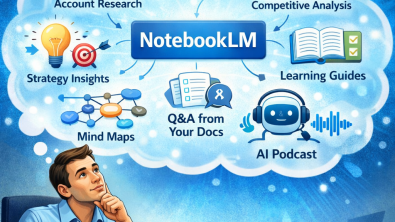
Find better target accounts faster with AI

Most sellers don’t struggle with outreach.
They struggle with who to reach out to.
The reality is simple. If the target accounts selected are not the right fit, everything that follows becomes harder. Messaging feels generic. Conversations don’t land. Pipeline quality drops.
This is where AI is starting to have a practical impact.
Not by replacing how sellers work, but by making one part of the workflow more efficient.
Choosing the right accounts.
Where prospecting breaks today
Today, prospecting often looks like this:
- A list gets pulled from a tool
- Accounts are filtered by industry or size
- Sellers manually scan LinkedIn or company websites
- Some light qualification happens
- Then outreach begins
It feels structured, but it is still largely inefficient.
The signals are often surface level. The criteria are broad. And the time spent validating accounts is limited.
So sellers default to volume.
More accounts. More outreach. More noise.
The problem is not effort. It is how long it takes to get to a usable list.
Why the current approach falls short
Even with good tools, sellers are constrained.
- They do not have time to analyse hundreds of accounts properly
- They rely on static filters like SIC codes or employee size
- They spend too much time just trying to find where to start
So the result is predictable.
Slow starts. Inconsistent targeting. Wasted effort on low-value accounts.
This is where a simple AI tool fits into the workflow.
Not as a replacement.
As an efficiency layer.
What AI account research actually is
At its core, this is a very simple interaction.
A seller inputs:
- Industry
- Country
- Employee range
- Number of companies
From there, the bot applies structure in the background.
It maps industries to SIC codes, enforces headquarters location, filters for credible companies, removes duplicates, and returns a clean, usable list.
It also applies basic quality controls such as:
- keeping location criteria fixed
- expanding only when necessary
- grouping companies by size
- indicating confidence levels
The output is not a perfect list.
It is a faster, more structured starting point.
And that is the point.
Why this matters for sellers
This does not change how sellers prospect.
It improves how quickly they can start.
Instead of spending time building lists, sellers can generate one in seconds and move straight into qualification and outreach.
It also improves how existing tools are used.
For sellers using LinkedIn Sales Navigator, this becomes a starting point. They begin with a defined set of accounts and use those platforms to validate contacts and execute.
For sellers without access to those tools, it provides a simple way to build a relevant pipeline.
The impact is straightforward:
- Less time searching
- More time engaging
- More consistent targeting
Practical ways sales teams can use it
There are a few clear ways to apply this in day-to-day sales execution.
Building initial target lists
Generate a clean set of target accounts based on simple inputs instead of manually filtering databases.
Accelerating Sales Navigator workflows
Start with an AI-generated list, then validate and expand inside Sales Navigator rather than building from scratch.
Refining focus areas
Quickly test different industries, geographies, or company sizes to see where the best opportunities may sit.
Supporting partner execution
Give partners a simple, repeatable way to identify target accounts without requiring advanced tools or deep research effort.
What makes this useful at scale
The value is not just speed.
It is consistency.
Every seller can follow the same simple process to generate target accounts. That reduces variability in how prospecting is done across teams.
Managers gain better visibility into targeting logic.
Enablement becomes easier to standardise.
And partners can align more closely with defined focus areas.
A simple way to get started
This is easy to adopt:
- Define your industry, geography, and company size
- Generate a list of target accounts
- Review and refine inputs
- Validate against real opportunities
- Use existing tools to go deeper
It fits into the workflow without disruption.
That is what makes it practical.
Where this is heading
Prospecting is not being reinvented.
It is being streamlined.
The advantage will not come from new processes.
It will come from executing existing ones faster and more consistently.
AI is starting to play a role in that.
Not by replacing sellers.
But by removing friction from how they work.
Explore the Account Researcher Bot to generate your next set of target accounts faster.
About the author
Benedict Russell is a Global Partner Development Executive responsible for scaling global GTM programs across all motions. He helps shape Siemens’ digital selling and AI strategy, embedding best practices that accelerate SaaS adoption and recurring revenue. Previously, he drove partner coverage and expansion, adding 300+ partners to the Siemens ecosystem. Read Benedict’s most recent blog here.